Connection level
12 direct connectionsAnunnaki is the best-known modern form for a group of deities from ancient Mesopotamia, also found in spellings such as Anunna and Anunnaku. On AwakenMap, this theme works as a companion page to Annunaki / Anunnaki: here the focus is the most-used form of the name, its textual base and the difference between Mesopotamian religion and modern reinterpretation.
Why another page if Annunaki already exists?
Because both spellings appear in searches. Annunaki / Anunnaki covers the general bridge between Mesopotamian gods, Nibiru and pop culture. This page goes deeper into Anunnaki, the spelling most common in books, videos, debates and online searches.
That helps users arrive through the path they already know. Someone typing Anunnaki is usually looking for a mix of Sumer, ancient gods, Zecharia Sitchin, Nibiru and ancient astronaut theory.
The ancient base: Anunna, Anunnaku, Anunnaki
At the historical base, we are dealing with names connected to Mesopotamian religion. The Oracc project at the University of Pennsylvania presents Anunna, Anunnaku and Anunnaki as related forms for a group of gods. They appear in different contexts, sometimes connected to the great gods, sometimes to the underworld and judgment.
This layer matters because it takes the theme out of emptiness. Anunnaki does not begin as an internet word. It comes from a world of cuneiform texts, temple-cities, rituals, kings, myths and ancient cosmologies.
The real image of the Mesopotamian environment
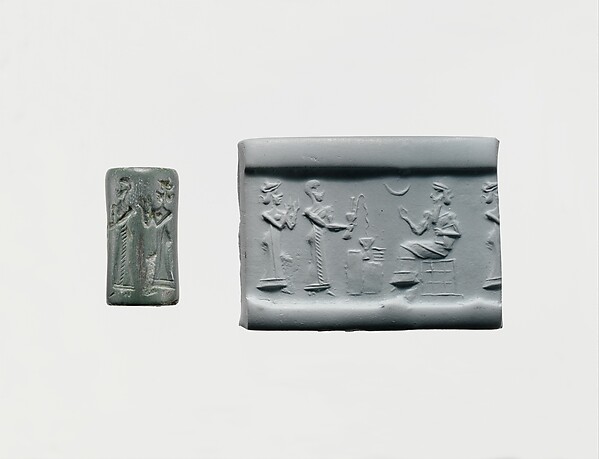
This Neo-Sumerian cylinder seal shows a worshiper before a seated god. It does not prove the Anunnaki were extraterrestrials, and it does not represent the whole group. But it shows the kind of visual culture surrounding ideas of divinity, authority and cult.
This is essential: before any modern theory, the theme belongs to a civilization that recorded power, ritual and memory in small, precise objects loaded with symbol.
What they did in myths
In Mesopotamian texts, gods had functions and hierarchies. The Anunnaki could appear as a divine assembly, as authorities of fate or as judges associated with the underworld. This variation depends on the text, period and local tradition.
The central point is that they are part of a complex polytheistic religion. They were not isolated characters, but names inside a network of gods, cities, temples and narratives about the order of the world.
How they became an ancient aliens theme
The modern turn came with Zecharia Sitchin, especially after The 12th Planet, published in 1976. Sitchin reinterpreted the Anunnaki as beings from Nibiru, a long-orbit planet, who came to Earth to obtain gold and influenced the creation of humanity.
This reading became famous because it offered a complete narrative: ancient gods as astronauts, gold mining, genetic manipulation, human origin, hidden planet and possible return. It is a powerful story, even when it is not accepted as an academic reading of the texts.
The common mistake: mixing everything
The common mistake is to speak as if every Mesopotamian text clearly says what modern internet claims: planet Nibiru, gold mining, genetic engineering and extraterrestrials. That reading belongs to a specific modern tradition, not to the consensus of Mesopotamian studies.
The article becomes stronger when the layers are separated. The first is historical: ancient gods and texts. The second is interpretive: Sitchin and similar authors. The third is cultural: videos, memes, documentaries, games and online debates.
Why the theme grips people
Anunnaki grips people because it seems to join the beginning of civilization with the beginning of humanity. The reader looks at Sumer, cuneiform writing, ziggurats, ancient kings and celestial gods, and feels that a hidden origin may be there.
This imaginative force explains why the theme connects so well to ancient aliens, ancient civilizations, ancient ruins and Akasha. It sits on the frontier between ancient memory and cosmic speculation.
Connections to continue
After this theme, open Annunaki / Anunnaki, ancient aliens, ancient civilizations, ancient ruins, ancient Egypt, Ancient India and Atlantis. This path shows how ancient gods can become modern narratives about origin, technology and cosmos.
Simple summary
Anunnaki is the most popular form for a group of Mesopotamian gods also called Anunna or Anunnaku. In ancient studies, they belong to the pantheon and myths of Mesopotamia. In modern culture, authors such as Zecharia Sitchin reinterpreted them as extraterrestrials connected with Nibiru and human origins.
References and starting points
- Oracc / University of Pennsylvania - Anunna (Anunnaku, Anunnaki)
- Electronic Text Corpus of Sumerian Literature - Oxford
- The Met - Cylinder seal and modern impression: worshiper pouring a libation before a seated god
- The Met - Cylinder Seals: Tiny Treasures That Leave a Big Impression
- Simon & Schuster - Zecharia Sitchin, The 12th Planet
- Smithsonian Magazine - The Idiocy, Fabrications and Lies of Ancient Aliens
- Bible Archaeology - Debunking Ancient Aliens / Michael Heiser participation
FAQ
Are Anunnaki and Annunaki different?
In modern practice, they are spellings of the same theme. Anunnaki is the most-used form; Annunaki appears as a variant.
Does Anunnaki mean extraterrestrial?
Not in Mesopotamian texts. The extraterrestrial meaning comes from modern reinterpretations, especially Zecharia Sitchin.
Does Nibiru appear in the texts as the planet of the Anunnaki?
That is Sitchin's modern reading. It is not the common academic interpretation of Mesopotamian texts.
Keep exploring
You can open another path
 Esoteric practices Sumerian Creation Story 5/5 intensity Explore →
  Esoteric practices Sumerian Tablets 5/5 intensity Explore →
  Ancient civilizations The Grand Experiment 4/5 intensity Explore →
  Ancient civilizations Ancient Aliens 4/5 intensity Explore →
  Esoteric practices Book of Enoch 4/5 intensity Explore →
  Esoteric practices Elohim 4/5 intensity Explore →
Join the conversation
Comments are moderated. Keep the discussion respectful and distinguish evidence, interpretation and personal experience.