Connection level
84 direct connectionsCollective Consciousness is the idea that individuals do not think in isolation: societies, symbols, archetypes, networks and crises form shared fields of perception.
The mind was never alone
The idea of Collective Consciousness begins with a simple and uncomfortable intuition: what we call my opinion, my faith, my fear or my will may never be entirely mine. We think with words we received, symbols we inherited, stories that pass through us, traumas that did not begin with us and desires an entire age learns to desire.
This does not mean the individual is a puppet. It means something more interesting: each person is a living border between interior and world. What happens inside a consciousness also happens inside a language, a family, a social class, a religion, an internet, a nation, an ancestral memory.
Durkheim: society thinking inside us
In sociology, one doorway is Émile Durkheim. When he spoke of collective conscience, Durkheim was not describing telepathy or a mystical thought-cloud. He observed how shared beliefs, values and norms give cohesion to society. Britannica explains that common values and beliefs form a collective conscience that acts inside individual members and leads them to cooperate.
This layer matters for AwakenMap because it prevents naive reading. Before saying humanity is awakening, we need to ask: which institutions, rituals, media, fears and narratives are shaping what we call humanity? A society does not need to control every thought to orient the field of the thinkable.
Jung: archetypes, dreams and returning images
Another lineage comes from Carl Gustav Jung. Jung proposed the collective unconscious, a psychic dimension that was not merely personal but composed of recurring patterns, archetypes and images in human experience. Britannica associates Jung with archetypes and the collective unconscious; analytic psychology describes this unconscious as inherited and linked to universal forms of experience.
Here we enter symbolic territory. Mother, shadow, hero, wise old man, divine child, catastrophe, flood, serpent, tree, labyrinth, apocalypse: certain images return because they organize deep experiences. One does not need to believe they all come from a supernatural source. It is enough to notice that different cultures use similar forms to deal with birth, death, fear, initiation, loss and meaning.
Noosphere: the planet creating a layer of thought
Pierre Teilhard de Chardin took the question to planetary scale. A paleontologist, Jesuit and philosopher, Teilhard imagined evolution moving toward greater complexity, consciousness and spiritual unity. Britannica describes him as known for the theory that humanity evolves mentally and socially toward a final spiritual unity.
From this comes the image of the noosphere: a sphere of thought surrounding Earth, as the biosphere surrounds life. Today, with the internet, satellites, social networks, artificial intelligence and instant communication, this image has become almost too literal. The planet has not gained one single mind, but it has gained infrastructure through which emotions, rumors, images and shocks cross borders in seconds.
The internet as psychic accelerator
If Durkheim thought social cohesion and Jung thought archetypes, the internet created a brutal laboratory for both. Memes, hashtags, moral panics, cancellations, conspiracy theories, collective mourning, solidarity campaigns and waves of outrage show that collective consciousness is not always elevated, calm or wise. It can be brilliant; it can be hysterical.
The network connects consciousnesses, but it also connects wounds. A phrase can become identity. A fear can become movement. An image can organize millions of people before analysis touches the ground. The same technology that enables global meditation also enables emotional contagion, radicalization and algorithmic manipulation.
The modern spiritual use
In contemporary spirituality, Collective Consciousness often means a subtle field of thought and energy shared by humanity. The idea appears in mass meditation, Law of Attraction, Great Awakening, light body, planetary transition, 5D and collective healing practices.
Pew Research Center surveys help contextualize this interest. Many adults continue to believe in soul, spirit, unseen forces or something spiritual beyond the natural world even as institutional religious affiliation changes. This does not prove a planetary mental field; but it shows that spiritual language remains an important way to name connection, meaning and experience.
When collective consciousness becomes ill
Not every collective heals. Crowds can also persecute, humiliate, obey, repeat slogans and turn complexity into enemy. History is full of moments when a whole society seemed to dream the same nightmare: wars, persecutions, racism, satanic panics, totalitarian propaganda, digital bubbles.
A page about Collective Consciousness therefore needs responsibility. Participating in a collective field does not absolve us. It increases the ethical question. What kind of emotion do I spread? What image do I feed? What certainty do I repeat without examining? What field do I help make normal?
Collective awakening or collective contagion?
One common confusion in alternative culture is calling any intense wave an awakening. But intensity is not lucidity. A group can feel synchronicity, chills and belonging while moving away from reality. It can also pass through painful crisis and mature because of it.
The criterion is not whether many people feel the same thing. The criterion is what the feeling produces: more compassion or more hatred? more clarity or more confusion? more autonomy or more obedience? more capacity to live with questions or more dependence on absolute answers?
Collective Consciousness in AwakenMap
In AwakenMap, Collective Consciousness is a connection node. It speaks with Great Awakening, Mass Meditation, Maharishi Effect, Law of Attraction, Matrix, Mainstream Media, AI, Love and Light, Return to Source and spiritual states. Almost all these themes depend on one shared question: to what extent does the individual mind participate in a larger field?
The most honest answer may be double. Yes, we participate in larger fields: language, culture, biology, technology, memory, affection and symbol. But no, this does not authorize saying anything in the name of collective energy. The challenge is keeping sensitivity without losing criteria.
The best way to read this theme
Reading Collective Consciousness well means accepting three truths at once. First: society thinks through us more than we like to admit. Second: deep images cross cultures and dreams in ways reason alone does not exhaust. Third: not every shared feeling is wisdom.
Perhaps collective awakening is not everyone thinking the same. Perhaps it is the opposite: millions of people learning to perceive the fields passing through them without being possessed by them. Collective consciousness matures when the collective stops being mass and starts becoming presence.
Critical reading
Collective consciousness should not be used as a shortcut to claim anything about energy, telepathy or planetary destiny. The concept becomes stronger when it separates sociology, depth psychology, spiritual philosophy, technology and subjective experience.
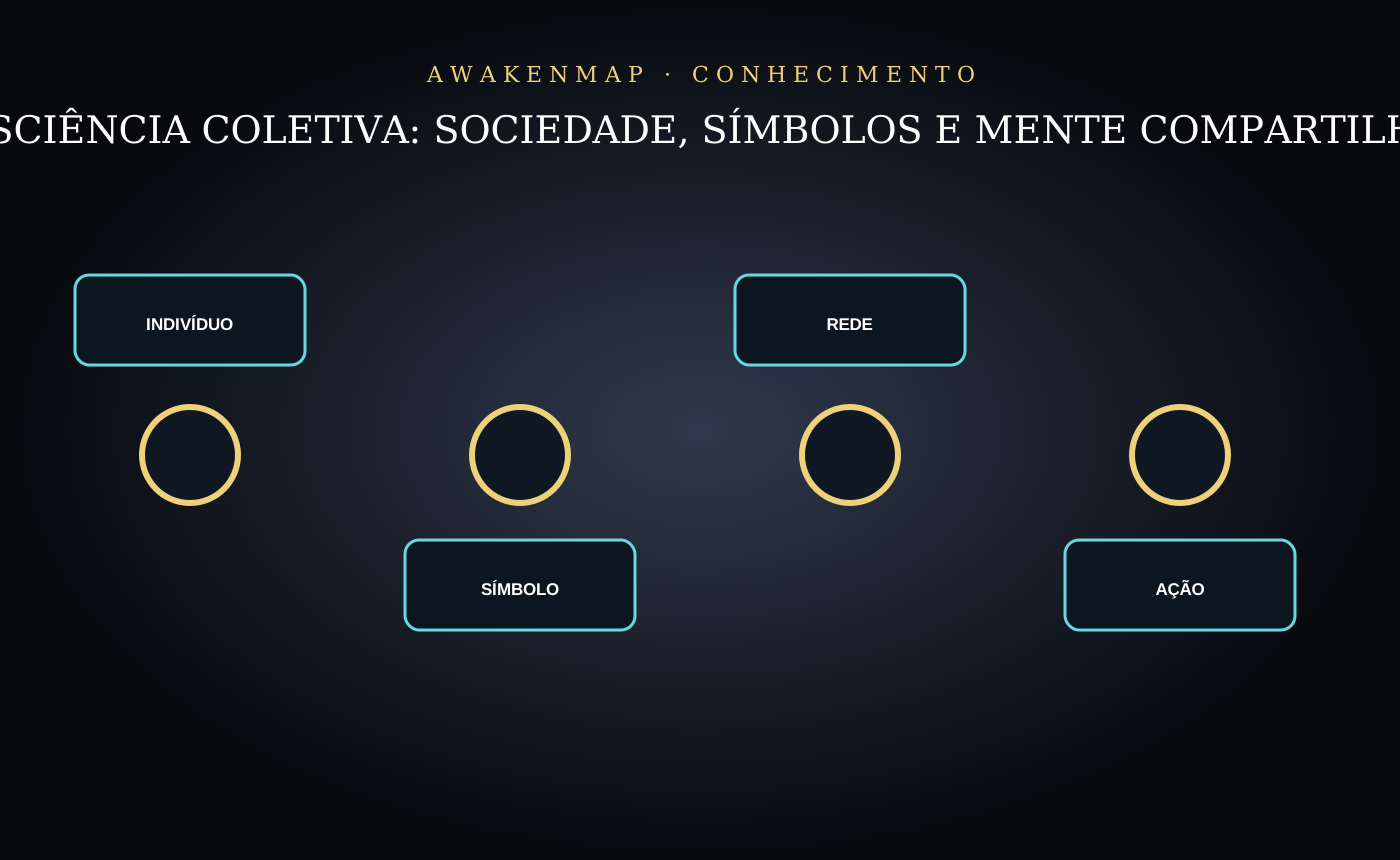
Collective consciousness and shared intentionality
Social philosophy distinguishes a mysterious group mind from the ordinary fact that several people direct attention, belief and action toward the same goal. Teams, assemblies and movements form shared intentions while each participant retains a distinct perspective.
Collective intentionality helps explain promises, institutions and cooperation. “We decided” does not mean one group brain replaced individuals; relationships, rules and commitments created coordinated agency.
Collective memory and disputes over the past
Societies remember through monuments, archives, holidays, schools, films and family stories. This memory is not a neutral storehouse. Groups select events, heroes and traumas that support present identities.
Collective memories may preserve victims and knowledge while erasing conflict. Asking who tells the story, who is absent and which documents support it turns shared remembrance into historical inquiry.
Invisible norms and social reality
Money, borders, offices and laws function because people and institutions recognize common rules. They are socially constructed, but constructed does not mean imaginary or powerless. A convention can organize resources, produce inequality and limit concrete choices.
Recognizing construction opens the possibility of change. Yet no individual changes an institution through thought alone. Collective transformation requires coordination, legitimacy, negotiation and power.
Emotional contagion and crowd behavior
Emotion circulates through expression, language and imitation. Fear accelerates rumor; enthusiasm sustains mobilization; indignation draws attention to injustice. Digital networks increase speed while removing context.
Contagion does not make crowds irrational by definition. Groups can cooperate, protect vulnerable people and create knowledge. Outcomes depend upon norms, leadership, information and material conditions.
Algorithms and collective attention
Platforms do not merely reflect interest: recommendation systems select what becomes visible. Emotional, polarizing or surprising content may circulate more widely, shaping the impression of what “everyone” thinks.
A trend does not necessarily represent society. Bots, advertising, coordinated communities and biased samples distort perception. Digital literacy includes asking how a subject reached the screen.
Ritual, synchronization and belonging
Song, dance, prayer, silence and ceremony synchronize bodies and attention. The experience may create intense unity and strengthen trust. This is a concrete dimension of collective sacred experience.
Synchronization may also suppress dissent when belonging requires conformity. Healthy ritual permits a return to autonomy; coercive ritual uses ecstasy and pressure to consolidate authority.
The collective unconscious: symbol and hypothesis
Jung proposed archetypes and a collective unconscious to explain recurring patterns of imagination. The theory influenced psychology, art and spirituality, but it is not equivalent to a demonstrated brain structure or physical field.
Symbolic similarities may arise from shared bodies, environments and human problems as well as cultural contact. Comparison becomes more rigorous when transmission is considered before universal origin is declared.
The Maharishi Effect and distant influence
Some movements claim that meditation groups reduce crime or conflict at a distance. Frequently cited studies face questions about design, selected time periods, social variables and independent replication.
Collective meditation may benefit participants and communities through known mechanisms such as regulation, bonding and organized action. A remote causal field requires additional evidence and reproducible predictions.
From shared perception to collective responsibility
Climate, violence and misinformation do not belong to an abstract consciousness; they involve distributed decisions. Collective responsibility does not eliminate individual responsibility or assign equal blame to people with unequal power.
An ethical reading asks which institutions can act, who bears costs and how participation becomes possible. “Raising consciousness” gains substance when it changes practices and relationships.
How to investigate a collective claim
Define the group, period and expected effect. Seek measures established before the hypothesis, comparable data and alternative explanations. A correlation discovered after an event may inspire research but does not establish cause.
In spiritual reports, separate experience from mechanism. Feeling connected is a valid experience; concluding global telepathy or an energy field is an interpretation requiring its own test.
Additional references
- Stanford Encyclopedia of Philosophy — Collective Intentionality
- Stanford Encyclopedia of Philosophy — Social Ontology
- Stanford Encyclopedia of Philosophy — Collective Responsibility
References and starting points
- Britannica - Mechanical and organic solidarity / collective conscience
- Britannica - Carl Jung
- Britannica - Analytic psychology
- Britannica - Pierre Teilhard de Chardin
- Pew Research Center - Spirituality Among Americans
- Pew Research Center - Religious and spiritual beliefs
FAQ
Is collective consciousness the same as collective unconscious?
Not exactly. In Durkheim, collective consciousness refers to shared social beliefs and norms. In Jung, collective unconscious refers to deep psychic images and patterns. In modern spiritual use, the terms often blur, but the difference matters.
Keep exploring
You can open another path
 Map center Optimal Timeline Reality 5/5 intensity Explore → AI and Matrix The Borg 5/5 intensity Explore →
  Consciousness and symbols Consciousness Renaissance 5/5 intensity Explore →
  Esoteric practices Dolphins and Whales 5/5 intensity Explore →
  Esoteric practices Lightworkers 5/5 intensity Explore →
  Map center Great Awakening 5/5 intensity Explore →
Join the conversation
Comments are moderated. Keep the discussion respectful and distinguish evidence, interpretation and personal experience.