Connection level
16 direct connectionsAn optimal timeline is an image of a future in which choices, circumstances and values converge toward the best available path. In spiritual discourse it may mean alignment with purpose; in practical language it is a way to imagine possibilities without confusing desire with prediction.
What does timeline mean?
In physics and history, a timeline orders events in sequence. In contemporary spiritual communities the term gained another use: choices, states of consciousness or events would form possible paths. The “optimal” line would offer greater coherence, learning or benefit.
This language can work as a decision metaphor. It becomes an extraordinary claim when it says universes were literally exchanged, historical events changed or someone can know the future with certainty. Metaphor, philosophy and physical claims require different standards.
Possible futures and prospective imagination
The human brain simulates scenarios. Before taking a job, ending a relationship or beginning a project, people imagine consequences. Prospective cognition combines memory, emotion, expectation and models of the world. It does not display the future; it creates internal rehearsals that may guide behavior.
An optimal timeline can be a reference scenario: if I act according to these values, which future becomes more likely? The question remains open to surprise and does not turn visualization into a promise.
Counterfactual thinking
Counterfactuals are thoughts about alternatives to the past: “if I had chosen differently.” They can teach, prepare decisions and turn regret into information. They can also fuel rumination when they repeat a story that can no longer be corrected.
Healthy reflection extracts an applicable rule: next time I will seek help early, verify the evidence or establish a boundary. Harmful reflection tries to inhabit an imagined reality and uses every outcome as proof of personal failure.
Destiny, free will and real conditions
The optimal-line idea moves between destiny and freedom. If a superior path already exists, who defined it? If everything depends on choice, how do chance, inequality, the body, politics and other people enter the picture?
A mature reading recognizes limited agency. Choices matter without controlling everything. Freedom grows through awareness of constraints, resources and consequences. Responsibility should not become blame for events beyond individual control.
Manifestation and total promises
Visualizing goals may clarify priorities and sustain effort. Selective attention may also make relevant opportunities easier to notice. None of this demonstrates that thought alone commands external events or guarantees health, wealth and safety.
The promise of “shifting timelines” becomes cruel when illness, violence or poverty are attributed to inadequate vibration. Spiritual practice should expand care and action rather than blame people for the conditions they face.
Quantum vocabulary
Superposition, many worlds and the observer frequently appear in spiritual explanations. They are real concepts in physics, but their technical use does not establish that macroscopic intention selects any desired future. Quantum interpretations address specific problems and remain debated.
Using “quantum” as a metaphor for possibility can inspire when clearly identified as metaphor. Presenting it as scientific proof requires equations, predictions and tests. Mystery does not need borrowed authority.
Values before outcomes
The best future is not necessarily the most comfortable. A coherent decision may involve loss, work and uncertainty. Defining values is therefore more stable than picturing results alone: honesty, care, autonomy, justice, creativity or service.
Values continue to guide when circumstances change. Goals may fail while an ethical direction remains available. The optimal timeline becomes a way of walking rather than a perfect photograph.
Scenario planning
Instead of one prediction, build three scenarios: likely, favorable and adverse. For each, identify signals, actions and limits. This method reduces magical thinking without surrendering to rigid pessimism.
Scenarios should change when new evidence arrives. Revising a plan is not abandoning purpose. Sometimes the wiser path appears precisely when an original expectation stops working.
Intuition, signs and synchronicity
Dreams, coincidences and bodily impressions may participate in reflection. The caution is not to treat them as infallible orders. A sign can open a question; it should not close inquiry, especially in medical, financial or legal decisions.
Record an impression before the result and compare afterward. This reveals accurate intuitions, forgotten errors and memory adjustments. Discernment grows when spirituality accepts feedback.
Anxiety about the correct future
The search for a perfect line can paralyze. Every choice seems capable of destroying destiny and every difficulty becomes evidence of misalignment. Such vigilance increases anxiety while reducing contact with the present.
Human decisions rarely provide total certainty. Choose with sufficient information, decide when to review and allow life to continue. If the theme causes persistent fear or functional harm, psychological support may help.
The collective dimension
Futures are not merely individual. Climate, technology, democracy, health and inequality depend on institutions and coordinated action. A “collective timeline” gains substance when translated into cooperation, policy and shared responsibility.
Waiting for an automatic vibrational shift may discourage action. Mature hope combines imagination with organization. A desired future needs compatible practices in the present.
A four-movement method
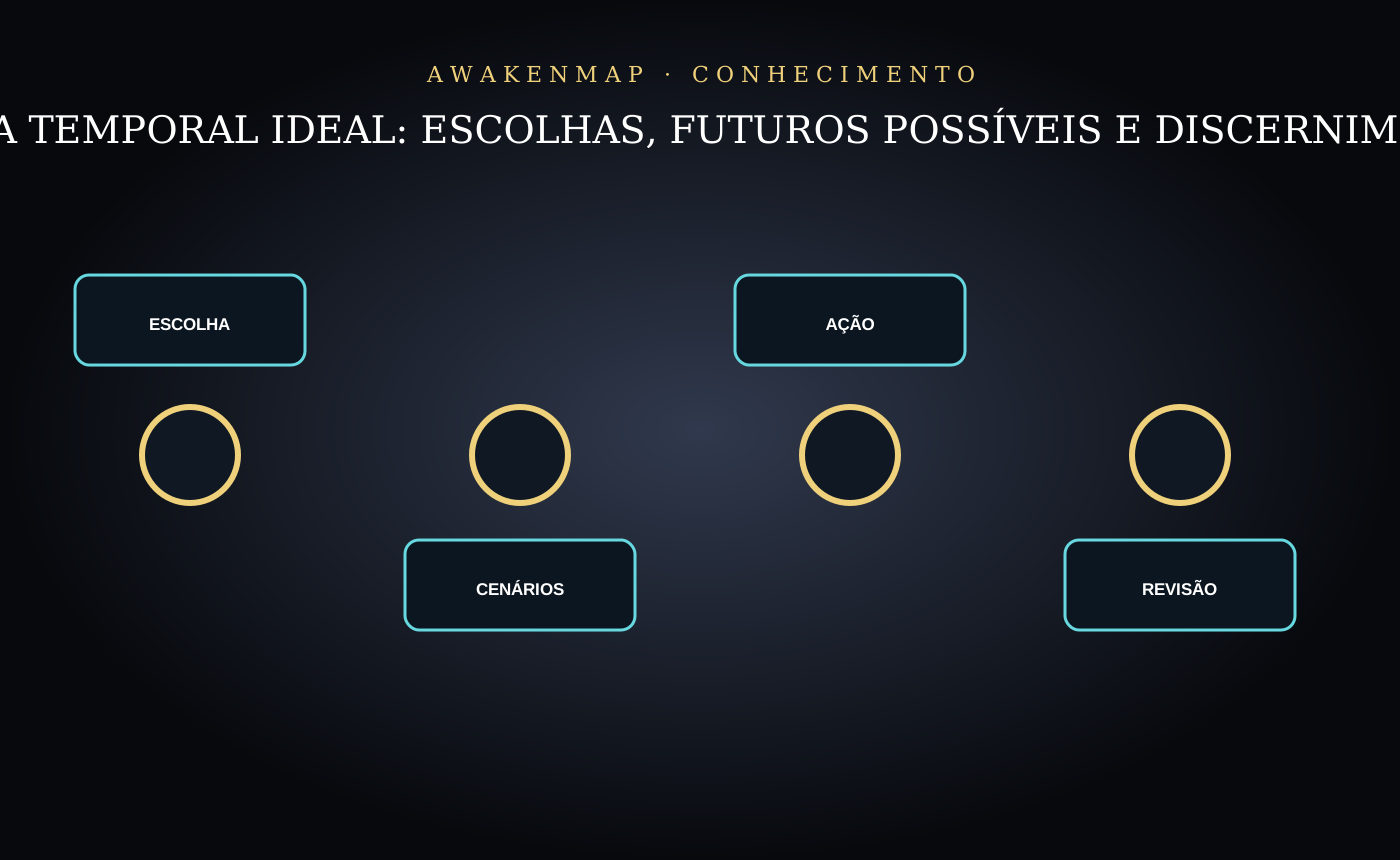
First describe the desired future without hiding its costs. Second identify values and necessary conditions. Third choose one small, verifiable action. Fourth review results without turning error into condemnation.
This cycle keeps vision connected with the world. The optimal line is not where nothing fails, but where information, repair and learning remain possible.
The optimal timeline in AwakenMap
This node connects Intuition, Synchronicity, the Mandela Effect, the Matrix, the Great Awakening, Collective Consciousness and Service to Others. The links show how future, memory and meaning cross different narratives.
On the map, the line does not assert a proven metaphysical road. It organizes questions: which future does a belief favor, which choices does it inspire and who accepts the consequences?
Critical reading
Evidence shows that people use mental simulations and counterfactuals to learn and plan. There is no robust evidence that thought permits deliberate jumps between universes or rewrites historical facts.
The symbol can remain without overclaiming. The best timeline is an ethical and strategic hypothesis continuously tested against reality.
Narrative identity and future selves
People imagine not only events but who they will become: professional, caregiver, artist, survivor or community member. The more concrete a future self becomes, the easier it is to connect present choices with distant consequences.
Future identities can also imprison. A rigid vision makes necessary change feel like betrayal. A scenario should guide without demanding loyalty to an outdated version of oneself.
Probability is not possibility
Something possible may be extremely unlikely. Spiritual narratives often treat every imaginable possibility as equally accessible. Responsible planning asks about frequency, conditions, evidence and the cost of error.
Distinguishing possible, plausible and probable improves decisions. A rare outcome is not impossible; it simply requires greater caution and plans that do not depend upon it alone.
Reversible and irreversible decisions
Some choices can be tested: a short course, prototype or initial conversation. Others change health, property or relationships in ways that are difficult to undo. The less reversible the choice, the stronger the information should be.
Small experiments create learning without wagering an entire life on a vision. They transform “which timeline should I choose?” into “which next step will produce useful information?”.
Anticipated regret
Imagining future regret may reveal values and risks. Ask what you might regret doing and what you might regret leaving undone. The exercise becomes more balanced when it considers both directions.
Anticipated regret should not govern everything. Anxious minds overestimate catastrophe. Use it alongside evidence, recovery capacity and available support.
Hindsight bias
After an event, its outcome appears more predictable than it really was. Hindsight bias creates the sense that signs were obvious and someone “chose the wrong line” through negligence.
Evaluate decisions through the information available at the time, not the outcome alone. A sound choice may end badly; a reckless choice may be lucky.
Commitment rituals
Writing an intention, setting a date or sharing a commitment may increase consistency. Ritual focuses attention and gives emotional form to change.
Its effect need not be supernatural to be profound. The caution is to permit revision: healthy commitment supports values, while rigid vows ignore new evidence.
When to leave a timeline
Persistence matters, but sunk cost does not justify continuation. Warning signs include growing harm, false assumptions, prolonged lack of progress and conflict with fundamental values.
Leaving a plan does not erase its learning. An optimal path may include return, pause and redirection. Flexibility is part of the intelligence of the journey.
Advice, prediction and authority
When psychics, coaches or algorithms announce the “best line,” ask how they know, which interests they hold and what happens if they are wrong. Responsible guidance states uncertainty and does not demand obedience, secrecy or escalating payment. No prediction should control another person's relationships, treatment or property.
The role of chance
Unexpected encounters, accidents and collective changes redirect lives. Recognizing chance does not remove meaning; it prevents every surprise from becoming cosmic reward or punishment. After an event, people may construct meaning and response without pretending they caused it or could have predicted it.
Metrics of alignment
Instead of seeking elevated feeling alone, track concrete indicators: sleep, financial stability, relationships, health, contribution and ethical coherence. No single metric decides a path, but together they reveal when an inspiring narrative produces damage that the narrative itself attempts to hide.
Hope without certainty
Hope is not optimistic prediction. It is willingness to act despite lacking control of the outcome. This makes the concept more human: an optimal timeline need not be guaranteed to guide courage, cooperation and care. The future remains open, and that is precisely why choices carry weight.
A good-enough future
The language of optimization can suggest that one perfect answer is hidden somewhere. In real life, several paths may be worthy and coherent. Seeking a good-enough future reduces perfectionism and preserves energy for action. Mature decisions do not remove every loss; they choose which costs can be accepted without abandoning central values.
This also leaves room for unplanned joy. Not everything important begins as a goal. Relationships, discoveries and vocations may emerge during the journey. A living timeline combines direction with readiness to recognize opportunities the original plan could not name.
References and starting points
- The Functional Theory of Counterfactual Thinking
- Cognitive neuroscience of human counterfactual reasoning
- Counterfactual Thinking Facilitates Behavioral Intentions
- Counterfactual curiosity
FAQ
Is there one perfect timeline?
No scientific method identifies a single perfect path. The concept can support reflection on values, scenarios and choices.
Do thoughts change reality?
They influence attention, decisions and behavior, which may change outcomes. That differs from controlling every event through mind alone.
Does the Mandela Effect prove timeline shifts?
No. Shared false memories, familiarity and cultural circulation provide testable explanations without requiring altered universes.
How can I choose without certainty?
Define values, gather evidence proportional to risk, prefer reversible action when possible and schedule a review.
Keep exploring
You can open another path
 Map center Great Awakening 5/5 intensity Explore →
  Consciousness and symbols Collective Consciousness 5/5 intensity Explore →
  Esoteric practices Timeline Convergence 5/5 intensity Explore →
  Esoteric practices The Law of Attraction 4/5 intensity Explore → Esoteric practices Law of Attraction 4/5 intensity Explore →
  Return to Source 5D Earth 4/5 intensity Explore →
Join the conversation
Comments are moderated. Keep the discussion respectful and distinguish evidence, interpretation and personal experience.