
Connection level
12 direct connectionsTemporal Defense belongs on AwakenMap through the question of who controls the narrative when the past itself seems disputable. The idea begins with a strange question: if time could be observed, altered or attacked, would it need protection? In conspiracy narratives, temporal defense is the set of technologies, protocols or groups trying to prevent changes to the past, timeline manipulation, paradoxes, loops, memory erasure and interventions from the future.
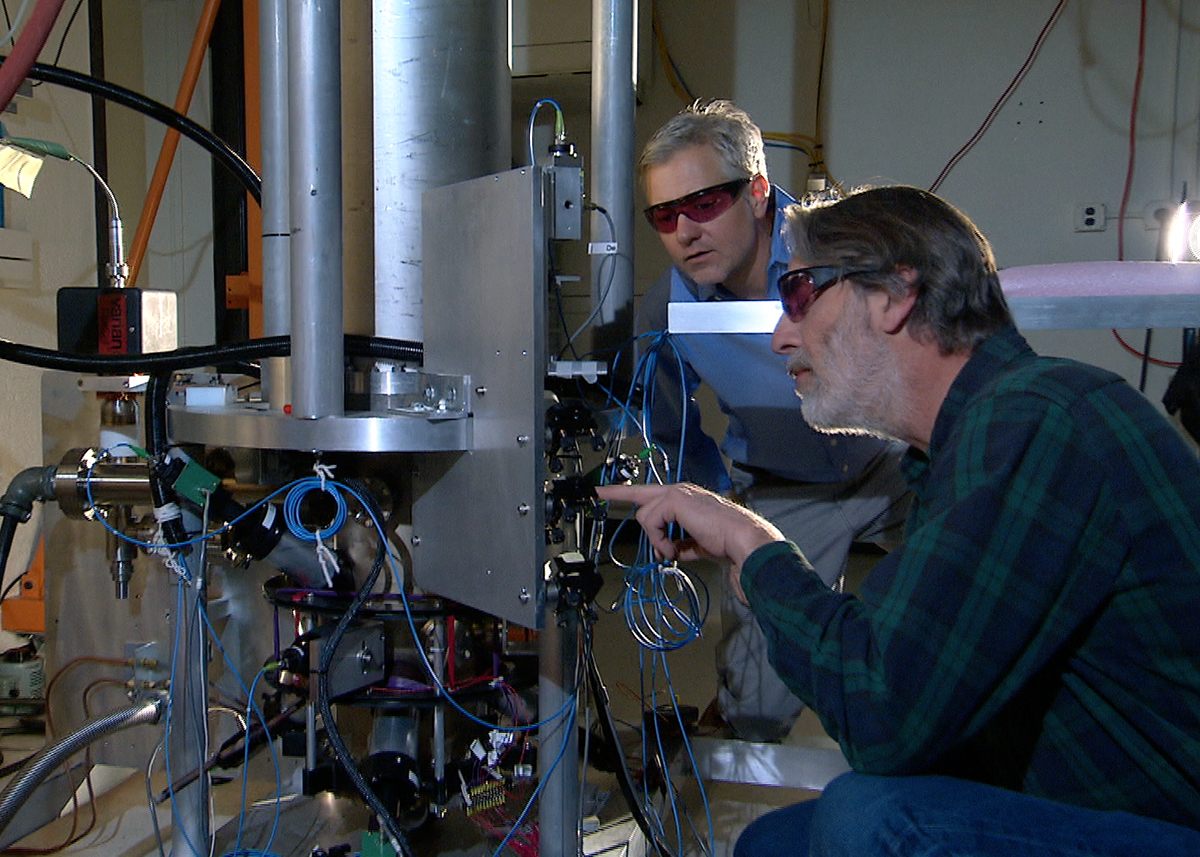
The real base must come first. Modern physics does not treat time as a flat fantasy. Relativity, gravity, velocity and atomic clocks show that measured time can vary in tiny but real ways. Systems such as GPS must correct relativistic effects to work precisely. This does not prove time travel in the popular sense, but it shows that time, measurement and technology already meet at the heart of modern infrastructure.
The image beside this text shows the NIST-F2 atomic clock. It matters because it grounds the topic: before talking about temporal war, there is the science of precise time measurement. Clocks like this help test relativity, synchronize networks and sustain systems that depend on nanoseconds.
The conspiratorial leap happens when that real precision becomes an imagination of historical control: if governments measure time this precisely, could they also monitor, correct or defend timelines?
A concrete case helps separate science and myth. Experiments with atomic clocks and systems such as GPS confirm that altitude, gravity and motion affect measured time. NASA and NIST use this precision to test Einstein's predictions. The result is fascinating but limited: we are talking about tiny measurable differences, not agents returning to 1947 to alter a war or prevent a disclosure.
The conspiratorial layer begins when this physical opening expands into time travel. If time is not absolute, imagination asks whether it could be crossed, bent, shielded or attacked. From there come time machines, portals, jumps, military programs and units tasked with protecting the “correct line” against sabotage. Temporal defense becomes an invisible police force of causality.
The theme connects directly to time travel and temporal defense, which functions almost as the explicit version of this idea. If time travel exists, temporal threat exists too: someone could kill witnesses before they speak, implant technologies in the past, erase events, create alternative realities or guide humanity toward a specific line. Protecting time becomes protecting history.
Montauk is one of the central mythologies of this imagination. In stories about the Montauk Project, military experiments allegedly involved mind control, portals, time travel and reality manipulation. Most of these claims have no strong public documentary confirmation, but the narrative became influential because it mixes the Cold War, military bases, trauma, secret technology and fear that the state could invade even memory.
The Philadelphia Experiment works as a mythical ancestor. The story speaks of naval invisibility, teleportation, temporal effects and horrible physical consequences for crew members. Even when treated by many researchers as a modern legend, it supplies a narrative model: an out-of-control military experiment opens a breach in spacetime, followed by decades of cover-up.
The connection with Project Stargate is subtler. The real remote-viewing program was evaluated and closed inside official United States structures. It was not a time-travel program, but it shows that governments did investigate anomalous mental capacities in strategic contexts. This feeds the conspiratorial question: if they tried to see at a distance, did they try to see through time?
timeline convergence and the optimal timeline provide the spiritual layer. Some narratives say there are probable lines, diverted lines, artificial lines and a more favorable line for human awakening. Temporal defense, here, is not only military technology; it is protection of collective destiny. The future is contested by choices, rituals, artificial intelligence, entities, secret groups or collective consciousness.
The time-bubble slowdown brings the theme closer to local experiences: fields where time slows down, anomalous zones, memory gaps, lapses and reports of missing hours. These stories usually do not prove temporal manipulation, but they provide emotional material for the idea. People feel time failed; the theory offers engineering for that failure.
The Time Wave adds Terence McKenna and the notion of historical patterns compressing toward novelty points. Even without accepting the mathematics behind these ideas, they show how time can be imagined as wave, not only line. If time has waves, cycles and convergences, temporal defense becomes the attempt not to be carried by a manipulated historical current.
quantum physics is often invoked confusedly in this field. Terms such as superposition, collapse, many worlds and observer are used to suggest that choices create lines of reality. Real quantum physics is much more technical and restricted than these popular readings. Still, it supplies the vocabulary for speaking about time as a probabilistic field rather than fixed chronology.
The link with the matrix is inevitable. If reality is a matrix, defending time means defending historical code against editing. False memories, Mandela effects, retroactive changes and conflicting versions of events become suspicions of system updates. The question stops being “did I remember wrongly?” and becomes “did someone change the line?”
The bridge with black projects closes the political layer. Real secret projects exist in military and technological areas; this does not prove temporal war, but it makes extreme compartmentalization plausible for many readers. Temporal defense feeds on that environment: if there are hidden programs in space, mind and energy, why not in time?
The intellectual danger of the theme is turning every historical divergence into proof of manipulation. Incomplete archives, propaganda, faulty human memory, journalistic error and political dispute already explain a lot. When every contradiction becomes “they changed the timeline”, investigation loses strength. Mystery grows, but method disappears.
A mature reading separates three planes. First, physical time measured by clocks, relativity and precision systems. Second, psychological and historical time, made of memory, trauma, narrative and power. Third, the conspiratorial hypothesis of technologies or groups able to protect, alter or patrol timelines. Confusing these levels produces delusion; separating them shows why the myth is so seductive.
Temporal defense matters because it reveals a deep fear: not only being deceived about the present, but having the past edited before we even understand it. The promise of protecting the timeline can sound heroic. It can also become a perfect justification for invisible authority: someone, somewhere, claims to know which future must survive.
Simple summary
Temporal defense is the idea of protecting timelines against manipulation, alteration of the past, paradoxes or attacks from the future. The real base involves relativity, atomic clocks, GPS and precise time measurement. The conspiratorial layer appears in narratives about Montauk, the Philadelphia Experiment, time travel, secret projects, optimal timelines and the matrix. The critical point is separating the science of measured time, historical memory and claims of secret temporal warfare.
References and starting points
- NIST - testing relativity with atomic clocks
- NASA - Einstein relativity and GPS
- Wikimedia Commons - NIST-F2 atomic clock
- CIA - evaluation of the remote viewing program
- AARO - Historical Record Report, Volume 1
- Great Awakening Map - original poster
Why it belongs on AwakenMap
It belongs because many awakening theories do not only dispute the future; they dispute memory of the past. Temporal defense asks who has authority to say which line is true, which future should be protected and when the search for historical coherence becomes paranoia about reality editing.
Keep exploring
You can open another path
 Map center Great Awakening 5/5 intensity Explore →
  Esoteric practices Montauk 5/5 intensity Explore →
  Secret Space Program Time Travel 5/5 intensity Explore →
  Esoteric practices Time Travel and Temporal Defense 5/5 intensity Explore →
  AI and Matrix Matrix / Everything is an Illusion 4/5 intensity Explore → Map center Optimal Timeline Reality 4/5 intensity Explore →
Join the conversation
Comments are moderated. Keep the discussion respectful and distinguish evidence, interpretation and personal experience.