Connection level
17 direct connectionsAtlantis begins in Plato’s dialogues and crosses philosophy, archaeology, catastrophe, esotericism and popular culture. A critical guide to separating the ancient source from later locations and imagined technologies.
Before searching for the island, return to the text
Atlantis does not begin with an underwater photograph, a secret map or a tradition preserved independently by dozens of peoples. Its known ancient source is concentrated in two dialogues by Plato, Timaeus and Critias, written in the fourth century BCE. The account appears within a philosophical discussion of the ideal city, cosmic order, memory and the character of societies.
This origin changes the method. Anyone investigating Atlantis must first ask what Plato wrote, what genre he used and what purpose the story served. Only then does it make sense to compare islands, eruptions and ruins. When the process is reversed, almost any place with ancient stones, rings of land or flood memories can be adjusted to fit.
The chain of transmission described by Plato
In Timaeus, Critias says that the story reached his family through Solon, the Athenian lawgiver. Solon supposedly heard it from Egyptian priests at Sais, who preserved records of remote ages lost to the Greeks through repeated catastrophes. The story opposes a virtuous ancient Athens to an expansionist island power.
This chain—Egypt, Solon, Critias’s family and Plato’s dialogue—is essential to the account’s authority, but it is not independent documentation. We do not possess the Egyptian record allegedly consulted by Solon or a clearly identifiable pre-Platonic version. The chain is presented by the very text under examination.
Beyond the Pillars of Heracles
Plato places Atlantis beyond the Pillars of Heracles, generally associated with the Strait of Gibraltar. The island was the centre of a powerful confederation ruling other islands and parts of a continent. Its forces advanced into the Mediterranean before being defeated by ancient Athens.
The phrase suggests the Atlantic, but it does not supply modern coordinates. Greek geographical knowledge used boundaries and conventions different from ours. Translating every ancient term directly onto a contemporary map creates a precision the text does not possess. Even so, the location beyond Gibraltar explains why so many searches focus on the Atlantic Ocean.
The city of concentric rings
In Critias, the Atlantean capital receives an unforgettable description: alternating rings of land and water, bridges, canals, harbours, temples, walls and an organized fertile plain. Poseidon divided the territory among ten kings descended from his union with Cleito. The political and sacred centre expressed abundance and order.
These details make the narrative resemble an engineering report. Yet literary detail is not automatically historical observation. Plato also describes divine genealogies and immense dimensions. The circular city functions as an image of organized power, hydraulic mastery and centralization—a beautiful geometry eventually unable to contain corruption.
Moral collapse before physical collapse
The decisive movement in the myth is not technological but ethical. While their divine inheritance remains strong, the Atlanteans rule with moderation. As that proportion fades, wealth and power produce ambition, display and domination. Zeus recognizes their degradation and summons the gods.
Critias ends abruptly just as Zeus is about to speak. Even unfinished, its structure is clear: Atlantis reflects on greatness without measure. Physical submergence dramatizes an inward fall. This is why the island remains such a powerful political myth: civilizations may collapse not from lack of technique but from the purposes technique serves.
Nine thousand years and the chronological problem
The Egyptian priests place the war thousands of years before Solon, commonly interpreted as about 9600 BCE. This would put Atlantis long before urban and metallurgical societies known to archaeology. The time scale is one of the greatest difficulties for a literal historical reading.
Some writers propose mistranslation, confusion between years and months, or multiplication by ten. Such solutions can move the story closer to the Bronze Age, but they require textual evidence and cannot be adopted simply because they make a preferred location more convenient. Correcting Plato to fit a theory is not the same as explaining Plato.
Santorini, Akrotiri and the Minoan hypothesis
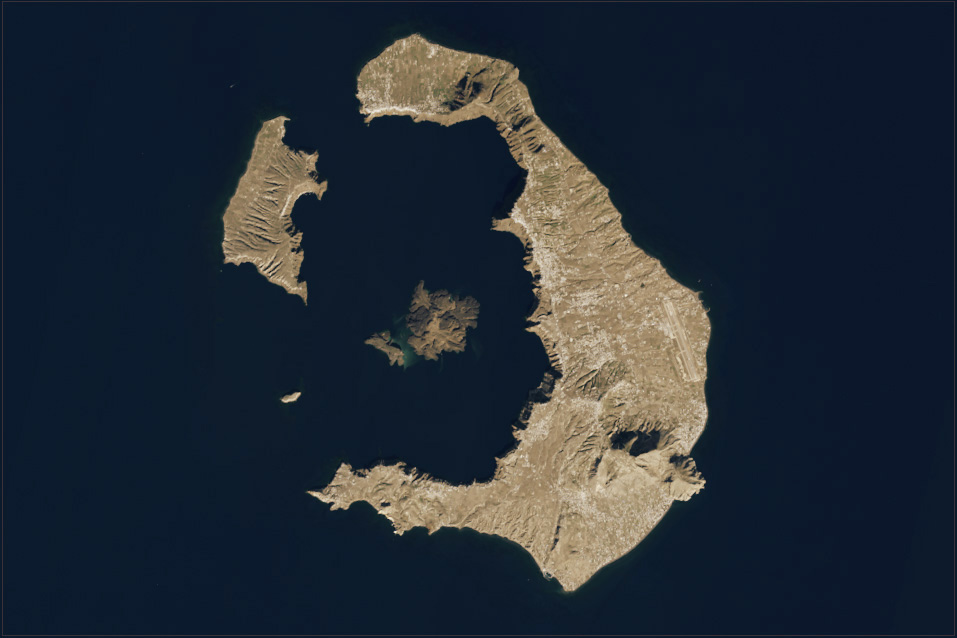
The eruption of Thera, modern Santorini, during the second millennium BCE devastated the island and affected the Aegean. Akrotiri preserved buildings, streets, frescoes and a sophisticated maritime society beneath volcanic deposits. Prosperity, sea power, earthquake, eruption and tsunami offer striking parallels. A recent NASA Earth Observatory image, captured by Landsat 9 on December 18, 2024, shows the caldera and surrounding islands clearly enough to make the volcanic setting readable as landscape, not just legend.
Santorini, however, lies inside the Mediterranean, is much smaller than Plato’s Atlantis and does not match the nine-thousand-year chronology. Minoan civilization did not disappear in a single day. The hypothesis works better as possible partial inspiration or cultural memory of catastrophe than as a perfect identification.
Doñana, the Azores, Morocco and other locations
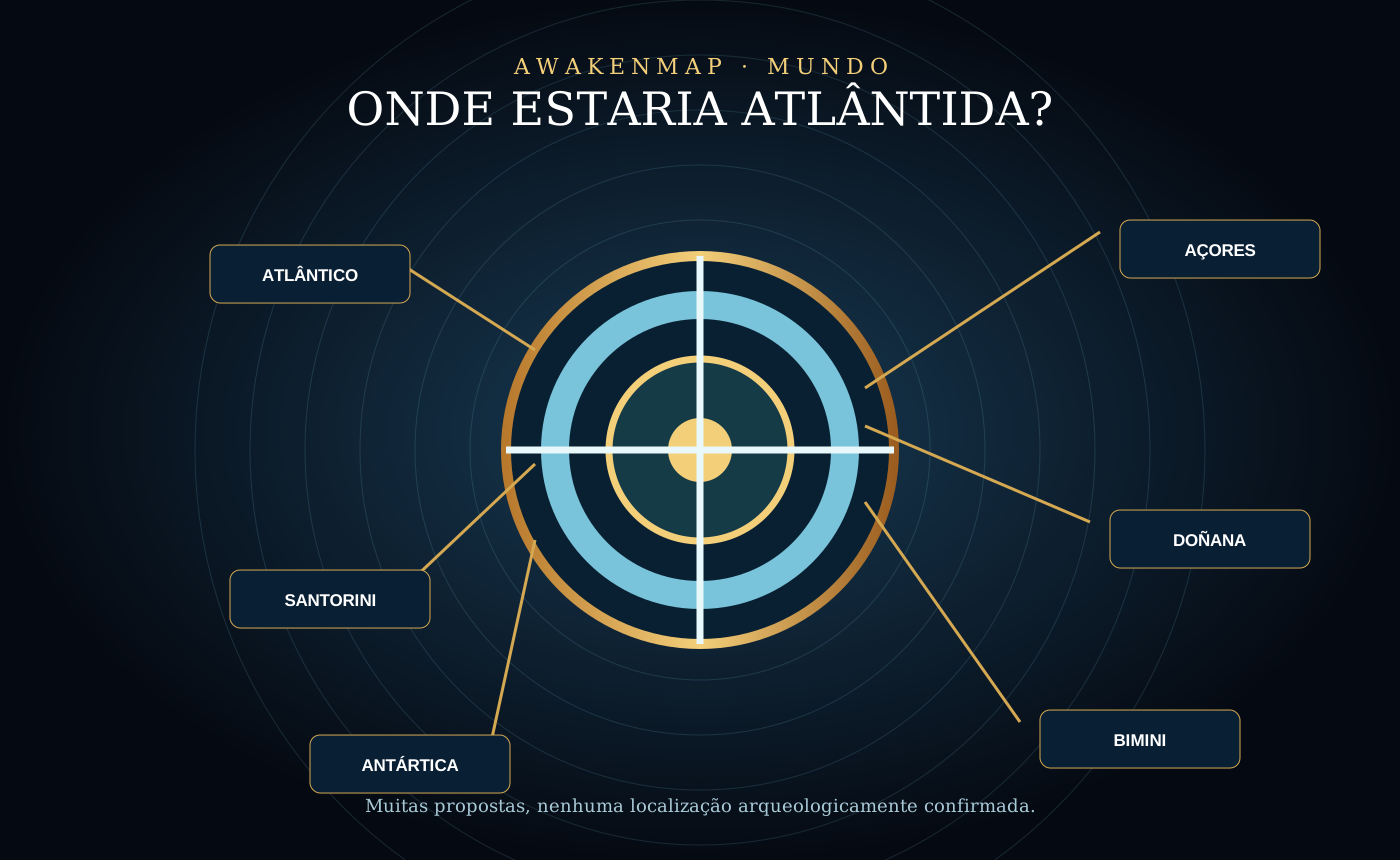
Proposals have placed Atlantis in southern Spain near ancient wetlands and Doñana, in the Azores, Canaries, Morocco, Mauritania, the Mediterranean, Caribbean and even Antarctica. Each selects different correspondences: rings, plains, metals, elephants, orientation or flood memories.
The proper test is not counting similarities but evaluating the complete pattern and its contradictions. A hypothesis must explain location, chronology, scale, material culture and transmission better than alternatives. When every discrepancy becomes Plato’s error, a bad translation or destroyed evidence, the theory can no longer be tested.
Bimini Road and the seduction of underwater ruins
The formation known as Bimini Road in the Bahamas became a modern symbol of the search for Atlantis. Fractured, aligned beachrock blocks beneath shallow water resemble a road or wall. Their geometric appearance, combined with predictions attributed to Edgar Cayce, turned the site into an Atlantean icon.
Geological studies explain it through coastal sediment cementation, natural joints, erosion and settling. A natural formation can look constructed without fraud or lack of imagination. The case shows why underwater archaeology requires context, artefacts, working marks, stratigraphy and dating—not visual resemblance alone.
Can geology sink a continent?
Volcanic islands can partly collapse, coastlines can flood, earthquakes alter landscapes and sea level has risen greatly since the last glacial period. Real settlements and coastal landscapes now lie underwater. Aquatic catastrophe belongs to human history, not only myth.
Plate tectonics, however, does not support the recent disappearance of a continent of Plato’s implied scale in the middle of the Atlantic. Oceanic and continental crust have detectable structures. This does not rule out lost islands or submerged coasts; it constrains the idea of a vast advanced continent sinking intact within human times.
Ignatius Donnelly and modern Atlantis
In 1882 Ignatius Donnelly published Atlantis: The Antediluvian World. He argued that the island was a primordial civilization that spread agriculture, architecture, religion and knowledge to Egypt, the Americas and elsewhere. The book organized cultural comparisons into a grand common-origin narrative.
Donnelly wrote before major developments in archaeology, dating and plate tectonics. Similar pyramids, flood myths or symbols do not necessarily demonstrate one source; societies can develop similar solutions, exchange ideas through known networks or share environmental experiences. Nevertheless, his book shaped much of popular Atlantis.
Theosophy, root races and spiritual memory
Helena Blavatsky and later Theosophical writers transformed Atlantis into a stage of occult human history. It became home to root races, psychic abilities, spiritual technology and conflicts over misused subtle forces. New Age readings later connected crystals, healing, Akashic records and memories of Atlantean lives.
This layer belongs to the history of modern esotericism, not a direct continuation of Plato. It shows how an ancient myth can explain spiritual evolution, collective trauma and the feeling of belonging to a lost lineage. Subjective experience may hold personal meaning without becoming archaeological evidence.
Crystals, energy and lost technology
Popular culture often gives Atlantis giant crystals, free energy, antigravity, healing machines and weapons that caused its destruction. These elements are much later than Plato’s dialogues. Plato describes metals, canals, ships, temples and wealth, but not a futuristic technological civilization.
The image remains powerful because it condenses a modern warning: knowledge without maturity can destroy its possessors. Crystals and machines symbolize amplified power. When presented as factual history, however, they would require material remains, a technological chain and independent evidence.
Atlantis in AwakenMap
In AwakenMap, Atlantis connects to Lemuria, Mu, Antarctica, Ancient Egypt, pyramids, the Ancient Builder Race, Thoth, ley lines, free energy, crystals and planetary catastrophe. Some links are literary or esoteric; others are archaeological comparisons or geographic hypotheses.
The node does not claim that every line tells the same story. It shows how Atlantis became a gravitational centre of alternative imagination, joining the hope of a golden age to the fear that we may repeat its fall.
How to investigate without killing the mystery
Begin with complete translations of Timaeus and Critias. Record what is actually present and what appeared later. For each location compare chronology, geology, dimensions, material culture and geography. Look for archaeological publications rather than visual reconstructions alone.
Also ask what the hypothesis must ignore. A strong explanation accepts the possibility of being wrong. Mystery becomes more compelling when it does not depend on false quotations, distorted maps or natural ruins presented as certainty.
Critical reading
Atlantis should be read by separating ancient source, philosophical interpretation, historical hypothesis, geological formation and esoteric reinterpretation. An interesting connection is not confirmation by itself.
References and starting points
- NASA Earth Observatory - Santorini's Hidden Worlds
- Plato — Timaeus, Perseus Catalog
- Plato — Timaeus, MIT Classics
- Plato — Critias, MIT Classics
- Bryn Mawr Classical Review — Plato’s Atlantis Story
- American Scientist — The Minoan Eruption
- Smithsonian Ocean — Underwater Archaeology
- USGS — Plate Tectonics
- Encyclopaedia Britannica — Atlantis
Frequently asked questions
Did Plato invent Atlantis?
There is no absolute consensus about literary intention, but Plato is the only known detailed ancient source. Many scholars read the narrative primarily as a philosophical and political construction.
Was Santorini Atlantis?
The Thera eruption and Akrotiri offer real parallels, but location, scale and chronology do not fully match. It may have provided partial inspiration, not a proven identification.
Are there ruins of Atlantis on the seafloor?
Real submerged settlements and landscapes exist, but no ruin has been accepted by archaeology as Plato’s Atlantis.
Was Bimini Road built by Atlanteans?
The prevailing geological interpretation describes naturally fractured and eroded beachrock. There is not enough archaeological context to demonstrate an artificial road.
Did Atlantis possess crystals and advanced energy?
Those elements belong mainly to esoteric reinterpretations and modern culture. They do not appear in that form in Plato’s dialogues.
Why is the myth still powerful?
It combines a golden age, catastrophe, technology, corruption and lost knowledge. Atlantis lets cultures imagine the future through a civilization that failed.
Keep exploring
You can open another path
 Ancient civilizations Lemuria 5/5 intensity Explore →
  Map center Great Awakening 5/5 intensity Explore →
  Ancient civilizations Ancient Civilizations, Mysteries and Forbidden Archaeology 5/5 intensity Explore →
  Esoteric practices Emerald Tablets 4/5 intensity Explore →
  Ancient civilizations Ancient Builder Race 4/5 intensity Explore →
  Ancient civilizations Ancient Aliens 4/5 intensity Explore →
Join the conversation
Comments are moderated. Keep the discussion respectful and distinguish evidence, interpretation and personal experience.