Connection level
31 direct connectionsFree Energy is the dream of abundant, clean and accessible power, between real renewable technologies, perpetual-motion myths, Tesla, zero point and criticism of energy control.
The dream of a civilization without energy scarcity
Free Energy is one of the strongest ideas in the alternative imagination. It promises something almost impossible to ignore: a source of abundant, clean, cheap, decentralized power outside the control of large corporations, governments or monopolies. On a planet where energy defines survival, industry, food, water, transport, communication and autonomy, this dream has political and spiritual force.
The theme, however, lives in a dangerous zone. On one side, there is a legitimate question: why is energy still so expensive, concentrated, polluting and politically controlled? On the other, there is a market of fragile promises: miraculous motors, overunity devices, magnetic machines, zero-point generators and narratives of suppression without verifiable evidence.
In AwakenMap, Free Energy should be read with desire and criteria. Desire, because just and clean energy is a real civilizational need. Criteria, because the hope of energy liberation is easily exploited by technical charlatanism.
Free energy is not the same as free-of-charge energy
The expression Free Energy can mean different things. In a social sense, it can point to accessible, renewable, distributed energy less dependent on monopolies. In a more radical sense, it can suggest energy extracted from the vacuum, the field, magnetism or a hidden source at no real cost. These two readings should not be confused.
Solar, wind, geothermal and other renewables are not free-of-charge. They require mining, panels, turbines, maintenance, grids, batteries, labor, land, financing and public policy. But they can reduce dependence on fossil fuels and decentralize part of generation.
The promise of unlimited energy without source, without losses and without cost, however, runs into fundamental physical principles. The difference between democratizing energy and violating conservation of energy is enormous.
The wall of energy conservation
Britannica defines energy as the capacity to do work and describes conservation of energy as the principle according to which the total energy of an isolated system remains constant. Energy can change form, but it does not appear from nothing in a closed balance.
This does not mean every new energy invention is impossible. It means every machine needs to show where its energy comes from, how much enters, how much leaves, which losses exist and how measurement was done. Without this balance, we are facing belief, not engineering.
Many Free Energy devices fail exactly there: they measure poorly, ignore hidden batteries, confuse reactive power, induction, heat, magnets, inertia or electrical noise with surplus production. The mature question is always: what is the independent energy balance?
Perpetual motion and the seduction of overunity
Britannica treats perpetual motion as the idea of a machine that would continue operating indefinitely without external energy source, something incompatible with the laws of thermodynamics. Overunity culture, devices that would deliver more energy than they receive, is the modern version of this temptation.
The fascination is understandable. A self-feeding machine would solve almost everything: energy poverty, climate, oil wars, grid dependence and production costs. Precisely for that reason, the promise requires extreme evidence.
To date, no widely usable, replicable and independently validated free-energy machine has broken through this wall. If one appears, it will change history. Until then, the care is to separate hope from demonstration.
Tesla and the legend of free power
Nikola Tesla is almost always invoked when Free Energy is discussed. Britannica presents him as an inventor fundamental to the alternating-current system, a real and gigantic name in electrical modernity. His experiments with high voltage, resonance and wireless transmission created an aura of interrupted possibilities.
The popular narrative says Tesla found a way to deliver free power to the planet, but was blocked by financiers and corporate interests. Wardenclyffe became the symbol of this dream: a tower that could, in the alternative imagination, have distributed wireless energy to everyone.
There is symbolic truth in this story: energy is power, and business models shape infrastructure. But there is no public proof that Tesla demonstrated a free, efficient global energy network ready for use. Respecting Tesla requires not turning his genius into license for any myth.
Zero point and the vacuum as promise
Zero-Point Energy is another pillar of the theme. Britannica defines zero-point energy as residual energy quantum systems retain even in the ground state. The concept is real in quantum physics, and the quantum vacuum is not simply nothing in the classical sense.
But here comes the improper leap: if the vacuum has energy, then it should be possible to extract infinite energy from it to power machines. This conclusion is not demonstrated. The existence of energy associated with the ground state does not mean it is available as practical fuel.
In the map, Zero Point should be treated as fascinating conceptual frontier, not automatic proof of hidden generators. The difference between real physics and quantum marketing needs to remain clear.
Technological suppression: legitimate question, difficult answer
It is naive to pretend technology and power do not cross. Patents are bought, markets are protected, research gains or loses funding, economic sectors defend interests. The history of energy involves oil, coal, nuclear, hydroelectric plants, grids, tariffs, wars and geopolitics.
But recognizing interests does not prove that every functional alternative device was suppressed. Many inventions fail because they do not work, do not scale, are dangerous, are expensive, measure incorrectly or do not survive replication. The suppression narrative may be true in specific cases and false as universal explanation.
The correct question is double: which interests shape the energy system? And which technical claims were actually tested independently? Criticism without testing becomes paranoia; testing without criticism becomes political naivety.
Real free energy: renewables, grids and decentralization
The most concrete version of Free Energy may not be a secret machine, but the combination of known technologies: solar, wind, storage, efficiency, smart grids, microgrids, electrification, universal access and public policy. The International Energy Agency tracks renewable expansion as a central part of energy transition.
The U.S. Department of Energy presents solar energy as a broad technology field involving photovoltaic cells, concentrating solar power, grid integration, storage and cost reduction. This does not have the glamour of a secret tower, but it transforms the world measurably.
Perhaps the possible free energy is less absolute and more political: clean, accessible, distributed and resilient energy. It does not violate physics, but it challenges economic models and social choices.
The risk of electrical salvation sellers
The Free Energy theme attracts brilliant people, independent inventors and sincere researchers. It also attracts scams. Vulnerable people may invest money in machines that do not work, baseless courses, energy tokens, secret-patent promises or devices that never arrive.
Warning signs are clear: excessive secrecy, promise of fast financial return, refusal of independent testing, explanations that change when questioned, attacks on critics, appeal to conspiracy to justify lack of proof and constant request for money.
A revolutionary technology does not need to fear honest measurement. If it works, it should survive testing.
Free Energy in AwakenMap
In AwakenMap, Free Energy connects with Energy, Wireless Energy / Nikola Tesla, Zero-Point Energy, Scalar Healing, Hidden Technologies, Directed Energy Weapons, Technological Matrix and Ancient Civilizations. It is a node between civilizational hope and technical myth.
It matters because it expresses a deep desire: freeing life from artificial scarcity and energy dependence. At the same time, it needs to be critical because the desire for freedom can be used to sell impossibilities.
The page should keep both things together: the dream of a more just energy infrastructure and the demand for serious physical demonstration.
The best way to read this theme
Read Free Energy as civilizational question, not ready answer. The question is legitimate: how do we create clean, accessible and less controlled energy? The answers need to respect physics, engineering, economics, ecology and social justice.
The poor reading asks: which secret motor will save the world? The mature reading asks: what already works, what is speculative, what violates physical principles, what has been tested and who benefits from belief?
Read this way, Free Energy stops being an easy promise and becomes a serious field: technology, power, hope and discernment in the same circuit.
Critical reading
Free Energy should be read as civilizational dream and critical technical field. Clean and accessible energy is a real need; impossible motors and overunity promises require extreme evidence.
“Free” in thermodynamics and imagination
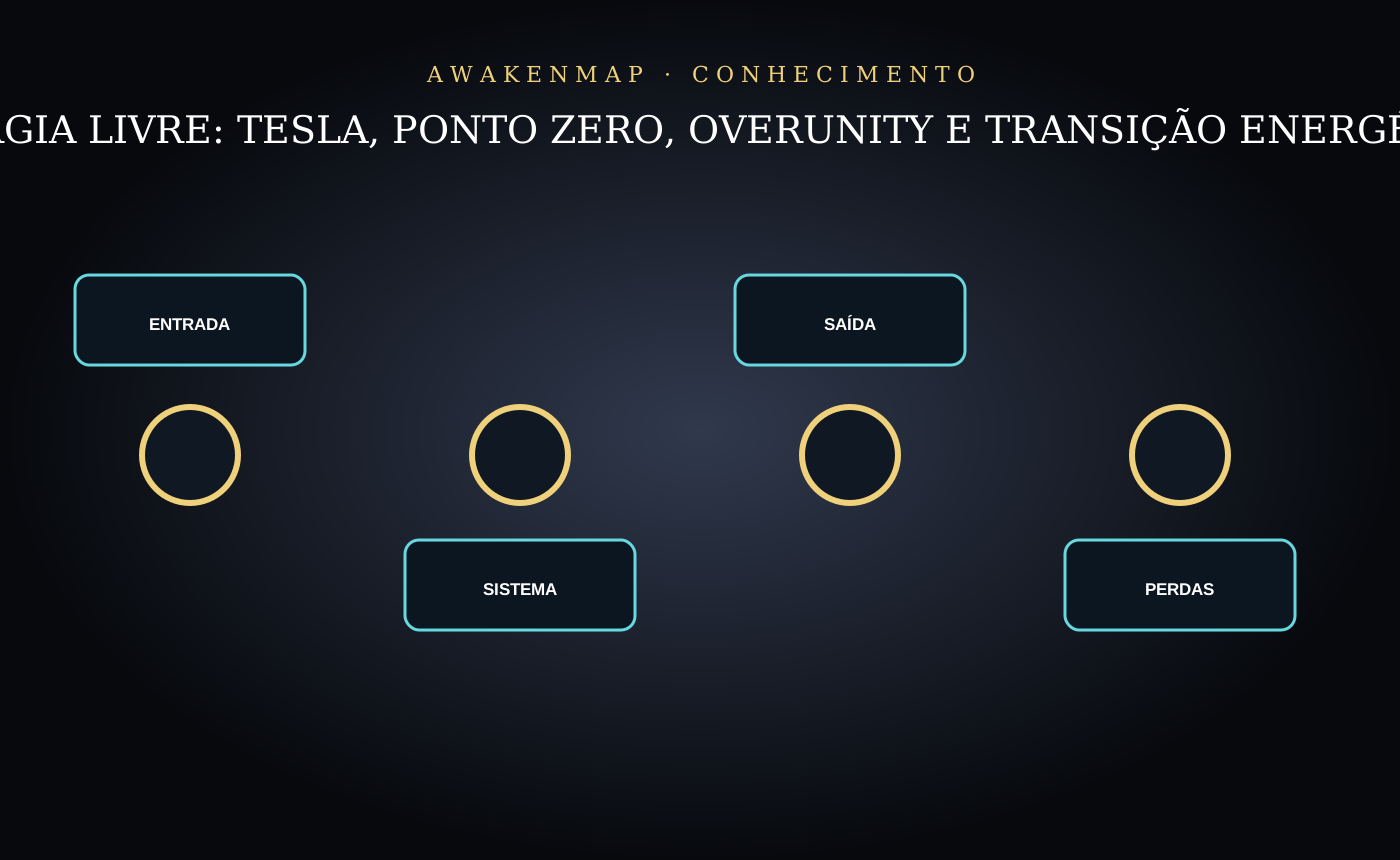
In thermodynamics, free energy has technical meanings such as energy available to perform work under particular conditions. In alternative culture, “free energy” usually means an inexhaustible, costless or ambient source.
Sharing a word does not make concepts equivalent. A technical term does not automatically support machines producing more energy than they receive.
The first and second laws
Conservation states that energy does not appear from nothing. The second law describes conversion limits and increasing entropy. A real machine loses useful energy through heat, friction, sound and resistance.
Efficiency above one hundred percent usually signals a poorly defined boundary, unmeasured input or error. Challenging such well-tested laws requires exceptional evidence and independent replication.
Power, energy and units
Power is a transfer rate; energy accumulates power over time. Comparing peak voltage with average consumption or volts with watts creates false conclusions.
Electrical measurement must consider current, phase, waveform, power factor and duration. Inadequate instruments can produce large errors with pulsed signals.
The system boundary
Magnets, batteries, capacitors, fuel, environmental heat and initial motion may store or supply energy. A test must include everything crossing the device boundary.
If a magnet demagnetizes or a hidden battery discharges, output is not free. The balance must run long enough to reveal storage.
Ambient heat and heat pumps
Heat pumps may deliver more heat than the electrical energy consumed because they move environmental heat. Conservation remains intact: total input includes electricity and captured heat.
A coefficient of performance above one is not overunity. Confusing transferred heat with created energy is common in demonstrations.
Casimir and zero-point energy
Quantum physics describes fluctuations and phenomena such as the Casimir effect. Their existence does not demonstrate an unlimited macroscopic source available to motors.
Extracting cyclic work requires returning the system to its initial state and accounting for costs. A measurable force is not automatically an exploitable reservoir.
Tesla: real invention and later myth
Tesla developed alternating-current systems, motors and high-frequency technology. His wireless projects sought to transmit energy rather than create it without a source.
Patents and isolated quotations need context. Admiring Tesla does not require assigning him a secret infinite-energy generator.
Testing a prototype
Use calibrated instruments and publish the circuit, components and uncertainty. Test with a known load, isolate external sources and permit independent inspection. A video without access to the device is insufficient.
The protocol should be set before the result. If criteria change whenever a test fails, the hypothesis becomes impossible to refute.
Signs of fraud or self-deception
Warnings include short demonstrations, hidden wiring, pressured investors, secrecy used to avoid verification and explanations blaming “negative energy” when the device stops.
Sincere inventors can also be mistaken. Measurement error and enthusiasm do not require bad faith; they require better controls.
A patent is not validation
A patent protects a description and does not certify that a device performs as promised. A working prototype, independent test and reproducible performance are different stages.
Patent rejection does not prove conspiracy either. Technical issues, novelty, documentation and law may explain the process.
Suppression and political economy
Companies and governments may resist technologies threatening established interests. History contains real patent conflicts, lobbying and infrastructure control.
This possibility does not validate every machine. Robust technology leaves data and can be reproduced by different teams. Verifiable documentation is the strongest defense against suppression.
Possible abundance
Solar, wind, storage, efficiency and smart grids may reduce costs and emissions without violating physics. “Free” still involves materials, maintenance, transmission and environmental impact.
Decentralization may widen access but requires policy, finance and governance. Real energy transformation is less magical and more collective.
Additional references
- U.S. Department of Energy — Thermodynamics Handbook
- U.S. Department of Energy — Energy Efficiency
- NIST — SI Units and Energy Measurement
References and starting points
- Britannica - Energy
- Britannica - Conservation of energy
- Britannica - Perpetual motion
- Britannica - Nikola Tesla
- IEA - Renewables
- U.S. Department of Energy - Solar energy
- Britannica - Zero-point energy
FAQ
Does proven free energy exist?
There are real renewables and possible decentralization. To date, there is no widely validated overunity machine that delivers useful energy from nothing or violates conservation of energy.
Keep exploring
You can open another path
 Map center Great Awakening 5/5 intensity Explore →
  Esoteric practices Orbo 5/5 intensity Explore →
  Esoteric practices Release Free Energy 5/5 intensity Explore →
  Consciousness and symbols Torus 5/5 intensity Explore →
  Control systems Vril Society 5/5 intensity Explore →
 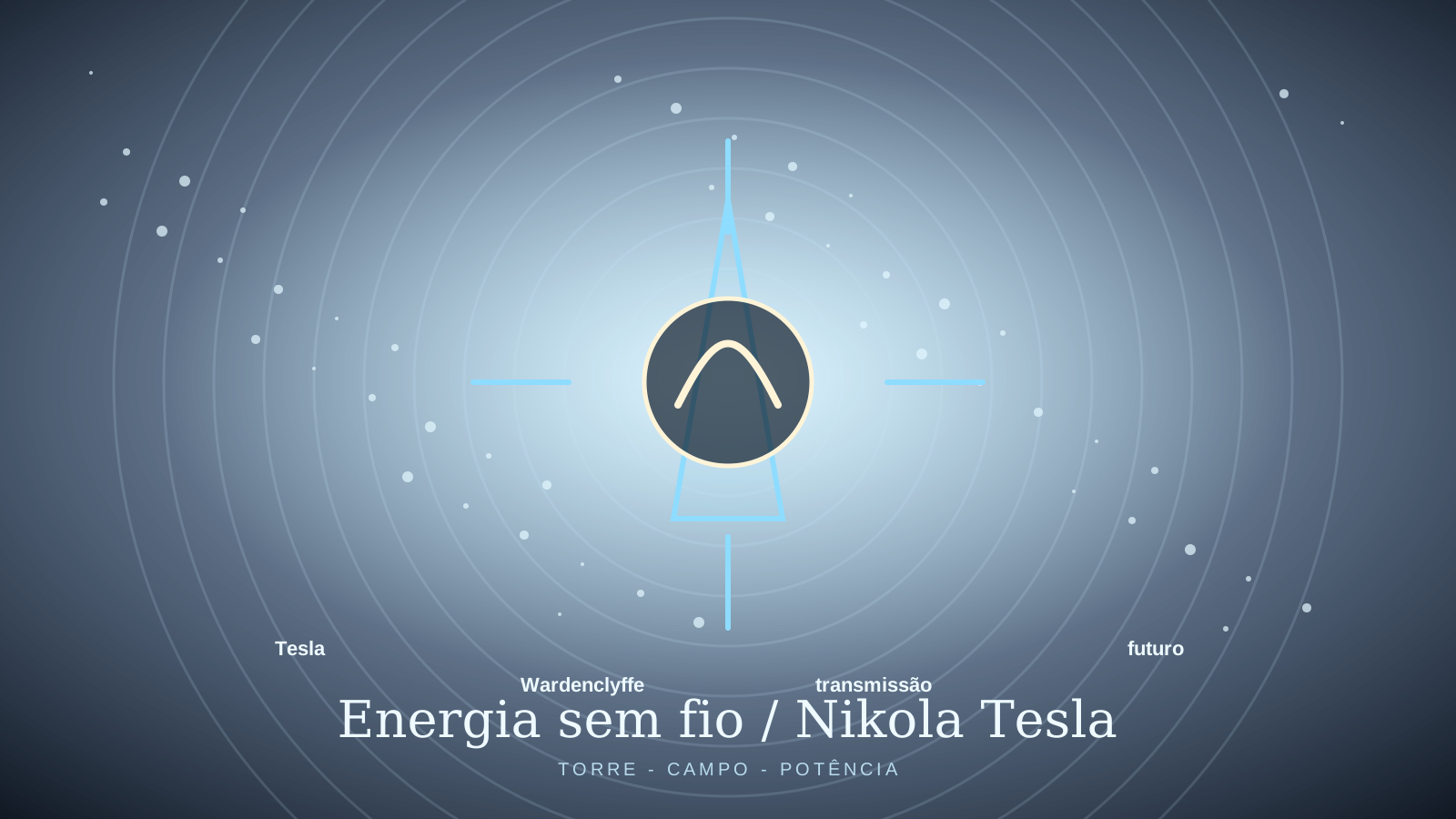 Healing and energy Wireless Energy / Nikola Tesla 4/5 intensity Explore →
Join the conversation
Comments are moderated. Keep the discussion respectful and distinguish evidence, interpretation and personal experience.