Connection level
43 direct connectionsHyperdimensional physics belongs on AwakenMap through the question of when mathematics becomes a secret map of the cosmos. The theme begins with a seductive intuition: perhaps the visible world is only a shadow of larger structures, and perhaps geometric patterns in planets, energy, consciousness and technology reveal a hidden physics behind ordinary reality.

Two things must be separated. In academic physics, extra dimensions appear in serious theories, such as models tied to string theory, gravity, particles and possible effects in accelerators. Institutions such as CERN and CMS discuss testable hypotheses: additional particles, gravitons, microscopic black holes or deviations that might appear in high-energy collisions. This is speculative, but it belongs to mathematical models, predictions and attempted tests.
The “hyperdimensional physics” of the conspiratorial imaginary is something else. It became popular around authors such as Richard C. Hoagland, who linked geometry, Mars, Cydonia, NASA, planetary monuments, tetrahedra, vortices, rotation, free energy and the famous 19.5-degree angle. In this reading, certain points on planets and stars reveal an energy geometry that official science has ignored or hidden.
The conspiratorial layer appears when this reading becomes a total theory. Volcanoes, planetary spots, storms, hexagons, pyramids, Martian ruins, ancient constructions and lunar anomalies become signatures of superior technology. Geometry stops being a descriptive tool and becomes an access code: whoever understands the pattern can explain free energy, antigravity, portals, the Secret Space Program and unacknowledged special access projects.
The delicate point is that mathematics really does reveal invisible structures. Equations describe fields, symmetries, particles and spaces that do not fit ordinary intuition. The error begins when geometric beauty becomes automatic proof of hidden engineering.
This is why the theme speaks to quantum physics, frequency, the Flower of Life, sacred geometry, Tesla, NASA, the Face on Mars and Cydonia. All of them deal with the temptation to turn pattern into intention.
The force of the theme comes from mixing real science and mythic language. Extra dimensions are difficult, but they exist as hypotheses in theoretical physics. Sacred geometry is symbolic, but visually fascinating. Planetary anomalies exist, but many have atmospheric, geological or optical explanations. When all of this is placed inside one narrative, the reader feels they are seeing a secret architecture. The problem is that a feeling of coherence does not replace prediction, measurement and falsifiability.
The number 19.5 is a good example. In hyperdimensional versions, it is the point where a tetrahedron inscribed in a sphere touches the surface, revealing special latitudes of energy transfer. From there, the model searches for examples: Mauna Kea, Olympus Mons, the Great Red Spot, sunspots and other phenomena. The methodological risk is choosing afterward the examples that seem to fit, ignoring those that do not, and treating angular coincidence as evidence of physical law.
A concrete case
A concrete case is the hexagon of Saturn. The shape is real, photographed by Voyager and later studied in detail by Cassini. NASA describes the hexagon as an enormous six-sided jet stream at Saturn's north pole, known since the 1980s. For planetary science, it is an extraordinary atmospheric phenomenon, tied to fluid dynamics, rotation, vortices and wave stability.
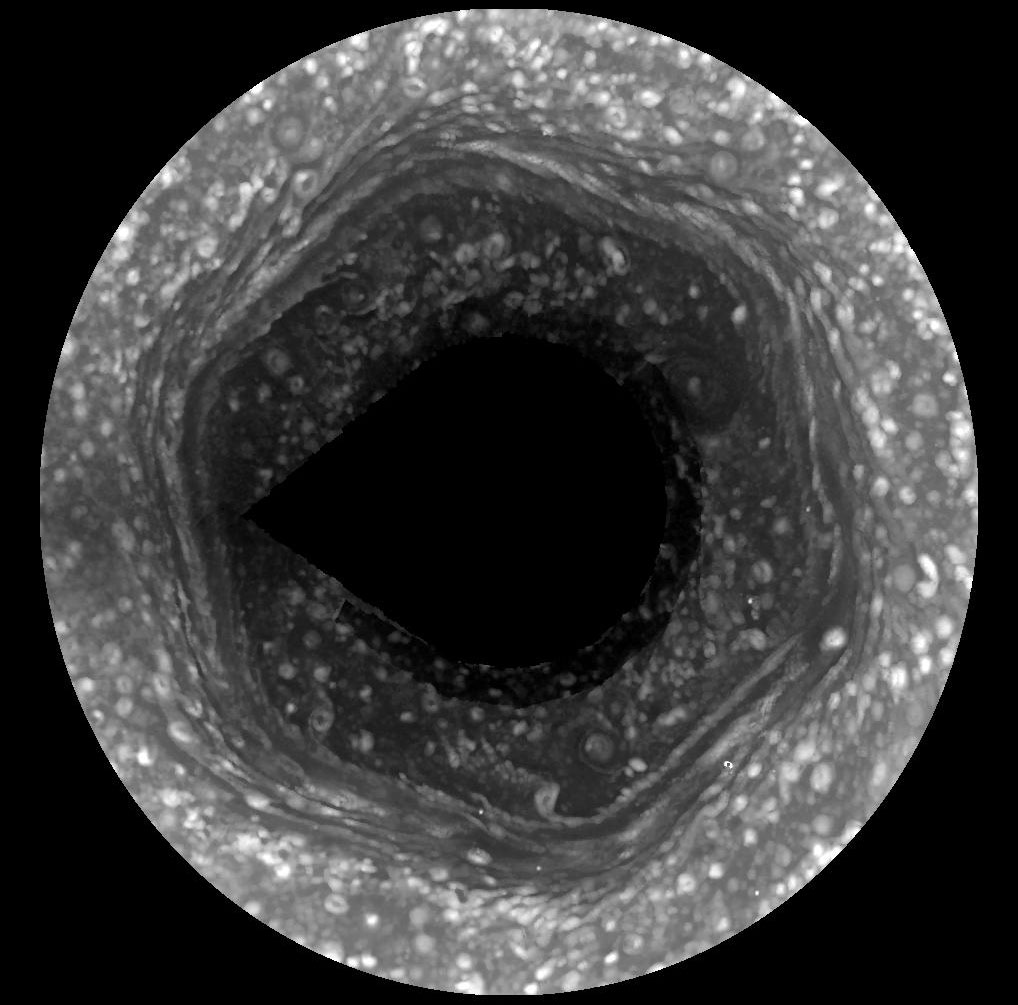
This case is perfect because no one needs to invent the mystery. The image really is strange. A hexagon on a gas planet feels like symbol, machine or signature. That is why it connects to the hyperdimensional hexagon, the black cube, esoteric Saturn and readings of cosmic geometry. What separates science from conspiracy is not finding the form fascinating; it is the kind of explanation accepted after fascination.
The scientific explanation seeks physical mechanisms: atmospheric currents, differential rotation, wave stability and comparison with fluid models. The hyperdimensional reading asks whether the form is a sign of a deeper energy structure, perhaps a geometry organizing planets and consciousness. The first tries to produce predictions and measurements. The second usually produces symbolic correspondences.
AwakenMap does not need to mock the question. The universe may have layers our intuition does not yet understand. But it also does not need to accept every impressive geometric pattern as proof. Between legitimate mystery and untested certainty lies an entire field called discernment.
Why it belongs on AwakenMap
Hyperdimensional physics belongs on AwakenMap because it is one of the most sophisticated forms of conspiratorial imagination: it does not only say that governments hide documents; it says that the physics taught to the public is itself a limited version of reality.
The philosophical connection lies in using mathematics as authority. Awakening here means asking when an equation explains, when it only decorates, when a geometry measures something real and when it only gives scientific appearance to a belief. The theme requires openness to frontier science and rigor against mystical shortcuts.
Simple summary
Hyperdimensional physics mixes the real idea of extra dimensions with esoteric and conspiratorial readings of geometry, energy, planets and hidden technology. In science, extra dimensions are testable mathematical hypotheses. In Hoagland-like narratives, patterns such as 19.5 degrees, Cydonia and Saturn's hexagon become signs of forbidden physics. The critical point is separating scientific model, powerful symbol, geometric coincidence and experimental evidence.
References and starting points
- CERN - extra dimensions, gravitons and tiny black holes
- CMS Experiment - detecting extra dimensions
- NASA Science - Saturn's hexagon in motion
- JPL - Saturn's unique hexagon in Cassini view
- APOD/NASA - Saturn hexagon image
- Text archive - 19.5-degree model associated with hyperdimensional physics
Keep exploring
You can open another path
 Map center Great Awakening 5/5 intensity Explore →
  Esoteric practices Quantum Physics 5/5 intensity Explore →
  Esoteric practices Simulation Matrix 5/5 intensity Explore →
  Esoteric practices Torsion Drives 5/5 intensity Explore → Map center Great Awakening 5/5 intensity Explore →
  Esoteric practices Hyperdimensional Hexagon 5/5 intensity Explore →
Join the conversation
Comments are moderated. Keep the discussion respectful and distinguish evidence, interpretation and personal experience.