Connection level
22 direct connectionsAncient Egypt unites the Nile, pharaohs, pyramids, temples, writing, ritual death, astronomy, engineering and the modern imagination of lost knowledge.
A civilization that became a mirror
Ancient Egypt occupies a rare place in human imagination. It is documented history, monumental archaeology, religious tradition, highly sophisticated art and, at the same time, a mirror for theories about lost knowledge, secret initiation, pyramid energy, Atlantis, stars and forgotten technology.
Egypt's force comes from the combination of continuity and mystery. For millennia, communities along the Nile developed agriculture, writing, statecraft, architecture, practical mathematics, funerary rituals and cosmologies of extraordinary symbolic coherence. The time scale alone is enough to provoke awe.
In AwakenMap, Ancient Egypt needs to be read with double fidelity: respect for Egyptology and openness to the symbolic power Egypt acquired in modern esotericism. The mistake is choosing between reducing everything to fantasy or turning every monument into automatic proof of lost civilization.
The Nile as axis of order
There is no Ancient Egypt without the Nile. The river structured agriculture, transport, calendar, fertility, trade, frontier and religious imagination. Seasonal floods deposited fertile sediments, allowing crops in a landscape marked by desert. The contrast between green valley and sand created an almost theological geography: life in a narrow band, death around it, rebirth in cycles.
Egyptian civilization learned to transform natural regularity into social order. Measuring floods, organizing labor, storing grain, calculating time and coordinating communities were practical needs, not only abstractions. The idea of Ma'at, order, truth and balance, speaks with this world where life depended on predictable rhythms.
This concrete foundation matters for containing exaggerations. Before invoking impossible technology, one must recognize the administrative, agricultural and symbolic intelligence of a society deeply adapted to its environment.
Pharaoh, Ma'at and sacred power
The pharaoh was not merely a secular ruler. He occupied a ritual position within cosmic order, responsible for maintaining Ma'at against chaos, disorder and rupture. This function connected politics, religion, economy and architecture. Building temples, offering to gods, administering works and guaranteeing continuity were not separate tasks.
This fusion explains monumentality. Pyramids, temples and tombs were not isolated caprice; they were social and symbolic machines of permanence. They articulated collective labor, authority, royal memory, cult of the dead and relationship with divinities.
In alternative reading, the pharaoh often becomes an initiate of hidden science. That can be interesting as symbol, but the real history already shows something deep: Egyptian power endured because it could transform cosmology into institution and institution into stone.
Pyramids: engineering, ritual and modern obsession
The pyramids are the point where Egypt and modern mystery meet most intensely. Djoser's pyramid at Saqqara, Snefru's experiments and the Giza complex show technical evolution, planning, logistics and material mastery. Britannica highlights Snefru as the probable builder of the first true pyramid.
Modern fascination often begins with the question: how did they do it? The conventional answer involves specialized workers, state organization, quarries, ramps, tools, practical geometry, transport and much time. This does not reduce the work. On the contrary: it places greatness where it belongs, in collective human capacity.
Still, pyramids are also symbols. Their form unites earthly base and celestial apex. They organize death, ascent, permanence and an axis between human and divine worlds. The mistake is not seeing them as sacred; it is turning sacredness into proof of lost machines without evidence.
Writing, memory and administration
Hieroglyphs, hieratic and demotic show that Egypt was a civilization of writing, record and bureaucracy. Funerary texts, royal inscriptions, lists, accounting, literature, magical formulas and administrative documents reveal a culture that knew how to use the word as instrument of power and passage.
Egyptian writing was not only communication. It could be effective image, ritual presence, a name preserving existence. Erasing someone's name was an attack on memory. Inscribing a name in stone was an attempt at survival. This gives Egypt an almost informational dimension: to exist is to be remembered correctly.
In AwakenMap, this layer connects to Akashic records, ancient libraries and planetary memory. The symbolic bridge is strong: Egypt teaches that memory needs support, form and ritual. But the historical bridge requires care not to project modern systems onto ancient texts.
Death, mummification and eternal life
Egyptian funerary culture is one reason for its permanence in imagination. Mummies, sarcophagi, canopic jars, painted tombs, Book of the Dead, judgment of Osiris and the journey beyond form a spiritual architecture of death. The Smithsonian summarizes this vision by presenting death as the beginning of a journey to eternal life.
For Egypt, death was not a simple ending. It was a dangerous transition requiring preparation of body, name, heart, texts and offerings. The preserved body, tomb, image and recitation were ritual technologies of continuity.
This vision still touches the modern world because death remains our great frontier. Egypt offers a visually powerful answer: prepare, align with order, remember the name, cross the judgment and continue.
Astronomy, calendar and ritual sky
Egypt observed the sky for practical and religious reasons. The cycle of Sirius, seasons, Nile inundation, temple orientation, calendar and rituals connected earth and sky. The relationship with stars, Sun, Moon and horizon was part of organizing time.
This feeds many modern theories about stellar alignments, Orion's belt, portals, pyramid energy and advanced astronomical knowledge. Some questions about orientation and celestial symbolism are legitimate. The problem is when visual similarities become proof of extraterrestrial contact or Atlantis without a chain of evidence.
Balanced reading recognizes that Egyptians were sophisticated observers of the sky. We do not need to underestimate them to explain their science, nor attribute everything to outside visitors to admire their symbolic precision.
Esoteric Egypt and modern occultism
Modern Egypt is not only ancient Egypt; it is also the Egypt imagined by Hermeticism, Freemasonry, Rosicrucianism, Theosophy, occultism, popular archaeology and cinema. Since the European rediscovery of monuments and decipherment of hieroglyphs, Egypt became a stage of initiation, secrets and veiled wisdom.
This layer has cultural value. It shows how modern societies project onto Egypt what they feel they have lost: unity between science and sacred, cosmic architecture, relationship with death, symbolic language and sense of permanence. Esoteric Egypt is less a faithful portrait of the past and more a diagnosis of modernity.
The care is not erasing real Egypt. Modern spirituality should distinguish inspiration from appropriation and hypothesis from fact. Using Egyptian symbols requires respect for history, language, gods and the people who study and preserve this heritage.
Who built Egypt beyond the pharaohs
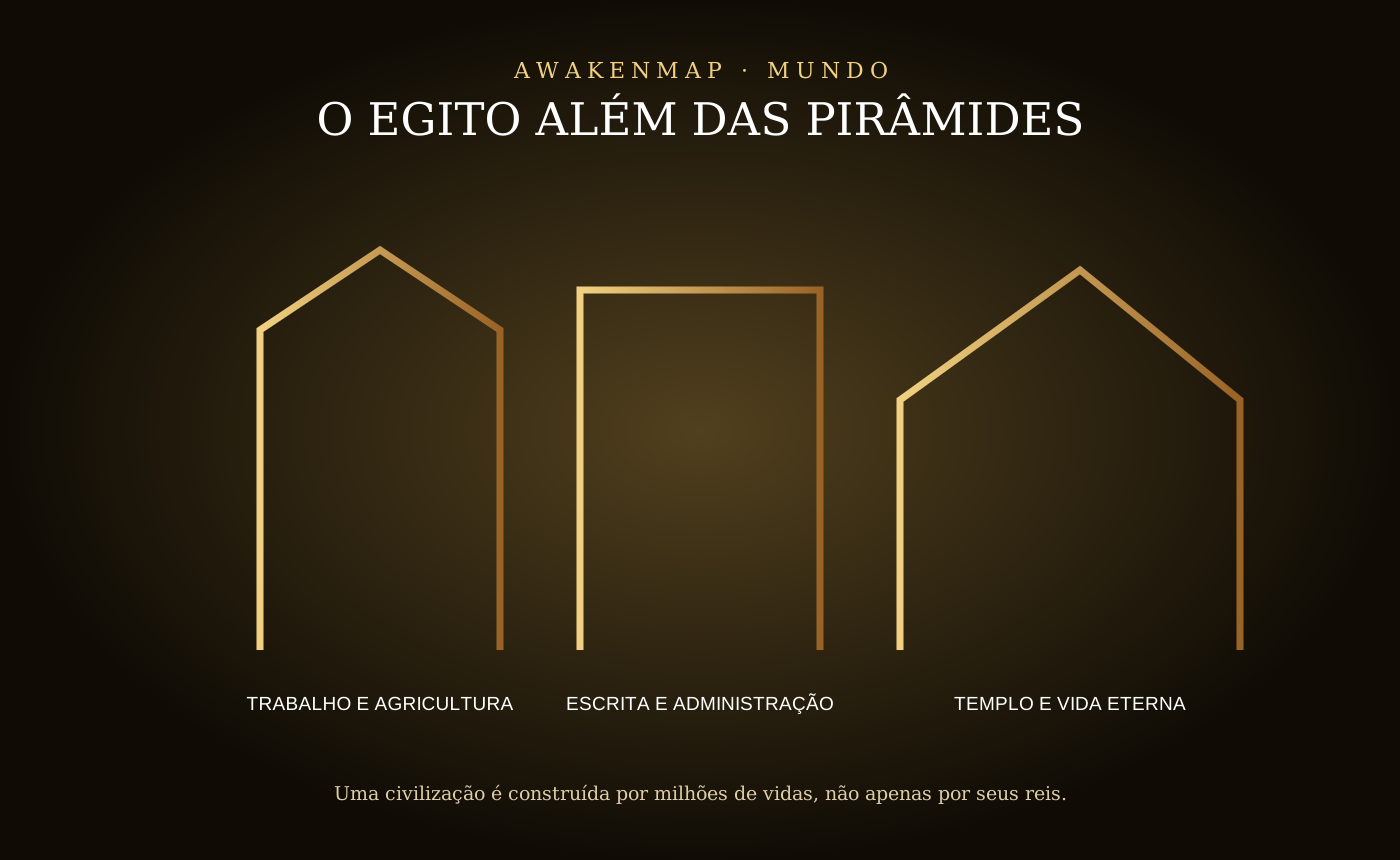
Popular images focus on kings, priests and monuments, but civilization depended on farmers, boatmen, masons, scribes, artisans, soldiers and administrators. Villages such as Deir el-Medina preserve evidence of specialized workers responsible for royal tombs.
Papyri and ostraca record payment, absence, disputes and even one of the earliest documented labour strikes during the reign of Ramesses III. These sources reveal people with families, claims and technical expertise—not an anonymous mass moved only by command.
Women, family and property
Egyptian women could own property, inherit, enter contracts, divorce and appear in court, although society remained shaped by inequalities of gender and social position. Some exercised exceptional power, including Hatshepsut, who adopted pharaonic titles and imagery.
Both extremes should be avoided: Egypt was not a modern society of complete equality, but it does not fit simple caricature either. Legal and funerary documents reveal varied roles across period, class and region.
African Egypt and the modern gaze
Egypt arose in northeastern Africa and maintained deep relationships with Nubia, the Sahara, the Levant and the Mediterranean. Trade, war, migration and diplomacy connected these worlds. Artificially separating Egypt from Africa impoverishes its history, while reducing it to one identity erases millennia of change.
European Egyptomania, colonialism and museums shaped public knowledge. Excavations removed objects and bodies, often under unequal relations of power. Studying Egypt today also involves heritage, repatriation and the voices of Egyptian researchers and communities.
Egypt must not be frozen into one timeless image. Its civilization crossed more than three millennia of political, religious and linguistic change, followed by Persian, Greek, Roman and Christian periods. Saying “the Egyptians” without identifying a period may combine societies separated by more time than exists between the Roman Empire and the present.
This long duration also explains why a symbol, deity or burial practice can change meaning. Evidence from one dynasty should not automatically be projected onto every other period. Chronology is not a technical footnote: it is what prevents a complex civilization from becoming a single timeless mystery.
Ancient Egypt in AwakenMap
In AwakenMap, Ancient Egypt connects to Pyramids, Giza Complex, Sphinx, Sacred Geometry, Atlantis, Ley Lines, Ancient Civilizations, Akashic Records, Free Energy, Anunnaki and the Great Awakening. It is a node of monumental memory.
As a World theme, it is linked to territory, river, monument, desert and archaeology. As Knowledge, it speaks of writing, calendar, mathematics and religion. As Cosmic, it connects earth and sky through solar rituals, stars and imagination of ascent.
The page should help the user maintain admiration without losing ground. Egypt is extraordinary enough as human civilization. When alternative theories enter, they should be evaluated as layers of reception, hypothesis and myth, not automatic replacement for history.
How to read this theme
Read Ancient Egypt in layers. The first is historical: Nile, state, dynasties, art, religion, economy. The second is architectural: pyramids, temples, tombs, logistics, orientation. The third is symbolic: death, rebirth, Ma'at, sky, name and memory. The fourth is alternative: Atlantis, lost technology, energy and initiation.
When someone presents an extraordinary claim, ask: what primary source? What archaeological consensus? Is there measurement? Is there Egyptian context or only modern projection? At the same time, do not let skepticism destroy wonder. Egypt deserves rigor precisely because it is immense.
Ancient Egypt remains alive because it teaches that civilization is an attempt to overcome time. Stone, name, ritual and sky were used to maintain order before death. That question is still ours.
Critical reading
Ancient Egypt should be read with admiration and method: real historical civilization, modern esoteric symbol and field of alternative hypotheses that need proportional evidence.
References and starting points
- Britannica - Ancient Egypt
- The Met - Egypt, 8000-2000 B.C.
- The Met - Egypt, 2000-1000 B.C.
- Smithsonian - Ancient Egyptian artifacts, mummies and pyramids
- National Geographic - How were the Pyramids of Giza built?
- Britannica - Nile River
- Britannica - Ancient Egyptian religion
FAQ
Do the pyramids prove lost technology?
They prove extraordinary engineering, social organization and symbolism. Claims of lost technology need specific evidence beyond awe at the scale.
Did Egypt come from Atlantis?
There is no archaeological consensus confirming that origin. The connection is strong in modern esotericism, but should be treated as symbolic or speculative hypothesis.
Keep exploring
You can open another path
 Consciousness and symbols Flower of Life 5/5 intensity Explore →
  Ancient civilizations Ancient Civilizations, Mysteries and Forbidden Archaeology 5/5 intensity Explore →
  Esoteric practices Ra 5/5 intensity Explore →
  Esoteric practices Emerald Tablets 4/5 intensity Explore →
  Ancient civilizations Ancient Builder Race 4/5 intensity Explore →
  Ancient civilizations Atlantis 4/5 intensity Explore →
Join the conversation
Comments are moderated. Keep the discussion respectful and distinguish evidence, interpretation and personal experience.