Connection level
8 direct connectionsThe Giza Complex gathers the pyramids of Khufu, Khafre and Menkaure, the Great Sphinx, temples, causeways, tombs and the largest modern field of projections about ancient engineering and lost knowledge.
The plateau where stone became sky
The Giza Complex is one of the most recognizable landscapes on Earth. Three main pyramids, the Great Sphinx, valley temples, processional causeways, queens' pyramids, mastabas, cemeteries and remains of workers' settlements form a ritual and political system much broader than the tourist image usually shows.
Giza is not merely a set of isolated monuments in the desert. It is an Old Kingdom royal necropolis linked to a vision of power, death, Sun, horizon, memory and dynastic continuity. The visual greatness only makes sense when the whole is understood: pyramid, temple, causeway, valley, secondary tomb, cult and landscape.
In AwakenMap, Giza is unavoidable. It unites Ancient Egypt, Pyramids, Sphinx, Sacred Geometry, Atlantis, Ley Lines, Hall of Records, archaeology, astronomy and theories of lost technology. Precisely for that reason it needs rigor: the real mystery is too large to depend on exaggeration.
Khufu, Khafre and Menkaure
The three main pyramids are associated with the pharaohs Khufu, Khafre and Menkaure of the Fourth Dynasty. The Great Pyramid of Khufu is the largest and became the center of modern obsession. Khafre's pyramid sometimes appears taller because it stands on higher ground and still preserves part of its casing near the top. Menkaure's is smaller, but belongs to an equally significant funerary complex.
The conventional reading understands these pyramids as royal tombs and centers of funerary cult. This does not reduce them. In Egypt, tomb, temple and cosmos were deeply connected. Building a pyramid was building a form of royal permanence and an interface between earthly order and divine order.
The modern mistake is imagining that if something was a tomb, it was simple. For Egypt, royal death was politics, religion, astronomy, economy and memory in a single operation. The pyramid was an institution in stone.
The complex, not only the pyramid
Each pyramid was part of a broader whole. Smarthistory notes that the Giza pyramids were accompanied by temples and long stone causeways leading to valley temples near the floodplain. These elements show that the monument worked as process: arrival, rite, cult, passage and memory.
There were also elite cemeteries, mastabas and areas linked to the organization of labor. The discovery and study of workers' settlements helped weaken the popular idea that the pyramids were built by masses of enslaved people. The more accepted picture involves specialized workers, organized teams, supply and state logistics.
This social layer is fundamental. Giza was not raised by abstract mystery, but by people: stonecutters, haulers, cooks, scribes, administrators, priests, artisans and families. Recognizing this gives humanity back to the monuments.
The Great Sphinx and the guardian of the horizon
The Great Sphinx is one of the ancient world's most enigmatic sculptures. Britannica describes it as a reclining lion with a human head, carved from limestone, about 73 meters long and 20 meters high. Many scholars associate it with Khafre, although details of dating and interpretation remain debated.
The Sphinx condenses animal power and royal face. It guards, faces the horizon and seems to participate in solar theology. Its presence changes the reading of the plateau: Giza is not only pyramid geometry, but also body, gaze, guardianship and passage.
In alternative imagination, the Sphinx became a doorway to the Hall of Records, hidden chambers, Atlantis and earlier civilizations. These ideas gained strength especially in the twentieth century. The critical question is to separate real anomalies, restorations, erosion, known cavities and archaeological hypotheses from narratives that jump directly to Atlantean libraries.
How were they built?
The construction question is legitimate. The scale is enormous: limestone blocks, granite transported from far away, alignment, leveling, labor coordination, food, tools, ramps and building sequence. National Geographic notes that communities across Egypt likely contributed workers, food and resources to what became a national project linked to pharaonic power.
Construction models vary: straight ramps, zigzag ramps, internal ramps, lever systems, sled transport, water to reduce friction and river logistics. No simple explanation resolves every detail, but that does not mean the only alternative is nonhuman technology.
The mature attitude is to recognize gaps without abandoning what is already known. Archaeology works with accumulated evidence, not a single magic answer. Giza remains researchable because there are real technical questions, not because every academic explanation has failed.
Astronomy, alignment and geometry
Giza feeds debates about astronomical alignments, cardinal orientation, Orion's belt, Sun, circumpolar stars and sacred geometry. Some observations are concrete: the pyramids have notable orientation and Egypt had a strong relationship between sky, calendar, royal death and solar ritual.
The problem begins when every alignment becomes proof of a universal coded message. Great monuments often orient through sky, horizon, geography and power. This shows cultural and technical sophistication. To claim a global, Atlantean or extraterrestrial code, one must demonstrate method, intention, context and verifiable repetition.
Giza's geometry is real as design and powerful as symbol. It points to order. The question is whether this order should first be read within Egyptian cosmology before being captured by modern systems that may say more about us than about the ancient Egyptians.
Hall of Records and hidden chambers
Few themes attached themselves to Giza as strongly as the Hall of Records, a supposed underground library containing knowledge from Atlantis or an earlier humanity. The idea was popularized in modern esoteric circles, especially through readings associated with Edgar Cayce, and keeps returning whenever news appears about anomalies, cavities or scans on the plateau.
It is true that noninvasive methods such as radar, muography and resistivity have revealed voids, corridors and structures still being discussed in Egypt. This is real and exciting archaeology. But a detected void is not automatically a lost library. An anomaly needs investigation, dating, context and publication.
The best posture is disciplined curiosity. Giza may still contain important discoveries. That possibility does not authorize turning every news item into proof of Atlantis. The mystery improves when it survives the slow time of verification.
Giza as modern projection machine
Giza became a screen for many modern anxieties: loss of trust in institutions, fascination with extraterrestrial visitors, desire for a mother civilization, search for free energy, nostalgia for lost wisdom and suspicion that official history hides something essential.
This projection is not irrelevant. It shows that the pyramids still function as psychic monuments. They receive questions modernity does not know where to place: who are we, what have we forgotten, how do civilizations fall, what is our relation to death, sky and technology?
The care is not letting projection erase the real builders. When one says humans could not have built Giza, one often underestimates ancient Egyptian intelligence. Admiring mystery should not mean stealing human authorship.
The workers’ settlement
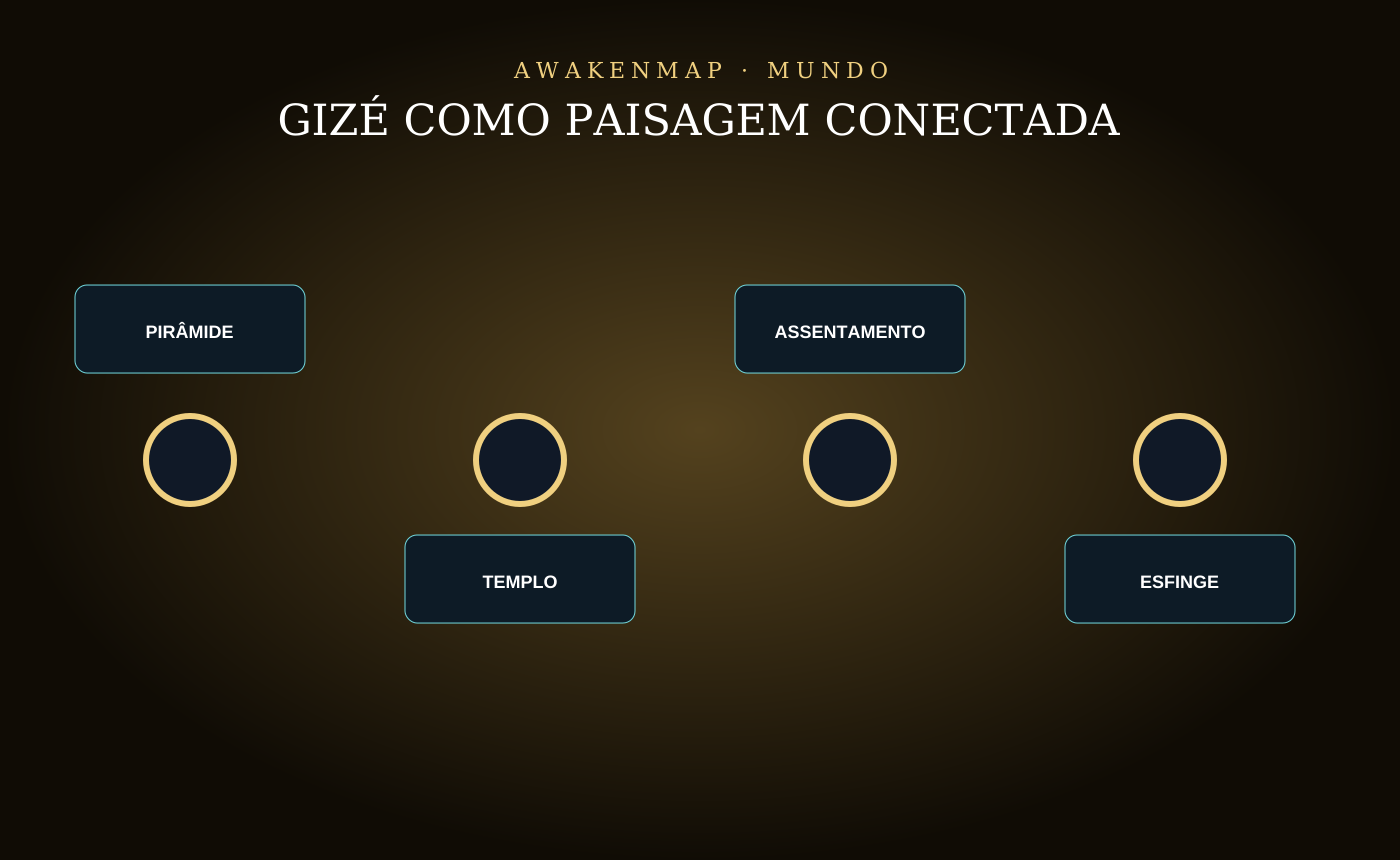
South of the complex, archaeologists found settlements associated with teams that built and maintained the monuments. Bakeries, animal bones, production areas, seals and administrative buildings reveal food supply, organization and specialization.
These remains weaken the image of construction without a visible society. Masons, transporters, bakers, scribes and supervisors formed a logistical chain. Monumentality came not from one trick but from sustained administration.
Boats, causeways and ritual movement
Pits beside the Great Pyramid contained dismantled vessels, including the famous Khufu ship. Valley temples connected to mortuary temples through monumental causeways, organizing movement between Nile, desert and pyramid.
These structures show that the complex was designed for movement, ceremony and continuing cult. Reading only the pyramid’s stone mass makes the system giving it meaning invisible.
Muon imaging and the Great Pyramid void
ScanPyramids used muons, particles produced by cosmic rays, to investigate density differences. In 2017 researchers announced a large void above the Grand Gallery. In 2023 imaging helped characterize a corridor near the north face.
A detected cavity is not automatically a library, secret tomb or machine. It may have structural, constructional or unknown purpose. The discovery shows how modern technology can expand archaeology without filling every gap with the most spectacular theory.
The value of scanning lies in non-destructive investigation. Fragile monuments cannot be drilled to satisfy every hypothesis. Combining muons, radar, photogrammetry and robotics allows better questions while conservation limits invasive intervention.
This caution follows a different rhythm from conspiratorial entertainment. Archaeology may require years to confirm the shape and function of a space. Waiting does not necessarily mean hiding; it means protecting the monument and separating detection, interpretation and conclusion. Uncertainty is a normal and necessary stage of careful, responsible research, not evidence of suppression or institutional fear.
Giza in AwakenMap
In AwakenMap, the Giza Complex connects to Ancient Egypt, Pyramids, Sphinx, Sacred Geometry, Atlantis, Ley Lines, Akashic Records, Hall of Records, Ancient Civilizations, Free Energy and the Great Awakening. It is a central node of monumental memory.
As a World theme, Giza is physical place, heritage, stone and landscape. As Knowledge, it is engineering, archaeology, writing, ritual and astronomy. As Cosmic, it is a symbolic axis between earth and sky. This overlap explains why the plateau remains so powerful.
The page should guide the user through layers: what is archaeologically accepted, what is debated, what is alternative hypothesis and what is modern myth. In this way, Giza stays alive without becoming confusion.
How to read this theme
Read Giza as a complex, not as an isolated riddle. Observe pyramids, temples, causeways, workers, cemeteries, Sphinx, horizon and funerary cult together. The more the whole appears, the less we need to fill gaps with hurried fantasy.
When an extraordinary claim appears, ask for source, method, publication, excavation, Egyptian context and independent confirmation. When a symbolic interpretation appears, ask whether it illuminates Egypt or only projects modern desires.
Giza is great because it resists. It resists time, sand, simplification and our certainties. The best way to honor it is to unite awe, study and humility.
Critical reading
Giza should be read as archaeological complex, ritual landscape and modern myth. The place becomes stronger when we distinguish evidence, debate, alternative hypothesis and cultural projection.
References and starting points
- Britannica - Great Sphinx of Giza
- The Met - Egypt in the Old Kingdom
- National Geographic - How were the Pyramids of Giza built?
- National Geographic - Standing Tall: Egypt's Great Pyramids
- Smarthistory - The Great Pyramids of Giza
- Egyptian Museum - Old Kingdom Monuments: Pyramids of Giza
- UNESCO - Memphis and its Necropolis
FAQ
Was Giza built by slaves?
Current archaeological understanding favors organized and specialized workers with state logistics, not a simple mass of slaves as in popular imagination.
Is there a Hall of Records under the Sphinx?
There is no robust archaeological confirmation of an Atlantean library under the Sphinx. Cavities and anomalies should be investigated without jumping directly to esoteric conclusions.
Keep exploring
You can open another path
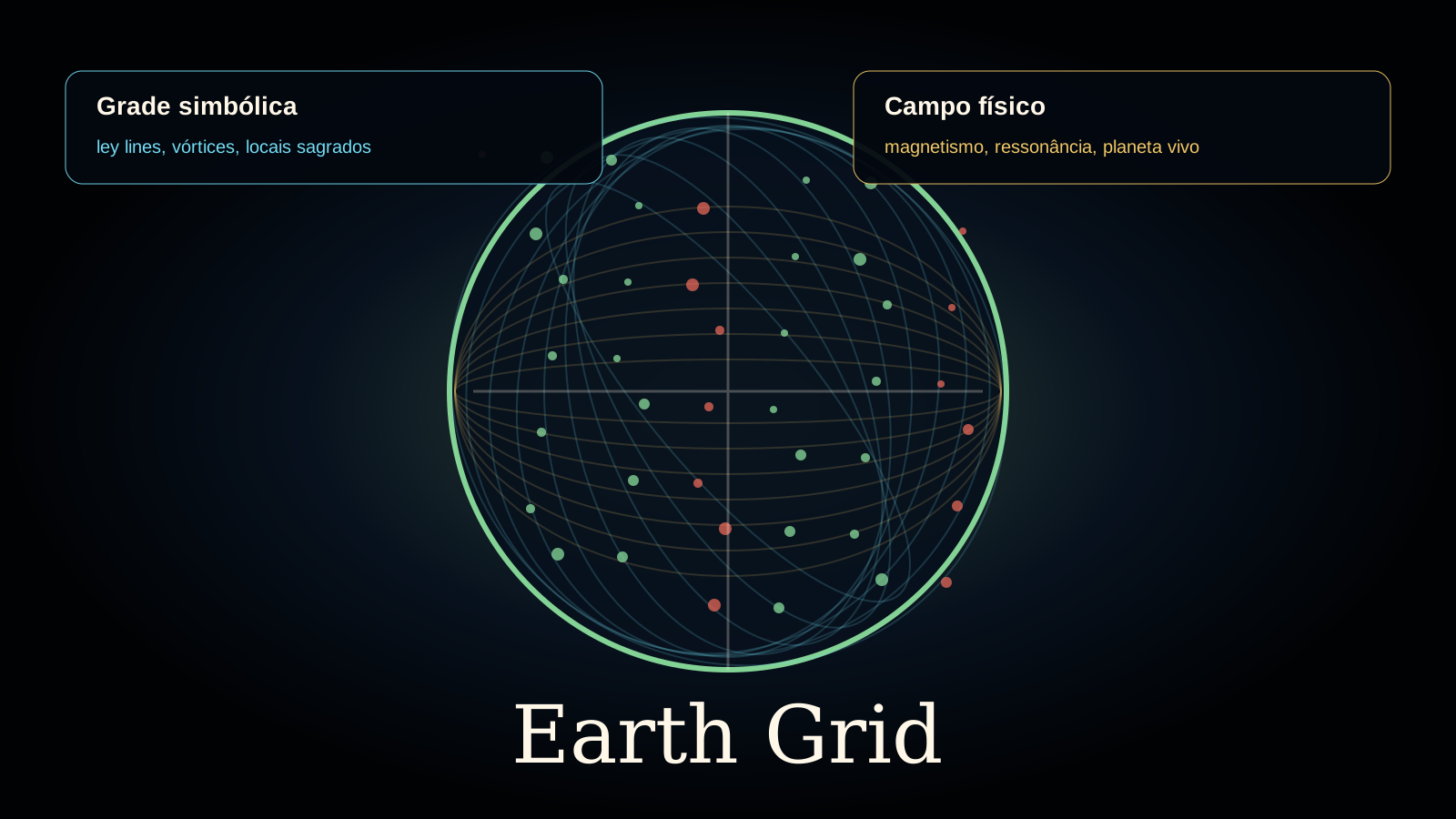 Earth and Antarctica Earth Grid 4/5 intensity Explore →
  Earth and Antarctica Ley Lines 4/5 intensity Explore →
  Ancient civilizations Ancient Egypt 4/5 intensity Explore →
  Ancient civilizations Pyramids 4/5 intensity Explore →
  Ancient civilizations Ancient Aliens 4/5 intensity Explore →
  Ancient civilizations Sphinx 4/5 intensity Explore →
Join the conversation
Comments are moderated. Keep the discussion respectful and distinguish evidence, interpretation and personal experience.