Connection level
49 direct connectionsAncient Aliens is the hypothesis that extraterrestrial beings visited Earth in the remote past and influenced myths, monuments, religions, sky maps and cultural leaps. The theme grips people because it joins two powerful questions: “are we alone?” and “how did ancient peoples build such grand things?”
What the hypothesis says
The best-known version says that ancient gods, celestial messengers, luminous beings, civilizing teachers and mythical builders could be distorted memories of visitors from other worlds. In this reading, what ancient peoples called heaven, divine chariot or dwelling of the gods would be reinterpreted as advanced technology.
On AwakenMap, the theme connects to ancient civilizations, ancient ruins, ancient Egypt, ancient India, Atlantis, the Ancient Builder Race, Ancient Builder Race on the Moon and Cosmic Disclosure. It works as a bridge between archaeology, myth, ufology and cosmic imagination.
Where the modern fever came from
The idea of celestial visitors did not begin in the twentieth century, but that is when it gained its popular form. Erich von Däniken’s Chariots of the Gods?, published in 1968, turned the ancient astronaut hypothesis into a global phenomenon. It suggested that pyramids, Nazca lines, statues, sacred texts and myths might preserve traces of extraterrestrial contact.
Then came documentaries, magazines, television programs and, later, the Ancient Aliens series. The theme stopped being only a book thesis and became pop language: wild hair, astronaut gods, hidden clues and the question attached to almost every ancient mystery — “what if it was not human?”
The real image that feeds the imagination
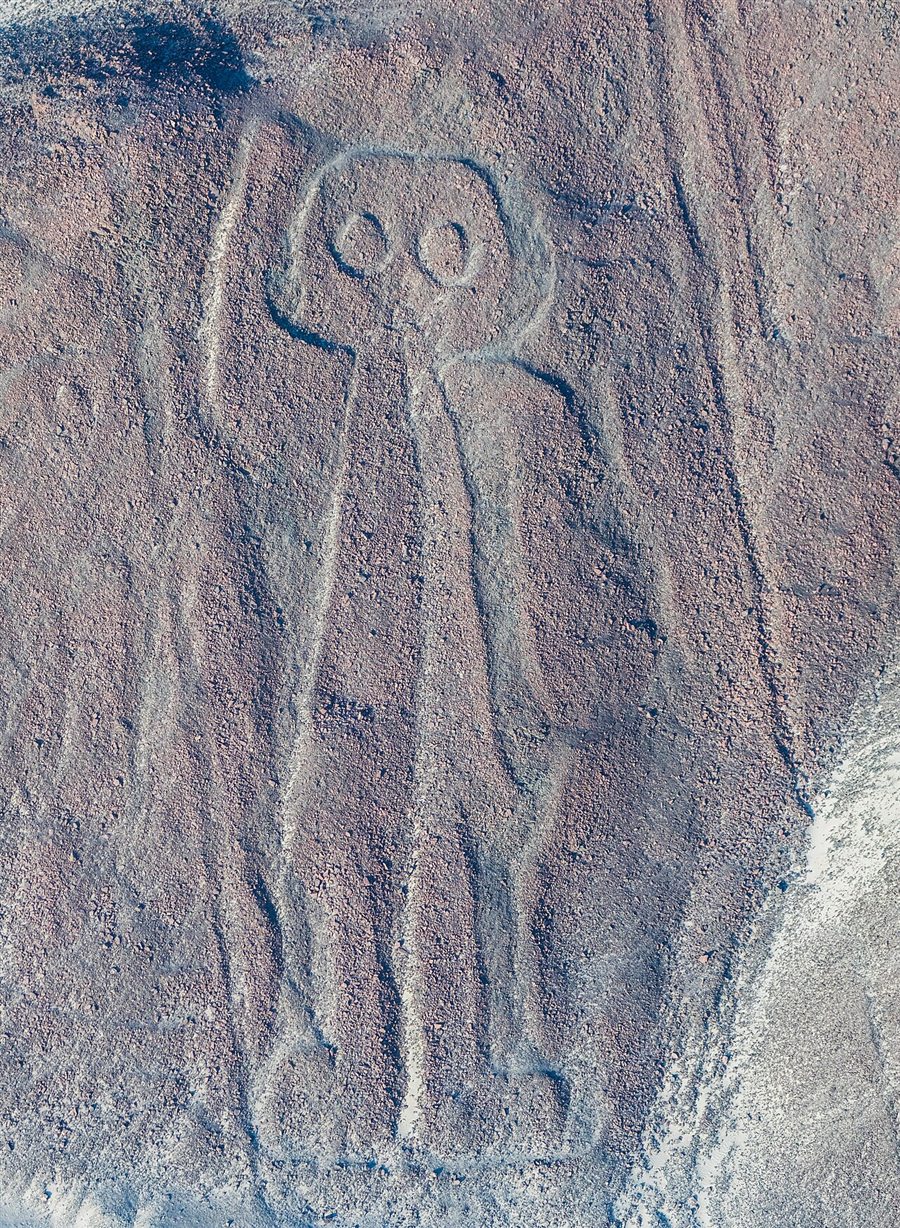
This image shows the Nazca geoglyph known as “Owlman” or “Astronaut”. It is one of the figures that most feeds the ancient aliens reading because, to modern eyes, it looks like a helmeted person waving toward the sky.
But this is exactly where the article needs balance: the image does not prove space visitors. It shows how an ancient form can be reinterpreted by a modern culture obsessed with rockets, helmets, satellites and extraterrestrial contact.
Nazca: alien clue or human work?
The Nazca Lines are real and impressive. UNESCO describes geoglyphs made between 500 BCE and 500 CE, covering a huge area of the Peruvian desert, with figures of animals, plants, imaginary beings and geometric lines. The visual impact is enormous, especially from the air.
It is easy to understand why the alien hypothesis moved toward Nazca. Seen from above, the figures look like messages to the sky. But archaeology does not work only with visual impressions. It asks who made them, when, with what tools, in what landscape and within what culture. In that sense, Nazca is stronger as testimony of human ritual engineering than as evidence of an extraterrestrial runway.
Why people see astronauts in gods
The emotional force of the theme comes from a simple inversion. Instead of saying ancient peoples imagined gods because they lived in symbolic worlds, the hypothesis says they were describing real technology with the language available to them. A “chariot of fire” becomes a craft. A “being descending from heaven” becomes an astronaut. “Revealed knowledge” becomes technology transfer.
This reading is seductive because it turns myth into testimony. The problem is that it can force ancient texts and images into modern questions. Not every helmet is a space suit. Not every disc is a craft. Not every astronomical alignment requires outside intervention.
The sensitive point: not erasing ancient people
An important criticism from archaeologists is that ancient alien theories often diminish the capacity of human civilizations themselves. When a pyramid, city, sculpture or calendar seems too sophisticated, the answer “aliens did it” can become a way of not recognizing engineering, organization, sky observation, religion, collective labor and local intelligence.
This is AwakenMap’s editorial care: the theme can be explored as modern myth and cosmic question, but without taking authorship away from the ancient peoples who made these works.
What is real in the subject
Real archaeology exists: Nazca, Egypt, India, Mesopotamia, the Andes, Mesoamerica, megaliths, calendars, observatories, ancient cities and rock art. Real science about life beyond Earth also exists: astrobiology, SETI, technosignature searches and exoplanet studies. The question of extraterrestrial intelligence is legitimate.
The problematic leap happens when a legitimate question becomes certainty about the past without enough evidence. Saying “life beyond Earth may exist” is different from saying “the pyramids were built with alien help”. A good article keeps these layers separate.
Why this theme grips people
It grips people because it restores wonder to the past. Instead of seeing ruins as dead stones, the reader begins to imagine clues, messages, contact, sky, memory and lost technology. The theme also speaks to a modern feeling: perhaps humanity is not the center of history; perhaps it is part of a larger story.
That is the beautiful side of the hypothesis. The dangerous side appears when imagination becomes contempt for archaeology, or when every mystery becomes a ready-made answer.
Connections to continue
After this theme, open ancient civilizations, ancient ruins, ancient Egypt, ancient India, the Ancient Builder Race, Ancient Builder Race pyramids, disclosure and NASA. This path shows how the theme spreads across ancient civilizations, space programs, ufology and the search for signs of intelligence.
Simple summary
Ancient Aliens is the hypothesis that extraterrestrial visitors influenced ancient peoples and were remembered as gods, teachers or celestial beings. The theme is powerful because it joins archaeology, myth and life beyond Earth. But it needs careful reading: real monuments and ancient cultures should not be reduced to “alien proof” without strong evidence.
References and starting points
- UNESCO - Lines and Geoglyphs of Nasca and Palpa
- Penn Museum - “Scholars Will Call it Nonsense”
- Smithsonian Magazine - The Idiocy, Fabrications and Lies of Ancient Aliens
- Washington University - Archaeological Fantasies and Hoaxes
- Penguin Random House - Erich von Däniken, Chariots of the Gods?
- Oxford University Press - Kenneth Feder, Frauds, Myths, and Mysteries
- NASA - Searching for Signs of Intelligent Life: Technosignatures
- SETI Institute - SETI Research
- Wikimedia Commons - Nazca Lines Owlman / Astronaut geoglyph
FAQ
Is Ancient Aliens a proven theory?
No. It is a popular and speculative hypothesis. There are real archaeological sites and interesting questions, but there is no public proof that extraterrestrials built ancient monuments.
Were the Nazca Lines made for spacecraft?
The “runway” reading is popular, but archaeological explanation treats Nazca as a human work connected with culture, landscape, rituals and geoglyphs.
Does that mean extraterrestrial life cannot exist?
No. The search for life and technosignatures is a real scientific field. The caution is not turning that possibility into certainty about any ancient monument.
Keep exploring
You can open another path
 AI and Matrix Ancient Artificial Intelligence 5/5 intensity Explore →
  Ancient civilizations H Blocks 5/5 intensity Explore →
  Ancient civilizations Nazca Lines 5/5 intensity Explore →
  Esoteric practices Sumerian Creation Story 5/5 intensity Explore →
  Esoteric practices Sumerian Tablets 5/5 intensity Explore →
  Ancient civilizations Ancient Builder Race 5/5 intensity Explore →
Join the conversation
Comments are moderated. Keep the discussion respectful and distinguish evidence, interpretation and personal experience.