
Connection level
16 direct connectionsVimanas belong on AwakenMap through the question of when ancient myth reveals symbolic wisdom or becomes rushed proof of lost technology. The word appears in different worlds: celestial palace or chariot in Indian texts, temple superstructure in Hindu architecture, and in modern internet culture an “ancient aircraft” used as evidence for advanced civilizations.

This distinction matters. A vimana in a religious context is not automatically an airplane in the modern sense. The language is often poetic, royal and cosmological: divine vehicle, moving palace, sky chariot or elevated abode.
The best-known example is the Pushpaka Vimana in the Ramayana, associated with Kubera, Ravana and later Rama. Traditional readings place it inside an epic universe of gods, kings, weapons and cosmic travel; modern readings often treat it as evidence for real ancient aviation.
The image beside this text shows a representation of the Pushpaka Vimana. It is contextual, not a photograph of an ancient machine. Its value is visual: it shows how a celestial chariot became an image of flight, majesty and supernatural travel.
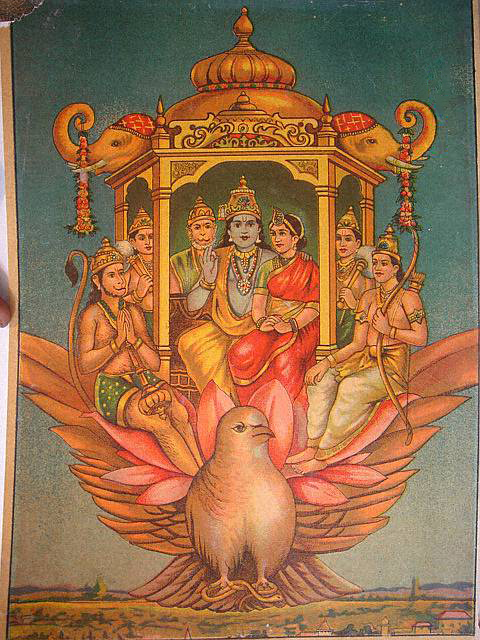
Mahabharata also feeds the imaginary through descriptions of celestial chariots, terrible weapons and cosmic war. The conspiratorial layer begins when such passages are translated directly into missiles, aircraft, nuclear weapons or extraterrestrial technology.
ancient India is essential because these texts belong to complex traditions of language, ritual, philosophy and poetry. Removed from that ground, vimana becomes an isolated proof in a global theory of ancient engineering.
The concrete modern case is the Vaimānika Śāstra, attributed to Bharadvaja and, according to accounts, transmitted by Subbaraya Shastry in the early twentieth century. It describes flying machines, materials, engines, mirrors and maneuvers. For ancient-technology believers, it is the bridge between myth and engineering.
But a 1974 technical study by researchers at the Indian Institute of Science concluded that the aircraft described in the Vaimānika Śāstra were not aerodynamically viable and showed poor knowledge of flight. This does not remove the text's cultural interest; it only prevents it from being treated as proven Vedic aeronautics.
The image beside this text, called Shakuna, comes from the modern Vaimānika Śāstra tradition. It shows the shift from celestial chariot to technical-looking machine.
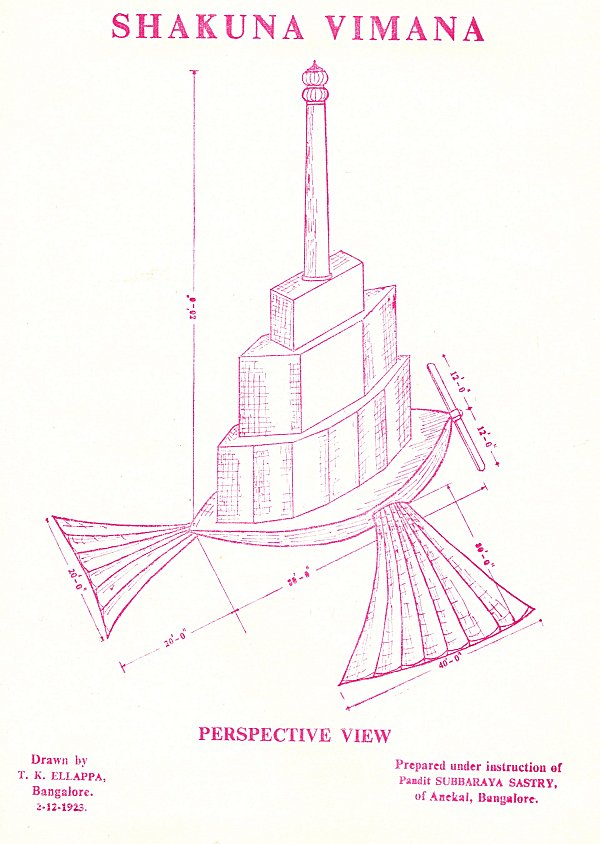
ancient aliens use vimanas as a central argument: gods, sky chariots and luminous weapons become records of contact with advanced beings. hidden history turns this into an accusation that real ancient knowledge was erased.
ancient civilizations place vimanas beside pyramids, megaliths, old maps and civilizing gods. The Ancient Builder Race and its Ancient Builder Race technology reinterpret them as vehicles from a pre-human or non-human civilization.
ancient artificial intelligence adds modern imagination: autonomous machines, non-human pilots and navigation systems. UFO / UAP connects ancient sky vehicles with modern sightings. stargates treats vimanas as passage machines between worlds or dimensions.
free energy and zero-point energy appear when people ask how such machines supposedly worked: mercury, vortexes, sound, plasma, antigravity or vacuum energy. directed-energy weapons enters through readings of epic weapons as ancient directed-energy devices.
pyramids and Sumerian tablets broaden the comparison, placing vimanas within a large internet mythology of hidden global technology.
Simple summary
Vimanas are vehicles, palaces or elevated structures in Indian traditions, especially associated with the Ramayana, Mahabharata and temple architecture. The Pushpaka Vimana is the most famous example. In the twentieth century, the Vaimānika Śāstra turned the theme into alleged ancient aircraft engineering, but a 1974 Indian Institute of Science study found its models aerodynamically unviable.
References and starting points
- Valmiki Ramayanam - textual reference to the Pushpaka Vimana
- IISc - A Critical Study of the Work Vaimanika Shastra
- Rare Book Society of India - Vymanika Shastra and modern edition
- Wikimedia Commons - Pushpaka Vimana representation
- Wikimedia Commons - Shakuna illustration from the Vaimānika Śāstra
Why it belongs on AwakenMap
It belongs because vimanas show how sacred texts, mythology, architecture, modern esotericism and ancient-technology theories can merge into one narrative of lost civilization.
Keep exploring
You can open another path
 Ancient civilizations Ancient Aliens 5/5 intensity Explore →
  Esoteric practices Ancient India 5/5 intensity Explore →
  Map center Great Awakening 5/5 intensity Explore →
  Esoteric practices Hidden History 5/5 intensity Explore →
  Ancient civilizations Ancient Builder Race 4/5 intensity Explore →
  Ancient civilizations Ancient Builder Race Technology 4/5 intensity Explore →
Join the conversation
Comments are moderated. Keep the discussion respectful and distinguish evidence, interpretation and personal experience.