Connection level
7 direct connectionsAncient Ruins are archives in stone: Pompeii, Petra, Angkor, Machu Picchu and countless broken cities preserving engineering, collapse, memory and human mystery.
What a ruin still says
An ancient ruin is not only what was left behind. It is what resisted. When a broken wall, a roofless stairway or a city taken by vegetation reaches us, it carries a double message: something was great enough to be built and fragile enough to disappear.
That tension makes ruins irresistible. They show technique, power, religion, trade, war, routine and death without giving everything in words. The visitor approaches stones and suddenly meets questions: who lived here, who ordered this built, who carried the blocks, who was forgotten, why did the city fall?
In AwakenMap, Ancient Ruins is a World theme because it speaks of concrete places. But it is also a Knowledge and Cosmic portal: each ruin is a meeting between archaeology, collective memory, sacred landscape, civilizational collapse and the modern desire to recover origins.
Pompeii: life frozen by disaster
Pompeii and Herculaneum are powerful examples because they preserve not only monuments, but gestures. The eruption of Vesuvius in 79 CE destroyed cities, yet also preserved streets, houses, paintings, ovens, inscriptions, bodies, objects and marks of an urban life brutally interrupted.
UNESCO recognizes Pompeii, Herculaneum and Torre Annunziata as archaeological areas of exceptional value precisely because they reveal Roman society with rare intimacy. There, disaster became archive. What was an ending for the living became a window for history.
Pompeii teaches that a ruin is not always the result of slow decadence. Sometimes a city disappears not because it failed morally or politically, but because nature tears time apart in a few hours. This forces the reader to treat ruins carefully: each one has its own biography.
Petra: stone, water and trade
Petra in Jordan shows another kind of ruin: a city carved into landscape. Famous for facades cut into sandstone and for water-control systems, Petra was a Nabataean capital and strategic point on trade routes. Its beauty is inseparable from its engineering.
Popular fascination usually fixes on the Treasury, the monumental facade seen in photographs and films. But reducing Petra to a carved doorway is unfair. The city involves tombs, temples, channels, cisterns, canyons, trade and intelligent adaptation to desert.
In AwakenMap, Petra shows that ancient ruins are not only remains of stone. They are technologies of survival. Where the tourist gaze sees romantic mystery, archaeology also sees hydraulics, economy, route, resource control and deep relationship with territory.
Angkor: city, temple and forest
Angkor in Cambodia is one of the largest archaeological landscapes in the world. UNESCO describes Angkor Archaeological Park as extending over about 400 km2, with remains of the capitals of the Khmer Empire from the ninth to the fifteenth century, including Angkor Wat and the Bayon.
Angkor's impact comes from scale. It is not only isolated temples; it is an urban, religious and hydraulic landscape. Reservoirs, canals, roads, temples, sculptures and forests form a historical organism revealing how power, water and worldview could be organized at enormous dimensions.
Angkor also warns about the modern problem of conservation. A famous ruin attracts tourism, money and national pride, but also erosion, urban pressure and the risk of turning living heritage into scenery. Preserving a ruin always means negotiating access and protection.
Machu Picchu: architecture and mountain
Machu Picchu is a ruin that cannot be separated from the mountain. UNESCO describes it as an extraordinary urban creation of the Inca Empire, 2,430 meters above sea level, in a tropical mountain forest environment. Walls, terraces and ramps seem to grow from the rock itself.
That integration is the key. Machu Picchu impresses not only through fitted stones or dramatic views. It shows a sophisticated relationship between engineering, topography, agriculture, ritual, water control and sacred landscape. The city does not dominate the mountain from outside; it negotiates with it.
For that reason, simplistic theories about impossible builders weaken the theme. The real astonishment lies in the Inca ability to unite technique and territory. When we attribute everything to an outside force without evidence, we steal real intelligence from human builders.
Ruin does not mean vanished people
A common mistake is imagining every ruin belongs to a people that mysteriously disappeared. Many ruins were abandoned, transformed, looted, rebuilt, reoccupied or reinterpreted by later communities. The city may end, while descendants, languages, memories and practices continue.
This distinction is politically important. Speaking of a 'lost civilization' can erase living peoples. Machu Picchu is not a ruin of aliens or of a humanity without heirs; it belongs to Andean and Inca history. Angkor belongs to Cambodian memory. Petra is tied to complex regional histories.
AwakenMap can explore mystery without repeating erasure. The right question is not always 'where did everyone vanish?'. Often it is: how did the urban form change, who inherited the memory, which colonial narratives hid continuities and which parts of history were silenced?
The danger of easy explanation
Ancient ruins attract easy explanations because they look larger than our expectations. Giant blocks become antigravity; alignments become impossible technology; architectural precision becomes proof of external visitors; absence of writing becomes cover-up.
Critical reading does not need to kill wonder. On the contrary: it makes wonder more adult. It is far more interesting to ask how human societies organized labor, food, authority, ritual and technical knowledge than to use a single fantastic answer for every place.
Each ruin deserves its method. Pompeii asks for volcanology and Roman life. Petra asks for trade and hydraulics. Angkor asks for urbanism and water. Machu Picchu asks for the Andes, the Inca and topography. One explanation for all of them is usually a sign of intellectual laziness.
Ruins as machines of memory
A ruin organizes time. It allows the present to walk inside an absence. For this reason ruins are so powerful for spirituality, art and imagination: they show that the human world is temporary, but that certain gestures leave marks long after the voice disappears.
The ruin also changes with each era. An abandoned temple may become a quarry, then tourist attraction, then world heritage, then national symbol, then sacred site again. The same set of stones receives different lives.
This layer is essential for AwakenMap. Ruins are not only past. They are present disputes over what should be remembered, sold, protected, restored, hidden or returned.
Underwater archaeology, satellites and new discoveries
The twenty-first century changed how ruins are found. Satellite imagery, LiDAR, ground-penetrating radar, 3D modeling, underwater archaeology and environmental analyses reveal structures invisible to the naked eye. Forests, deserts and seas are returning information that seemed lost.
This matters because it shows there is still much to discover without abandoning science. New technologies can reveal cities under vegetation, submerged ports, ancient roads, agricultural terraces, buried walls and hydraulic networks. Real mystery remains open.
At the same time, discovery does not grant permission for total fantasy. An image anomaly is not automatically a lost temple. A submerged wall is not automatically Atlantis. Discovery needs excavation, context, dating and review.
Excavation also destroys
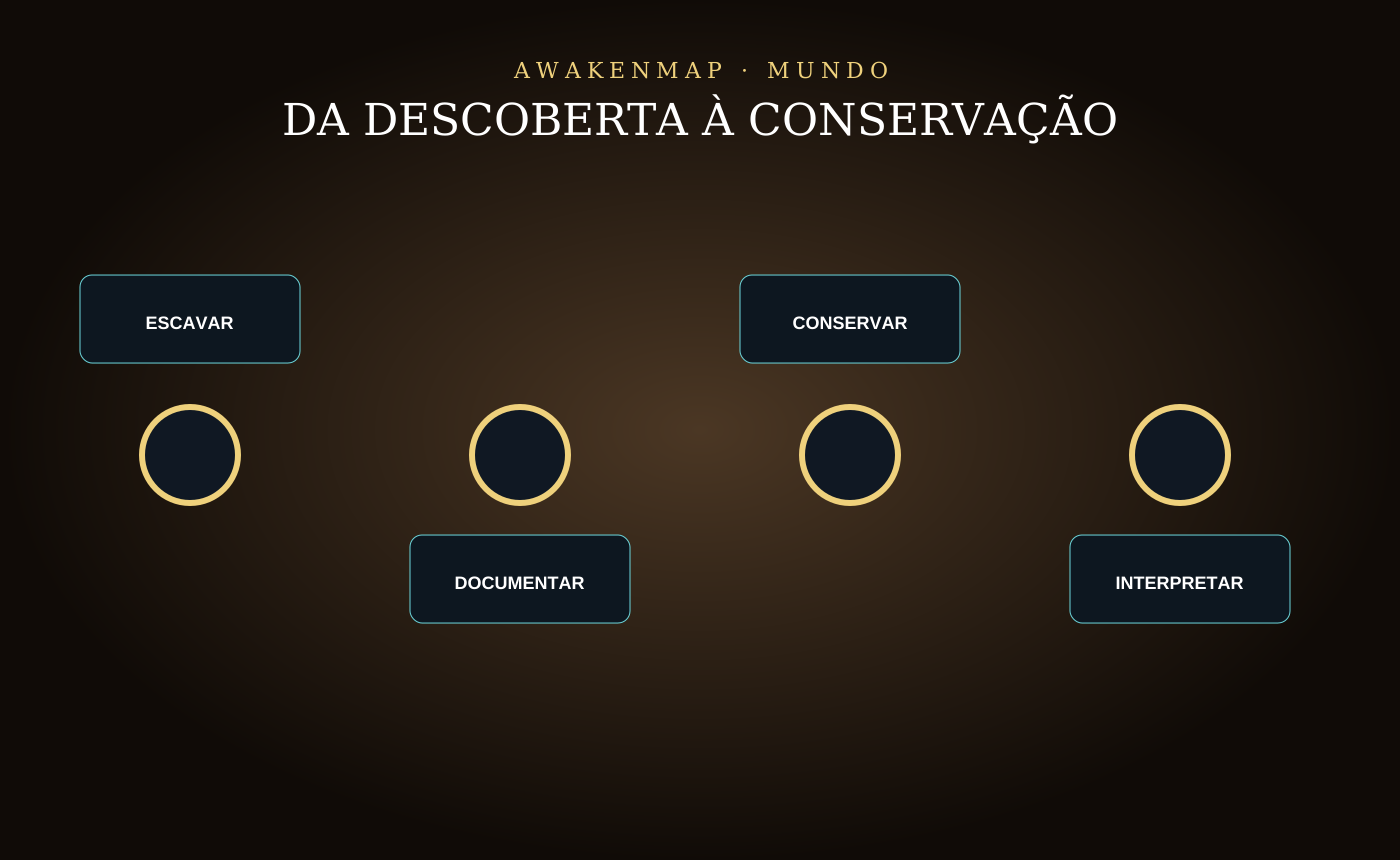
Archaeology is technically destructive: once a layer is removed, it cannot be restored exactly. Position, association, sediment and sequence must therefore be recorded before an object is lifted.
An excavated ruin faces sunlight, rain, vegetation, tourism and pollution. Structures preserved for centuries underground may deteriorate rapidly after exposure. Discovery without conservation turns knowledge into loss.
Reconstruction and authenticity
Many ruins seen by visitors contain repositioned pieces, modern reinforcement and partial reconstruction. Anastylosis uses original elements to reassemble structures where their position can be established. Other interventions complete volumes for understanding or stability.
No solution is neutral. Too much reconstruction creates modern fantasy; too little may leave a site incomprehensible and vulnerable. Honest presentation clearly identifies ancient material, restoration and hypothesis.
Tourism, heritage and living communities
Famous ruins generate income, national identity and tourist pressure. Visitors wear paths, change humidity and require infrastructure. At the same time, excluding local communities in the name of preservation can repeat colonial practice.
Heritage belongs neither only to specialists nor to a global market. Peoples living around sites hold memory, labour and spiritual relationships. Conservation must balance access, research, economy and cultural rights.
Climate and the future of ruins
Sea-level rise, storms, fire, desertification and extreme rainfall threaten archaeological sites. Climate change does not only damage ecosystems; it erases material archives of human history.
Digital mapping, photogrammetry and three-dimensional models help record structures, but a digital copy does not replace place, material and context. It is emergency memory, not an equivalent monument.
Ancient Ruins in AwakenMap
In AwakenMap, Ancient Ruins connects to Megalithic Sites, Machu Picchu, Gobekli Tepe, Ancient Egypt, Giza Complex, Sphinx, Pyramids, Atlantis/Lemuria/Mu, Ley Lines and Ancient Civilizations. It is a structural node because almost every historical mystery passes through a stone left behind.
As World, the theme speaks of place, matter, erosion, excavation, tourism and conservation. As Knowledge, it speaks of archaeology, chronology, power, collapse, urbanism and memory. As Cosmic, it speaks of civilizational cycles, soul marks, sacred landscapes and symbolic return to the past.
A premium page about ruins should hold the reader because each example opens a different question. The ruin is not an ending. It is an invitation to reconstruct, carefully, what time broke.
How to read this theme
Start with the specific place. Ask where it is, who built it, when, with which materials, in what environment and why it was abandoned or transformed. Then look for what archaeological research says and where hypotheses begin.
When an extraordinary narrative appears, see whether it respects the site. Does it cite excavations? Does it recognize local peoples? Does it distinguish dating from speculation? Or does it use the ruin only as a stage for a ready-made story?
Ancient ruins ask for balance: enough imagination to feel the presence of the past and enough discernment not to replace real peoples with convenient fantasies.
Critical reading
Ancient Ruins should be read as real places, with real peoples, real techniques and symbolic layers. The mystery grows when each site receives its context, not when all are compressed into one fantastic answer.
References and starting points
- UNESCO - Archaeological Areas of Pompei, Herculaneum and Torre Annunziata
- UNESCO - Angkor
- UNESCO - Historic Sanctuary of Machu Picchu
- World Heritage Sites - Petra
- UNESCO - New Discoveries Shed Light on Pompeii
- UNESCO - Angkor: Managing Success
FAQ
Do ancient ruins prove advanced lost civilizations?
They show that ancient societies were sophisticated, creative and organized. Some alternative hypotheses can be investigated, but extraordinary claims require proportional evidence.
Why are ruins in the World filter?
Because they are physical places: stone, soil, landscape, erosion, tourism and conservation. At the same time, they connect historical knowledge and symbolic reading.
Keep exploring
You can open another path
 Ancient civilizations H Blocks 5/5 intensity Explore →
  Ancient civilizations Ancient Builder Race 5/5 intensity Explore →
  Ancient civilizations Asteroid Belt 4/5 intensity Explore →
  Esoteric practices Runs of the Ancient Builder Race Civilization Lay Scattered Across the Solar System 4/5 intensity Explore →
  Esoteric practices Hidden History 4/5 intensity Explore →
  Esoteric practices Mars 4/5 intensity Explore →
Join the conversation
Comments are moderated. Keep the discussion respectful and distinguish evidence, interpretation and personal experience.