Connection level
14 direct connectionsNazca Lines are giant geoglyphs traced into the desert of southern Peru, between Nasca and Palpa. The theme belongs to the question of when a human work begins to look like a message to the sky.
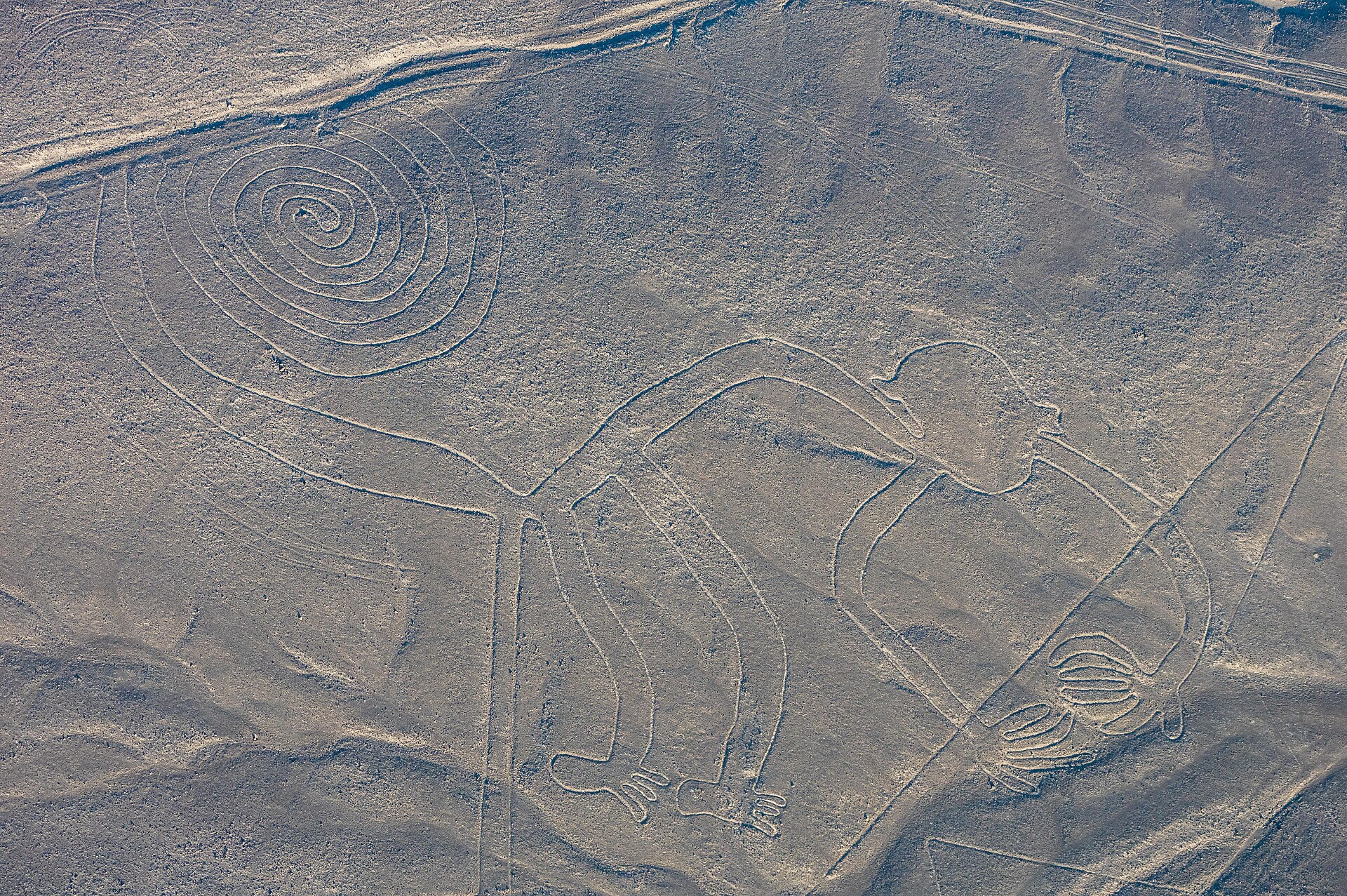
The lines did not begin as a modern curiosity. They belong to a much larger set of ground markings made by pre-Columbian cultures on Peru's arid coast. The technique is direct: remove dark oxidized stones from the surface and expose the lighter soil underneath. The difficulty is not only scratching the ground; it is producing long lines, coherent figures and forms crossing the desert for hundreds of meters, often seen more clearly from above.
UNESCO describes the Nasca and Palpa complex as one of archaeology's great enigmas because of its quantity, size, continuity and variety. There are straight lines, trapezoids, spirals, stylized humans, plants, birds, spiders, monkeys, fish and imaginary forms. The generally accepted dating places many works between about 500 BCE and 500 CE, with phases connected to Paracas and Nasca traditions.
The meaning is still debated. Some hypotheses speak of rituals tied to water, mountains, fertility and pilgrimage. In an extremely dry region, drawing paths, animals and figures on the ground may have belonged to ceremonies asking for rain, ordering ritual movement or connecting communities with landscape deities.
Other readings involve astronomy, agricultural calendars, alignments, processional routes and relationships with ceremonial centers such as Cahuachi. The important point is that archaeological explanation does not need to reduce Nazca to “decorative art.” It can be religion, territory, path, memory and social technology at the same time.

The conspiratorial layer begins when the scale of the figures is separated from cultural context. If some forms are better seen from above, then someone concludes they were made for aircraft, flying gods or visitors from outside Earth. This reading gained force in the twentieth century through authors of ancient aliens and the idea that Nazca was a runway, star map, signal to craft or a work impossible for ancient peoples without outside help.
The problem with that conclusion is that it usually skips steps. Ancient people did not need to fly to draw at large scale: they could use stakes, cords, units of measure, repetition, planning and observation from hills. The interesting question is not “how did they do it without modern technology?” but why they invested so much energy in an art that reorganizes the whole landscape.
This is where Nazca becomes powerful for AwakenMap. The lines produce a real sensation: something there feels larger than ordinary utility. The desert becomes an inscription surface. The figure does not fit inside the body of the person drawing it. The modern observer, looking from plane or satellite, feels they have found a message made for an impossible point of view. That sensation feeds connections with the Earth grid, ley lines, sacred geometry, the Ancient Builder Race and hidden history.
The delicate point is not confusing mystery with incapacity. There is mystery because we do not know the precise meaning of every figure, ritual and alignment. But this does not authorize treating Nasca culture as unable to plan, measure, walk, repeat patterns and produce monumental images. The conspiratorial reading often reveals more about modern astonishment than about the original makers.
On the map, the Nazca Lines connect to ancient aliens, pyramids, the Ancient Builder Race, the Earth grid, ley lines, sacred geometry, hidden history, UFO / UAP and the Sumerian creation story.
These connections show why the theme crosses archaeology, sacred geometry, ancient ufology and hidden history. Nazca does not prove extraterrestrial visitors, but it explains why certain ancient works become magnets of interpretation: they are real, beautiful, hard to summarize and open to the aerial gaze.
A concrete case
In 2024, researchers published in PNAS an artificial-intelligence-accelerated survey that identified 303 new figurative geoglyphs in the Nazca region. The number nearly doubled the known set of that figure type. The key point is that many were smaller and harder to perceive, exactly the kind of marking that can escape human eyes in an immense landscape.
This case changes the energy of the theme. Nazca is not only a mystery frozen in old books; it is an archaeological field still expanding. The same technology that feeds satellite and surveillance fantasies also helps find human figures, animals and forgotten forms. The result does not automatically point to aliens. On the contrary: it shows a richer, more populated and more human cultural landscape than conspiratorial imagination often allows.
For AwakenMap, this is the right closing: the higher we look, the more we see. The question is what we do with that view. We can use height to erase the peoples who made the lines, or to perceive the scale of the human gesture when ritual, territory and sky enter the same composition.
Why it belongs on AwakenMap
The Nazca Lines belong on AwakenMap because they are a perfect point between archaeological evidence and cosmic imagination. They exist, with materiality, location, technique and history. At the same time, they seem to invite a question beyond archaeology: for whom do you draw an image that fully reveals itself only from above?
The philosophical connection is in the gaze. The same trace can be ritual path, water mark, calendar, art, prayer, map or signal to gods. Awakening here is not choosing the most fantastic answer; it is learning to see without diminishing the ancients and without turning every gap into proof of outside intervention.
Simple summary
The Nazca Lines are pre-Columbian geoglyphs in the desert of southern Peru, made by removing dark stones to expose lighter soil. They include lines, geometric figures and images of animals, plants and stylized beings. Archaeology debates functions tied to water, ritual, pilgrimage, calendar and sacred landscape. The conspiratorial layer appears when scale and aerial visibility are read as runway, message to craft or work of ancient aliens. The critical point is preserving mystery without erasing the human capacity of the cultures that produced them.
References and starting points
- UNESCO - Lines and Geoglyphs of Nasca and Palpa
- PNAS - AI survey that identified 303 new geoglyphs
- PubMed - abstract of the AI and Nazca geoglyphs study
- National Geographic - Nasca Lines and hypotheses about water and ritual
- Wikimedia Commons - Nazca monkey geoglyph
- Wikimedia Commons - Nazca Lines category
Keep exploring
You can open another path
 Ancient civilizations Ancient Aliens 5/5 intensity Explore →
  Map center Great Awakening 5/5 intensity Explore →
  Earth and Antarctica Ley Lines 4/5 intensity Explore →
  Ancient civilizations Ancient Builder Race 4/5 intensity Explore →
 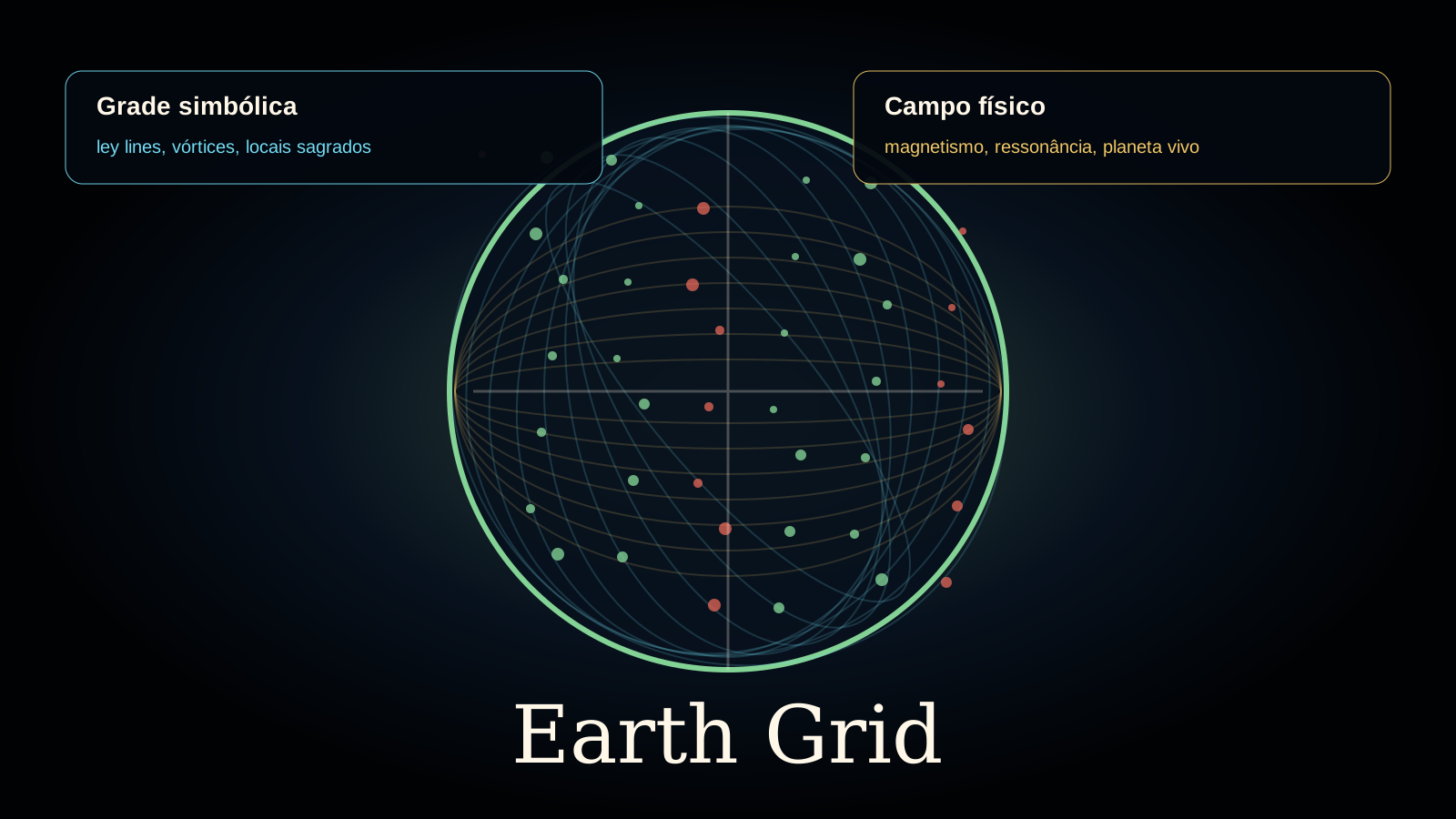 Earth and Antarctica Earth Grid 4/5 intensity Explore →
  Esoteric practices Hidden History 4/5 intensity Explore →
Join the conversation
Comments are moderated. Keep the discussion respectful and distinguish evidence, interpretation and personal experience.