Connection level
25 direct connectionsImagine the Saturn V rising in 1969: fire, smoke, vibration, millions of people watching a machine that looked too large to be real. To the public, it was science becoming spectacle. To the Cold War, it was power. To the AwakenMap imagination, NASA became a door: public space exploration on one side, questions about what stayed off camera on the other.
What NASA is
NASA is the civilian space agency of the United States. It was created in 1958, in the heat of the space race, to conduct flight research, space exploration, planetary science, satellites, human missions and aerospace technology.
On AwakenMap, NASA is central because it occupies a rare position: it is a public institution, with missions, photos, archives and open data; yet it is also surrounded by military silence, contracts, hard-to-interpret images and stories about backstage layers that never officially surfaced.
Where NASA came from
NASA was born after the shock of Sputnik, launched by the Soviet Union in 1957. On July 29, 1958, President Dwight Eisenhower signed the law creating the agency. On October 1, 1958, it began operations, absorbing the old NACA structure, which had studied aviation since 1915.
The founding law spoke of a civilian agency, but it clearly separated public space research from defense, weapons and military operations. That division is one root of the mystery: NASA appears as the open face of space while part of military space moves through other corridors.
Fact, public account and speculation
Fact: NASA exists, was created by law in 1958, led Apollo, sent missions to planets, telescopes, probes, rovers and space stations, and maintains a huge public archive of images and research.
Public account: Apollo 11 aimed to fulfill John F. Kennedy's goal: land humans on the Moon and return them safely to Earth. The mission launched on July 16, 1969 and returned on July 24, 1969.
Speculation: in Secret Space Program, UFO / UAP and hidden-technology narratives, NASA appears as a façade, filter or showcase. The idea is that part of what the agency shows is real, but incomplete: a public layer over a more restricted aerospace world.
The real image that explains the power of the symbol
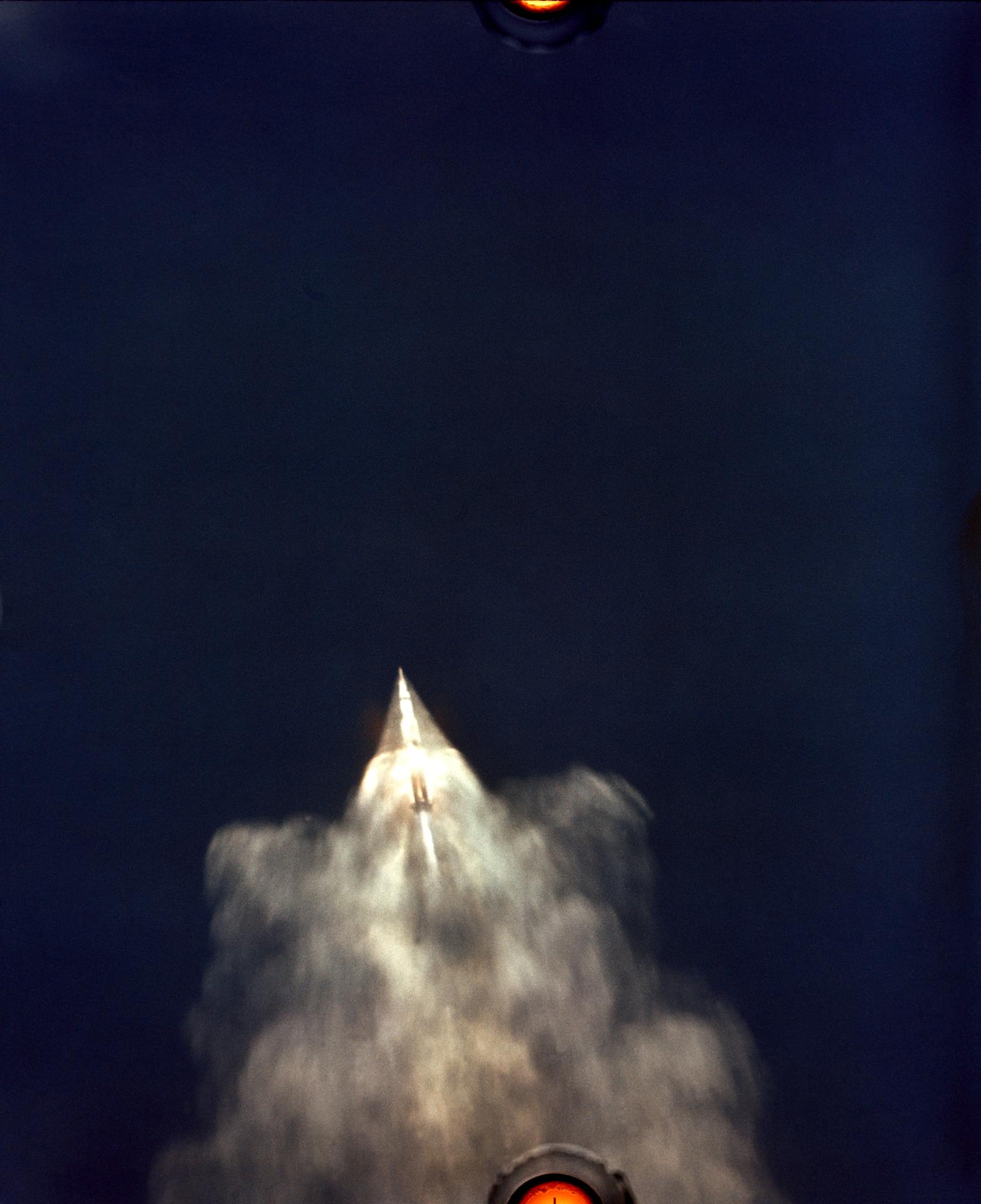
This photo shows the Apollo 11 launch. It is not a mystery: it is public, recorded, celebrated and studied history. That is exactly why it matters. NASA became a machine of images able to shape human imagination: rocket, Moon, astronaut, flag, black horizon.
When an institution can turn science into a global image, it also becomes a target for questions. The public looks at the photo and thinks: if this was shown, what else was seen? If this was open, what remained closed?
NASA, Paperclip and Wernher von Braun
To understand why NASA appears so often in secrecy stories, one has to pass through Project Paperclip and Wernher von Braun. Von Braun worked on the German V-2 program, was brought to the United States after the war and later played a central role in Saturn V.
This does not mean NASA is “Nazi,” nor that everything about the agency is hidden. It means something more uncomfortable and documented: part of the technology that took the U.S. to the Moon passed through difficult biographies and moral decisions. That historical bridge feeds themes such as Project Paperclip NASA 1958, Nazi Bell and TR-3B.
The public side: science, exploration and open archives
NASA is not only Apollo. It is tied to space telescopes, climate research, Mars exploration, interplanetary probes, solar studies, lunar missions, materials science, engineering, education and Earth observation.
This public side is enormous. There are image banks, reports, scientific data, broadcasts, missions followed in real time and decades of documentation. That is why a good text about NASA has to hold two things together: the real institution and the myth that grew around it.
NASA Coverups: why the theme stuck
NASA Coverups is the layer where the public suspects cuts, filters, edits, silence and omitted information. That suspicion is fueled by Moon images, old broadcasts, astronaut accounts, sightings, military contracts and the blurry edge between civilian space and defense space.
The interesting point is not telling the reader what to believe. It is showing why the suspicion exists. NASA is civilian, but it was born inside the Cold War, inherited teams and structures from an intense technology race and has always operated near military areas. That is enough for the imagination to ask: where does the showcase end and where does the closed room begin?
The Moon, the far side and secret bases
Within AwakenMap, NASA also connects to the Moon, the dark side of the Moon, Lunar Operations Command, Moon Operations Command and even narratives such as the Mars slave colony. These stories speak of off-world installations, omitted photos, ancient structures, lunar operations and a human presence older than official history admits.
There is no public proof that NASA has confirmed secret bases on the Moon or Mars. But these narratives are powerful because of a simple mix: the Moon is visible to everyone, but inaccessible to almost everyone. It is in the sky every night and still feels like forbidden territory.
What exists publicly
What exists publicly is robust: the founding law, institutional history, Apollo archives, missions, images, scientific data, technical documents, biographies and research records. NASA is one of the most documented scientific institutions on Earth.
What does not exist as public proof is the extreme layer: that NASA officially hides alien bases, lunar civilizations, a secret space fleet or open contact with nonhuman intelligences. That layer belongs to AwakenMap's speculative field and should be read as a modern myth around a real agency.
Simple summary
NASA is the United States civilian space agency, created in 1958 to lead public space exploration. It became a symbol of science, the Moon, astronauts and the future.
The topic grips because NASA is too real to ignore and too symbolic to escape mystery. Where there are rockets, cameras, the Cold War, archives and military silence nearby, human imagination always looks for a second door.
References and starting points
- NASA - NASA History
- NASA - 65 Years Ago: NASA Begins Operations
- NASA - National Aeronautics and Space Act of 1958
- Eisenhower Presidential Library - Early history and development of NASA
- NASA - Apollo 11 Mission
- NASA Images - Liftoff of the Apollo 11 lunar landing mission, S69-39957
- NASA - Wernher von Braun
- Smithsonian National Air and Space Museum - Project Paperclip
- AARO - Official UAP records
FAQ
Was NASA created in 1958?
Yes. The law was signed on July 29, 1958, and the agency began operations on October 1, 1958.
Is NASA military?
No. It is a civilian agency. But it was born inside the Cold War and has always existed near military and defense interests, which feeds many questions.
Does NASA prove the Secret Space Program?
No. NASA proves the public history of space exploration. The connection to secret space programs is an AwakenMap speculative layer.
Keep exploring
You can open another path
 Secret Space Program Kecksburg UFO Crash 5/5 intensity Explore →
  Secret Space Program Norman Bergrun 5/5 intensity Explore →
  Control systems Project Paperclip and NASA in 1958 5/5 intensity Explore →
  Secret Space Program Ringmakers of Saturn 5/5 intensity Explore →
  Esoteric practices S.O.H.O. 5/5 intensity Explore →
  Secret Space Program UFO / UAP 5/5 intensity Explore →
Join the conversation
Comments are moderated. Keep the discussion respectful and distinguish evidence, interpretation and personal experience.