Connection level
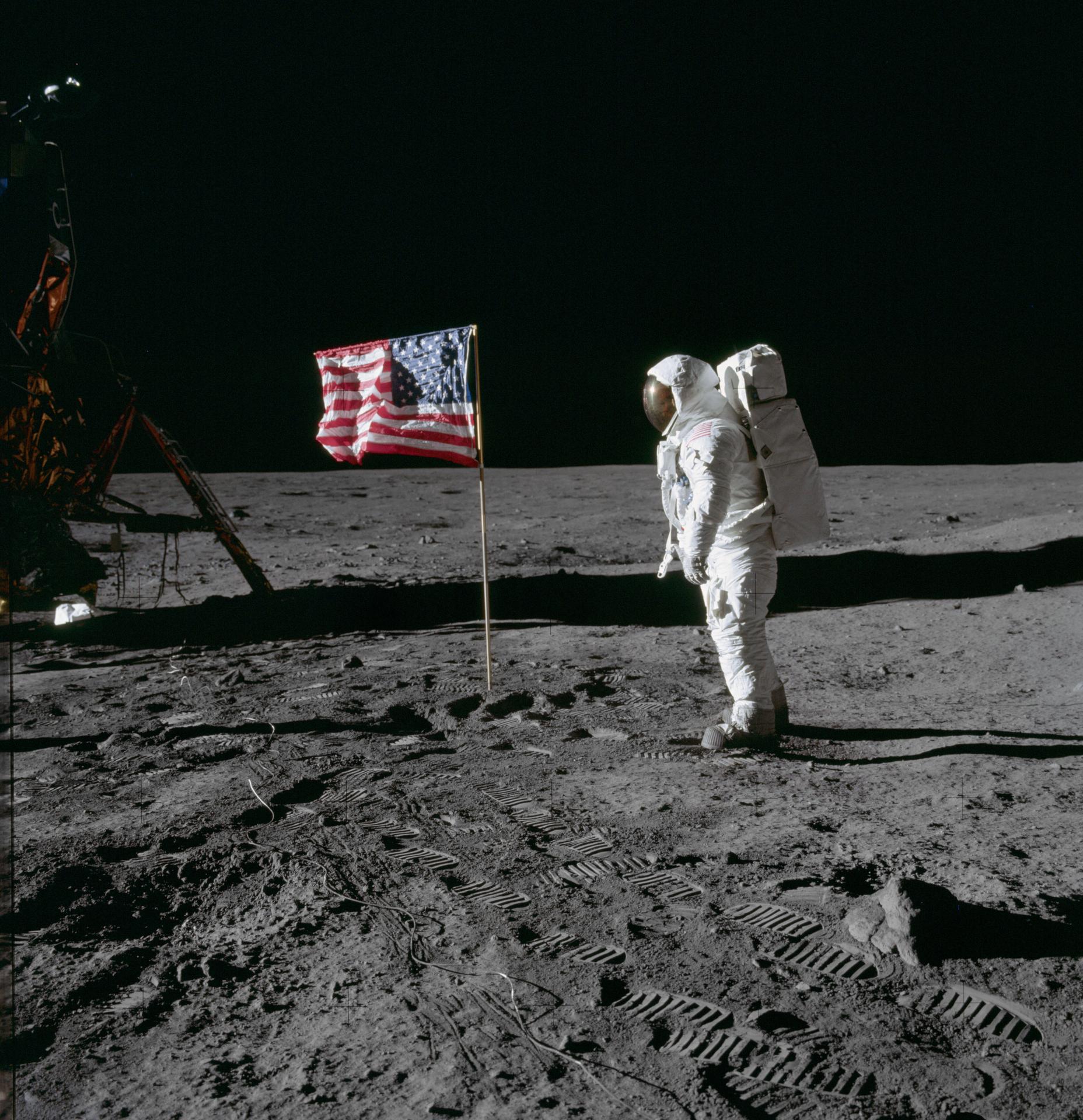
16 direct connectionsImagine a photo too perfect to rest: Buzz Aldrin beside the flag, absolute black sky, footprints on gray soil, reflections in the visor. To official history, it is an Apollo 11 record. To millions of people, it also became a question: if NASA controls the cameras, archives and narrative, what could it choose not to show?
What NASA Coverups means
NASA Coverups is the name given to suspicions about possible omissions by NASA: cropped photos, processed images, incomplete broadcasts, lost archives, poorly explained astronaut accounts and information that may have remained inside military or technical channels.
It is not one single theory. It is a collection of questions that grew around the world's most famous space agency. Some questions come from real archival facts. Others come from misread images. Others enter the speculative field of the Secret Space Program, UFO / UAP and off-world base narratives.
Where the suspicion came from
The suspicion grew because NASA became the source of some of the most powerful images of the twentieth century: Earth from space, astronauts on the Moon, the lunar horizon, Mars, nebulae and probes in distant worlds. When an institution controls images that symbolic, it also becomes a target for distrust.
The fuel came from many places: the Cold War, competition with the Soviet Union, the relationship between civilian space and defense, the Project Paperclip past with Wernher von Braun, Apollo 11 tapes that were not preserved the way the public imagined, and the modern culture of analyzing every pixel as a clue.
Fact, public doubt and speculation
Fact: NASA processes scientific images, publishes archives, restored old videos and acknowledges that some original Apollo 11 telemetry recordings were not preserved as accessible raw material.
Public doubt: many people look at shadows, reflections, crops, altered colors and low-quality old broadcasts and ask whether something is hidden. That doubt grew because space images often undergo technical processing to improve contrast, color, noise or scientific readability.
Speculation: in stronger versions, NASA Coverups speaks of structures on the Moon, nonhuman presence, bases on the dark side of the Moon, operations such as Lunar Operations Command and Moon Operations Command, and links to programs such as TR-3B and Mars slave colony.
The real image that became an icon and a question
This photo shows Buzz Aldrin beside the U.S. flag during Apollo 11. It is a real NASA image, taken by Neil Armstrong with a 70 mm Hasselblad camera. It does not prove a coverup. But it explains why the topic exists: every shadow, reflection and detail became material for public analysis.
The power of the photo lies in the contrast. For NASA, it is historical documentation. For the public imagination, it is almost a sacred scene of the space age — and sacred scenes always attract doubts, rereadings and suspicions.
The Apollo 11 tapes case
One point that strongly feeds the theme is the case of the original Apollo 11 telemetry tapes. It is not as simple as “NASA lost the Moon.” It involves old formats, slow-scan transmission, conversion for ordinary television and technical records that decades later were no longer available as expected.
NASA's final report on the telemetry recordings explains the search and restoration effort. For those already suspicious, the case sounded like an admission of coverup. For engineers and historians, it looks more like archival neglect, obsolete technology and the priorities of the time. Editorially, the key point is this: a real archival failure opened space for a much larger suspicion.
Processed images are not automatically fake
A key part of the topic is understanding that space images almost always need processing. Scientific cameras capture data in formats different from human vision. Many images require color adjustment, composition, contrast, noise reduction or filter combination.
That does not mean fraud. It means visual translation. The problem is that, to the public, “processed image” can sound like “manipulated image.” NASA Coverups is born in that gap between technical language and public trust.
Astronaut accounts and strange objects
Another fuel source is audio, interviews and accounts in which astronauts mention lights, objects, reflections or phenomena that were hard to identify during missions. Often, those cases receive technical explanations: panels, rocket stages, ice, reflections, debris or observation limits.
Even so, the force of the account remains. When the person who saw something was in space, imagination gives it different weight. That is why NASA Coverups naturally connects to AARO, UFO / UAP and questions about what was recorded but never became a headline.
NASA Coverups on AwakenMap
On the map, this topic works as a bridge between documented history and modern myth. It connects with NASA, Project Paperclip NASA 1958, the Moon, the dark side of the Moon, Lunar Operations Command, the Secret Space Program and TR-3B.
The best way to read this node is not as a closed accusation. It is a cultural investigation: why do so many people believe NASA knows more than it says? The answer passes through powerful images, incomplete archives, technical language, the Cold War and a sky that always seems to hold back more than it gives.
What exists publicly
A lot exists publicly: Apollo photos, image libraries, restored videos, technical reports, pages about image processing, mission records and scientific archives. NASA is not an empty box; it publishes material at enormous scale.
What does not exist as public proof is the extreme layer: that the agency has confirmed alien life, secret bases on the Moon, hidden ancient civilizations or a concealed space fleet. That remains in AwakenMap's speculative field.
Simple summary
NASA Coverups is the suspicion that NASA may have hidden, cut or filtered important information about the Moon, space images, UAPs and secret programs.
The topic grips because it mixes real archival facts with a very human question: when someone controls the camera pointed at the unknown, how do we know we are seeing everything?
References and starting points
- NASA - Apollo 11 Mission
- NASA Science - Buzz Aldrin beside the U.S. flag, AS11-40-5875
- NASA - Apollo 11 Image Library
- NASA - The Apollo 11 Telemetry Data Recordings: A Final Report
- NASA+ - Restored Apollo 11 Moonwalk
- NASA Science - What Are Raw Images?
- NASA SVS - LRO Apollo site images
- NASA - Wernher von Braun
- AARO - Official UAP records
FAQ
Did NASA lose Apollo 11 archives?
Yes, some original telemetry recordings from the lunar broadcast were not preserved as expected. That does not prove fraud, but it fueled public suspicion.
Does a processed space image mean a fake image?
No. Many scientific images need processing to become readable. The problem is that this process is often misunderstood by the public.
Does NASA Coverups prove secret bases on the Moon?
No. That link belongs to AwakenMap's speculative layer. What exists publicly are photos, archives, reports and debates about interpretation.
Keep exploring
You can open another path
 Secret Space Program Kecksburg UFO Crash 5/5 intensity Explore →
  Control systems Project Paperclip and NASA in 1958 5/5 intensity Explore →
  Map center Disclosure 4/5 intensity Explore →
  Map center Full Disclosure 4/5 intensity Explore →
  Esoteric practices Moon 4/5 intensity Explore →
  Esoteric practices NASA 4/5 intensity Explore →
Join the conversation
Comments are moderated. Keep the discussion respectful and distinguish evidence, interpretation and personal experience.