
Connection level
26 direct connectionsProject Paperclip and NASA in 1958 belongs on AwakenMap through the question of when technical progress requires forgetting who built it. The theme is delicate because it mixes real history, uncomfortable moral memory and heavy speculation. The fact: after World War II, the United States brought German scientists, engineers and technicians to work in military and technological programs. Another fact: NASA was created in 1958, during the space race. Extrapolation begins when that real bridge becomes automatic proof of extraterrestrial technology, Nazi antigravity, secret lunar bases or a hidden space program since the postwar period.
The first care is chronological. Project Paperclip was not born in 1958. It began after the war, when the United States sought to use German technical knowledge before the Soviet Union did. The name became associated with the transfer of specialists connected to rockets, medicine, aeronautics, chemistry, intelligence and other fields. The year 1958 matters for another reason: it is when the National Aeronautics and Space Act created NASA as a civilian agency in response to the Sputnik shock and the need to coordinate the space race.
The image beside this text shows Wernher von Braun in front of Saturn V engines. It summarizes the dilemma of the theme: the man who helped create the V-2 rocket for Nazi Germany became one of the central figures of the American lunar program.
The photo does not prove any secret technology. It proves something historically more uncomfortable: democratic states accepted morally contaminated technical inheritances when strategic competition seemed to justify the cost.
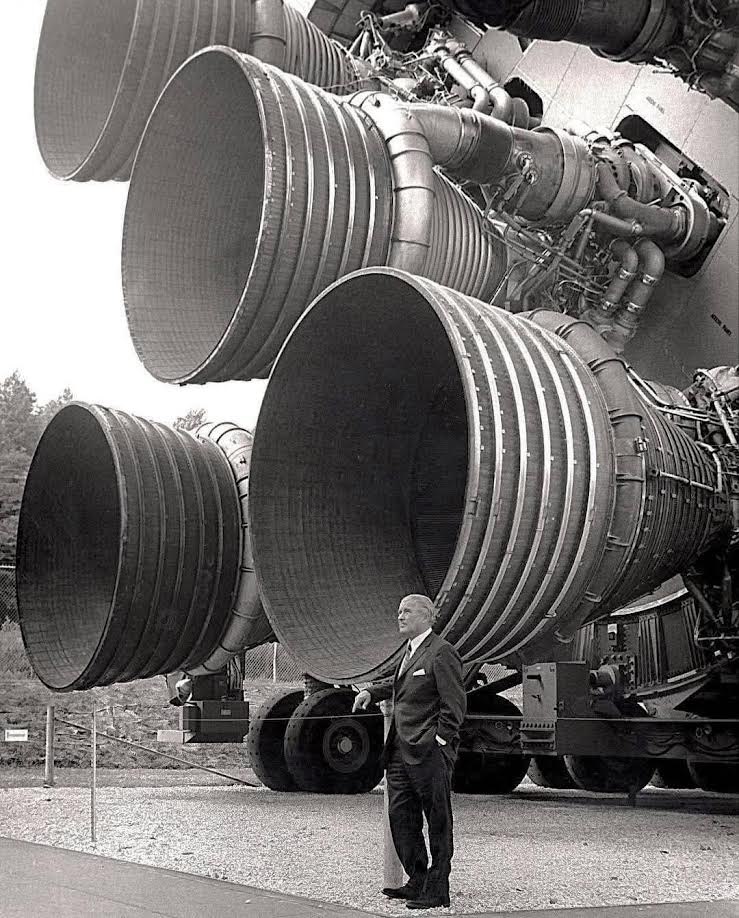
The concrete case is von Braun. He was an important figure in the development of the V-2, a missile used by Nazi Germany, and was later brought to the United States in the context of Paperclip. NASA records his arrival in the U.S. as part of that program and his later importance for the Saturn V rocket and the Apollo program. Official history, therefore, does not fully hide the bridge; what remains disputed is how that bridge should be morally judged.
The V-2 was advanced technology, but it was not magic. It was rocket engineering, produced in a brutal context that included forced labor, extreme militarization and total war. Saturn V, decades later, represented another technical level. Continuity exists in people, knowledge, institutions and ambition. Discontinuity also exists: new materials, new teams, new funding, new goals and a huge American infrastructure.
NASA's creation in 1958 does not mean the agency was born as a direct secret continuation of the Third Reich. It officially emerged as America's civilian response to the space race, inheriting structures from the former National Advisory Committee for Aeronautics and later incorporating rocket groups linked to the Army. The critical point is subtler: a civilian space-exploration agency was built in a world where science, war and national propaganda were already deeply mixed.
The relationship with aerospace corporations is direct. The American postwar period strengthened companies, laboratories, bases, military contracts and missile programs. The space race was not only poetry about the stars; it was also defense, prestige, surveillance, launch systems and ideological competition. This industrial ground makes the theme fertile for suspicion: where real secrecy, real contracts and real military technology exist, the imagination of hidden programs finds soil.
The CIA enters because the postwar period was also an era of intelligence, recruitment, captured files and global competition. The U.S. government did not only rescue knowledge; it filtered biographies, evaluated risks and decided who would be useful. The ethical question is harsh: how far can a power clean or relativize compromised pasts in the name of strategic advantage?
The comparison with MKULTRA helps explain the institutional climate. Paperclip and MKULTRA were not the same program. The point is that both feed the same historical distrust: democratic governments carried out secret, morally troubling actions during the Cold War. When the public discovers one real part of secrecy, it becomes more willing to imagine larger layers.
Operation Highjump appears because alternative theories link the postwar period, Antarctica, remaining German technology and escaped Nazi elites. Historically, Operation Highjump was a U.S. Navy mission to Antarctica in 1946-1947. The conspiratorial layer turns it into a search for hidden German bases, flying discs and antigravity technology. This transition is typical of AwakenMap: a real military event becomes a portal into a hidden-world narrative.
The Nazi Bell and Nazi Bell and antigravity represent the point where history enters technological mythology. Nazi Germany researched advanced weapons, rockets, aircraft and experimental systems. That is real. But theories about the Nazi Bell claim antigravity, exotic energy or temporal manipulation far beyond the public record. Paperclip then becomes the question: if the U.S. brought German engineers, did it also bring secrets of that kind?
The Nazi breakaway groups and the breakaway group expand the narrative. In stronger versions, German breakaway groups survived, migrated, preserved advanced technologies and formed structures separate from official civilization. From there, Paperclip stops being a transfer of scientists and becomes the facade of an occult continuity. The risk is replacing historical investigation with a totalizing script: every gap becomes proof of escape; every silence becomes an underground base.
The connection with the Secret Space Program is inevitable. Many versions of the Secret Space Program claim that public space technology is only the visible layer, while a parallel line advanced with antigravity, unconventional craft and off-world bases. Paperclip enters as the perfect origin for this myth: German knowledge, military secrecy, the space race, NASA, Moon, Mars and industrial complexes.
The Secret Space Program Alliance and Solar Warden and U.S. Navy space fleet appear when the narrative moves from technology to cosmic geopolitics. The postwar period becomes, in this reading, the beginning of hidden alliances, space fleets and pacts among human and non-human factions. There is no robust public evidence proving that structure. Still, the real history of military secrecy gives an appearance of plausibility to those who already believe the official surface is never the whole story.
NASA cover-ups are the cultural glue. If NASA was born in the Cold War context and had figures linked to Paperclip, then any lunar photo, Martian anomaly, cut transmission or institutional silence can be reinterpreted as cover-up. This mechanism is dangerous because it mixes legitimate criticism of institutions with paranoid readings of any ambiguity.
The link with disclosure and full disclosure comes from the expectation of total archive opening. In this imaginary, true disclosure would not show only UFOs; it would show how science, war, Nazism, industry, NASA and secret programs were stitched together after 1945. The critical question is which documents support each claim and where extrapolation begins.
The relationship with UFO / UAP and TR3B arises from the same desire for technological continuity. If public rockets were the slow path, perhaps there was another fast path: discs, triangles, reactionless propulsion, free energy and antigravity. The problem is that the existence of secret military research does not automatically prove every legendary aircraft. Real secrecy is not a blank check for any narrative.
The Moon, Mars, Mars colony and Mars slave colony show how much the story grows once it enters the Secret Space Program ecosystem. The sequence becomes almost inevitable: Paperclip brought the technology, NASA showed the public version, unacknowledged programs did the secret part, and off-world colonies were the result. It is a powerful narrative because it turns the space race into theatrical facade.
The unacknowledged special access projects are important because real categories of secrecy and compartmentalization exist in the American state. Classified and special projects exist. That does not prove bases on Mars, but it explains why the public finds it plausible that something could remain outside public view for decades. The healthy boundary is asking: are we looking at documented secrecy or at a claim protected by unverifiability?
advanced technology and high frequency closes the symbolic layer. Paperclip becomes a myth of inherited technology: frequency, energy, propulsion, medicine, consciousness and engineering from a dark past. The seduction lies in imagining the modern world was built on a vault of confiscated secrets. The true part is that knowledge and people were appropriated. The undemonstrated part is that this vault contained forbidden physics capable of explaining every mystery.
A mature reading separates three levels. First, documented history: Paperclip, von Braun, rockets, the Cold War, NASA's creation in 1958 and the later incorporation of rocket teams into the space program. Second, moral dilemma: the use of specialists with Nazi pasts in the name of strategic advantage. Third, conspiratorial layer: antigravity, secret bases, hidden Nazi continuity, NASA as facade and a parallel space program.
Project Paperclip and NASA in 1958 matter because the historical truth is already disturbing before fantasy. It is not necessary to invent everything to perceive the shadow: the space race had science, courage and imagination, but also war, propaganda, morally ambiguous recruitment and selective memory. One error would be denying the shadow. The other would be turning the shadow into permission for any myth.
Simple summary
Project Paperclip was the postwar program that brought German specialists to the United States. NASA was created in 1958 by the National Aeronautics and Space Act, in the context of the space race. The connection between the two themes passes through people such as Wernher von Braun, rockets, the Cold War and military institutions. On AwakenMap, the theme connects Project Paperclip, NASA, von Braun, aerospace corporations, CIA, Operation Highjump, Nazi Bell, antigravity, Secret Space Program, NASA cover-ups, Moon, Mars and disclosure.
References and starting points
- NASA - Wernher von Braun biography and Project Paperclip
- Smithsonian Air and Space - Project Paperclip and American rocketry after World War II
- U.S. Senate - National Aeronautics and Space Act of 1958
- NASA - history of NASA's creation
- National Archives - captured foreign records after the war
- Wikimedia Commons - von Braun in front of Saturn V engines
Why it belongs on AwakenMap
It belongs because it shows how documented history already contains secrecy, moral ambiguity and geopolitical power. The theme helps separate real historical criticism from conspiratorial extrapolation without erasing the fact that part of America's space dream was born from deeply uncomfortable technical inheritances.
Keep exploring
You can open another path
 Map center Great Awakening 5/5 intensity Explore →
 Esoteric practices NASA 5/5 intensity Explore →
 Esoteric practices NASA Coverups 5/5 intensity Explore →
 Control systems Project Paperclip 5/5 intensity Explore →
 Secret Space Program Secret Space Program 5/5 intensity Explore →
 Control systems Werner Von Braun 5/5 intensity Explore →
Join the conversation
Comments are moderated. Keep the discussion respectful and distinguish evidence, interpretation and personal experience.