
Connection level
3 direct connectionsImagine a clean NASA photo from 1965: Wernher von Braun appears as the rocket man, the technical face of a future that would carry humans to the Moon. Now pull the camera back. Before the Saturn V, there was the V-2. Before Huntsville, there was Peenemünde. Before the space hero, there was the engineer inside the Nazi war machine.
Who Wernher von Braun was
Wernher von Braun was a German rocket engineer who became one of the most famous figures of the space race. In Germany, he worked on the V-2 missile used by the Nazi regime against European cities. After the war, he was brought to the United States through Project Paperclip and worked on military rockets and later with NASA.
That is why he is so central on AwakenMap. Von Braun is not only a biography. He is a historical hinge: war, secrecy and forced labor on one side; television, NASA, Saturn V and the Moon landing on the other.
Why the theme is so strong
The topic grips because it does not need to begin with fantasy. The real story is already heavy. The same man is linked to the V-2 missile, the postwar transfer of German specialists to the U.S. and the Saturn V rocket that carried Apollo toward the Moon.
On the map, he connects with Nazi Bell, Nazi Bell Antigravity, TR-3B, the Philadelphia Experiment and the Secret Space Program. The narrative question is unavoidable: if rocket technology was officially absorbed, what other knowledge, files or projects may have moved quietly?
Fact, historical account and speculation
Fact: von Braun existed, worked on rockets in Nazi Germany, was brought to the United States after the war, directed NASA's Marshall Space Flight Center and played a central role in Saturn V.
Historical account: NASA's own biography records that he joined the Nazi Party, became a junior SS officer and later testified in 1969 that he had visited the Nordhausen/Mittelwerk area about 15 times between 1943 and 1945.
Speculation: in stories about black projects, USAPs and hidden technology, von Braun becomes a symbol of a larger transfer: not only public rockets, but possible buried layers of research, advanced engineering and unacknowledged space programs.
The real image that shows the turn
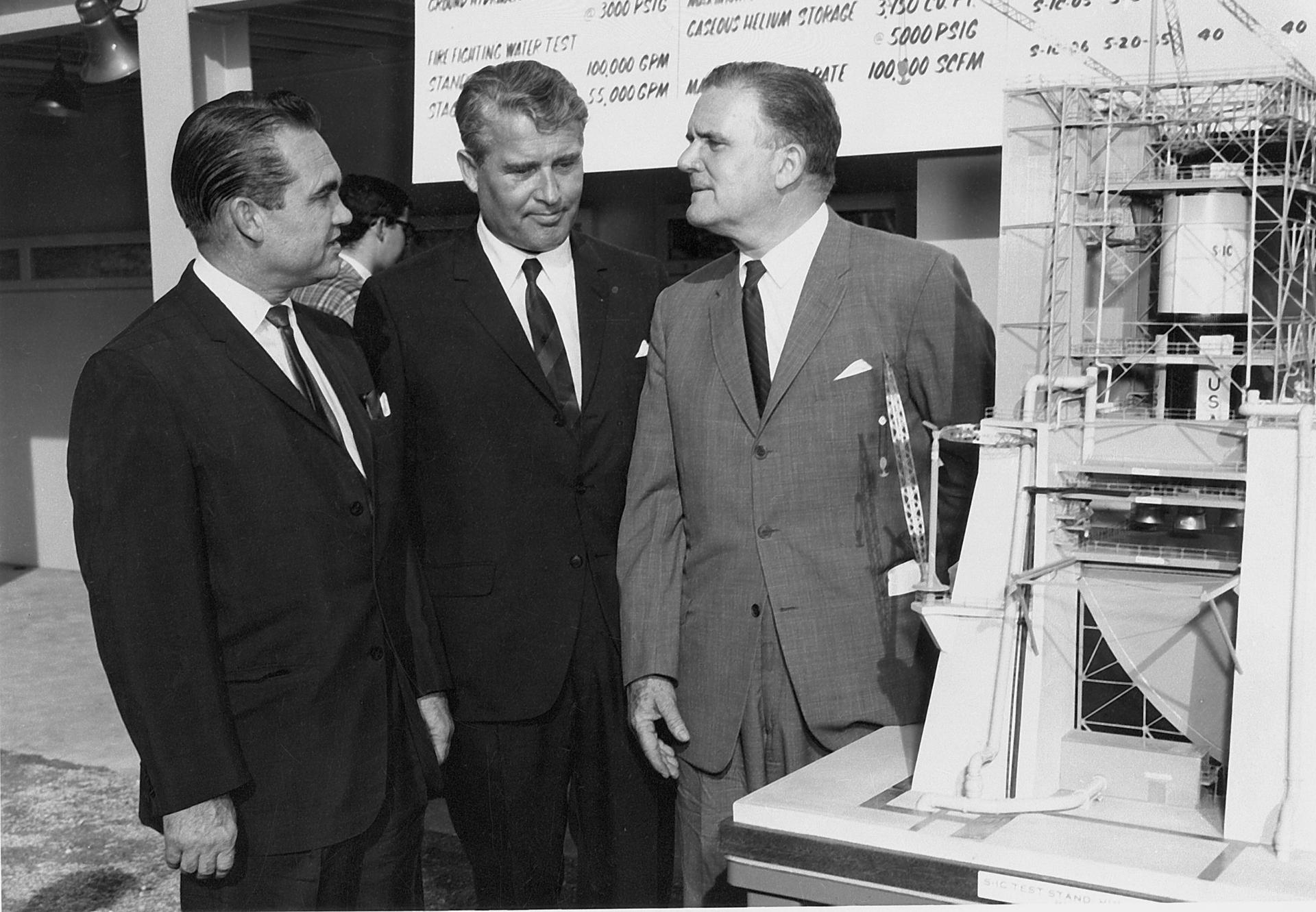
This NASA image shows von Braun in 1965. The photo is clean, official and almost calm. But it becomes interesting when the reader understands the contrast: the man shown there was also tied to the world of the V-2, Peenemünde, Mittelwerk and the postwar American choice to use compromised German knowledge.
That tension gives the theme its force. The photo does not prove any secret program. It shows something more human and more uncomfortable: how history can turn a biography marked by war into a symbol of the space future.
The V-2: the rocket that opened the wound
The V-2 was a German ballistic missile used against targets including London, Paris and Antwerp. NASA describes it as a direct ancestor of U.S. and Soviet intercontinental missiles and space launch vehicles.
The wound is the human cost. After the 1943 bombing of Peenemünde, production moved underground. The Mittelwerk complex used forced labor from prisoners connected to Mittelbau-Dora. UAH records more than 60,000 prisoners at Dora and more than 20,000 deaths in the Mittelbau-Dora system. That number is not a detail; it changes the way every later rocket is read.
The 1969 testimony and the moral question
One important point is von Braun's own later account. According to NASA, he testified in 1969 that he visited the Nordhausen area about 15 times between late 1943 and February 1945, on trips tied to design changes and final acceptance criteria for the V-2.
NASA's page also says he was aware of the terrible conditions and was involved in decisions about the use of slave labor. This prevents the article from becoming simple tribute. The subject is larger: how far will a society go in setting aside the past when knowledge seems too useful to lose?
Project Paperclip: the exchange that changed the space race
After Germany's defeat, von Braun and part of his team surrendered to the Americans. Through Project Paperclip, they were brought to the United States. They first worked for the Army at Fort Bliss and White Sands. Later the team moved to Huntsville, Alabama, developing missiles and rockets that fed the space race.
The deal was hard: the U.S. wanted to stop German specialists from going to the Soviet Union and speed up its own technology. Von Braun became valuable because he carried rare experience: building large rockets that had actually been tested in war.
NASA, Saturn V and the public face of the future
In 1960, von Braun's group was transferred to NASA. He became director of the Marshall Space Flight Center and was known as the chief architect of Saturn V, the rocket that carried Apollo missions to the Moon.
This phase created the other side of the image: the space advocate, the engineer on television, the man speaking of lunar bases, space exploration and humanity's future. For many people, von Braun became the face of the space promise. For others, he remained the face of an unpaid moral bill.
Von Braun and the Secret Space Program imagination
On AwakenMap, von Braun works as a bridge between documented history and the imagination of hidden technology. He connects NASA, NASA Coverups, Project Paperclip, Nazi Bell, TR-3B and the Secret Space Program because he shows that major technological leaps sometimes pass through shadow zones.
This is where speculative links appear: reverse engineering, hidden files, rockets beyond the public program, off-world base stories and even narratives such as the Mars slave colony. None of that is proven by von Braun's biography. But his life helps explain why those stories gained force: the real world already showed that science, war and secrecy can move together.
What exists publicly
What exists publicly is strong: institutional biographies, archives, photos, historical studies and records about the V-2, Mittelwerk, Mittelbau-Dora, Paperclip, Marshall and Saturn V. This is not a weak topic; it is a heavily documented historical node.
What does not exist as public proof is the extreme layer: von Braun as confirmed evidence of alien technology, antigravity or an already operational secret space program. That part remains speculative, connected to the map but separate from the historical fact.
Simple summary
Wernher von Braun was one of the most important rocket engineers of the twentieth century. He helped create the V-2 in Nazi Germany, was brought to the United States through Project Paperclip and later played a central role in NASA's Saturn V.
The theme is powerful because it forces a difficult question: when knowledge carries humanity to the Moon, what do we do with the human shadow left on the ground?
References and starting points
- NASA - Wernher von Braun
- NASA Images - Wernher von Braun photo, ID 9806957
- Smithsonian National Air and Space Museum - Project Paperclip
- Smithsonian archive - Von Braun research files
- USHMM - Mittelbau Main Camp
- UAH - Dora and the V-2 historical background
- NIST - Von Braun and F-1 engines image
- AARO - Official UAP records
FAQ
Did Wernher von Braun work for the Nazis?
Yes. He worked in the German rocket program, was tied to the V-2, joined the Nazi Party and became a junior SS officer, according to NASA's biography.
Did von Braun create Saturn V?
He did not create everything alone, but he was central. At NASA, he became director of the Marshall Space Flight Center and chief architect of Saturn V.
Does von Braun prove a secret space program?
No. He proves a real historical bridge between Nazi rockets, Paperclip and NASA. The connection to secret space programs belongs to AwakenMap's speculative layer.
Keep exploring
Join the conversation
Comments are moderated. Keep the discussion respectful and distinguish evidence, interpretation and personal experience.