Connection level
10 direct connectionsS.O.H.O. belongs on AwakenMap through discernment around images that seem to reveal something hidden. The name stands for Solar and Heliospheric Observatory, a joint ESA/NASA mission launched on December 2, 1995 to study the Sun, its outer corona, the solar wind and the heliosphere. The topic became conspiratorial because its public images, especially from LASCO and EIT, seem to show points, streaks, disks, comets and strange shapes near the Sun.
The origin is concrete. SOHO was built in Europe under ESA management, launched by NASA and operated with support from Goddard Space Flight Center and the Deep Space Network. From near the Sun-Earth L1 point, it can monitor solar activity continuously. Planned for only a few years, it crossed decades and reached its thirtieth anniversary in 2025.
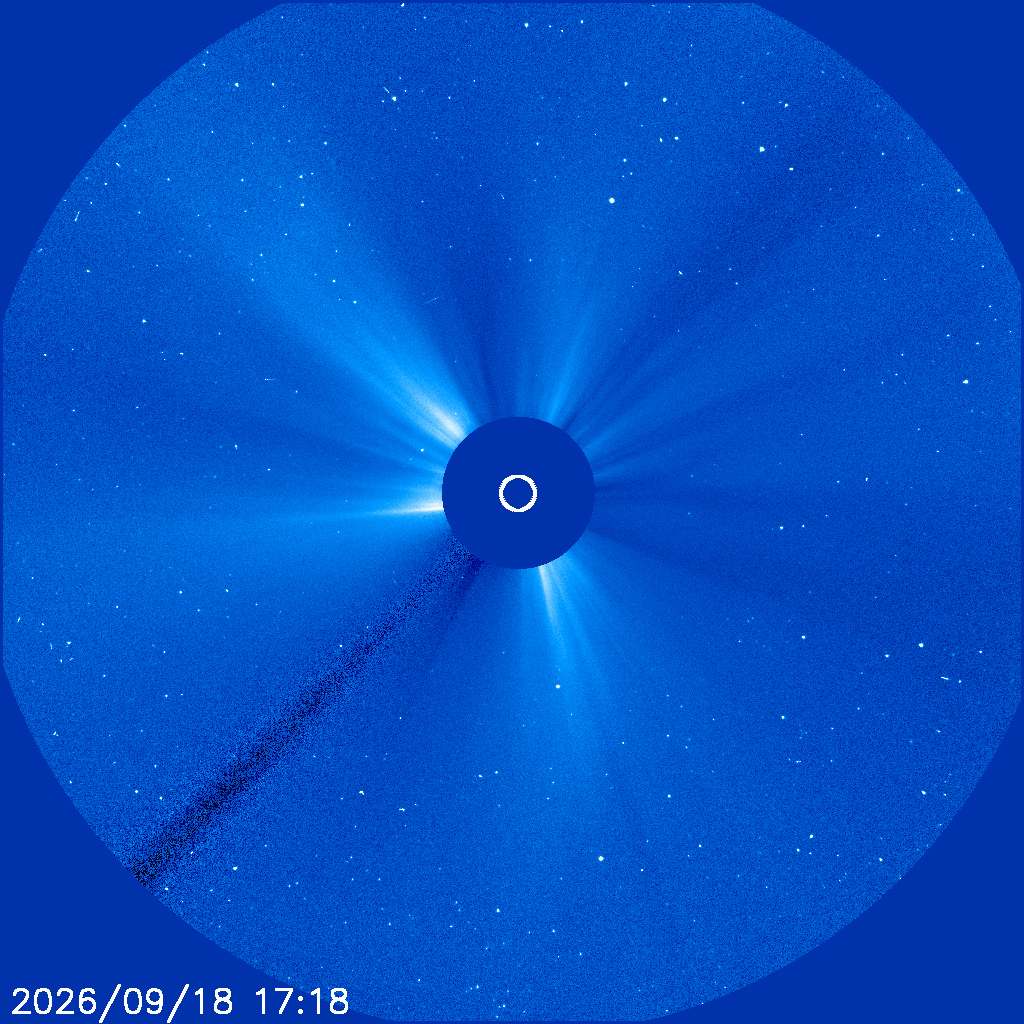
The instrument that feeds the imagination most is LASCO. It blocks direct sunlight to reveal the solar corona, coronal mass ejections, sungrazing comets and planets crossing the field of view. For researchers, this is observational technique. To someone looking at a single frame without scale, sequence or knowledge of saturation, cosmic rays and digital processing, the result can look like a giant craft parked near the Sun.
The image beside this text comes from the public SOHO/LASCO stream. The disk in the center is not the visible Sun: it is the occulting block used to hide direct glare. The white circle marks the approximate size of the Sun behind the shield.
This kind of image is exactly where popular interpretation divides: to astronomy, it is instrument data; to conspiratorial imagination, it is a poorly controlled window into something space agencies cannot fully hide.
A concrete case explains the mechanism. In January 2003, the SOHO team published an explanation showing how a crop of an EIT image from January 18, 2001 at 16:24 UTC could be transformed into something that looked like a glowing craft. The original feature was a cosmic ray hit on the detector. Cropping, interpolation, color scaling and retouching made the artifact resemble a UFO-like image.
The official response matters because it shows the process. Bright planets can saturate pixels and create bleeding lines. Cosmic rays can create points and streaks. Missing data can repeat blocks from previous images. Detector defects can look like persistent lights. Dust, micrometeorites and small spacecraft debris can also appear as strange tracks.
At the same time, SOHO really does see extraordinary things. It has recorded thousands of near-Sun comets; in March 2024, NASA and ESA announced its 5,000th comet discovery. Many were found by ordinary people studying public images. The same archive that fuels theories has also enabled real citizen science.
Within the Electric Sun narrative, SOHO becomes visual evidence that the Sun is not fully explained by conventional solar physics. Eruptions, filaments, arcs, coronal mass ejections and geometric-looking forms are read as cosmic circuits, energetic portals or interactions with technological objects.
In Cosmic Disclosure, SOHO images often appear as involuntary leaks. The claim is that space agencies, governments or military contractors know about huge objects near the Sun, but imperfect frames slip through because the archive is public and massive. The blurred image becomes a witness. The pixel becomes a document.
The link with the Galactic Federation and Ascension appears when the Sun becomes a messenger. In spiritual readings, SOHO records may be interpreted as solar craft, luminous beings, guardians, portals or preparation for a planetary transformation pulse.
global control enters through the archive. Because the images come from official agencies, any correction, delay, compression or technical failure can be read as deliberate editing. If an image disappears, it was removed. If a corrupted block appears, it was censored. If a scientist explains the artifact, the scientist is protecting the system.
As hidden history, SOHO shows a modern shift: the sky is no longer only observed through private telescopes or religious language; it is streamed as public digital images with timestamps and instrument labels. This democratizes observation, but also creates a new technical mythology.
propaganda uses this easily. A short video can take a frame, zoom in, invert colors, circle a shape and claim that NASA captured something impossible. Without date, instrument, surrounding frames, original resolution and comparison with known patterns, the object may be dramatic noise.
The best use of SOHO on AwakenMap is not to mock people who see something strange. It is to show how interpretation is born. There is a real image, a real instrument, a real agency and a real visual phenomenon. Then comes the question: comet, planet, cosmic ray, defect, processing artifact, craft, symbol or message?
Simple summary
S.O.H.O. is the Solar and Heliospheric Observatory, an ESA/NASA mission launched in 1995 to study the Sun. Its public LASCO and EIT images became fuel for theories about solar UFOs, giant craft, portals, solar pulses and space-agency coverups. The theme combines real science, open archives, citizen comet discoveries, imaging artifacts and conspiratorial interpretations of what appears near the Sun.
References and starting points
- SOHO - official ESA/NASA mission page
- SOHO - explanation of images mistaken for UFOs
- SOHO - image use and attribution notice
- SOHO - LASCO comet gallery
- ESA - SOHO celebrates thirty years
- NASA/ESA - SOHO discovers its 5,000th comet
- Battams and Knight - SOHO comets study
- SOHO LASCO CME Catalog version 2
Why it belongs on AwakenMap
It belongs because it shows how a scientific image can become contemporary myth. SOHO helps separate solar observation, instrumental error, citizen science, spiritual imagination and conspiracy narratives about space agencies hiding signs near the Sun.
Keep exploring
You can open another path
 Map center Great Awakening 5/5 intensity Explore →
  Esoteric practices NASA 5/5 intensity Explore →
  Esoteric practices Sun 5/5 intensity Explore →
  Esoteric practices Cosmic Disclosure 4/5 intensity Explore →
  Esoteric practices Electric Sun 4/5 intensity Explore →
  Control systems Global Control 4/5 intensity Explore →
Join the conversation
Comments are moderated. Keep the discussion respectful and distinguish evidence, interpretation and personal experience.