
Connection level
21 direct connectionsPropaganda belongs on AwakenMap through the question of who manufactures consent when many people believe they are awakening. It is not merely lying, political advertising or crude manipulation. Propaganda is a technology of attention: it chooses an enemy, simplifies a story, repeats an image, creates belonging and turns one interpretation of the world into an emotional reflex.
The word comes from the idea of propagating, spreading or circulating a faith, a cause or a version of events. Its modern weight grew in the twentieth century, when war, radio, cinema, mass press, advertising and social psychology converged. From then on, persuasion was no longer just argument; it involved rhythm, symbol, fear, desire and repetition.
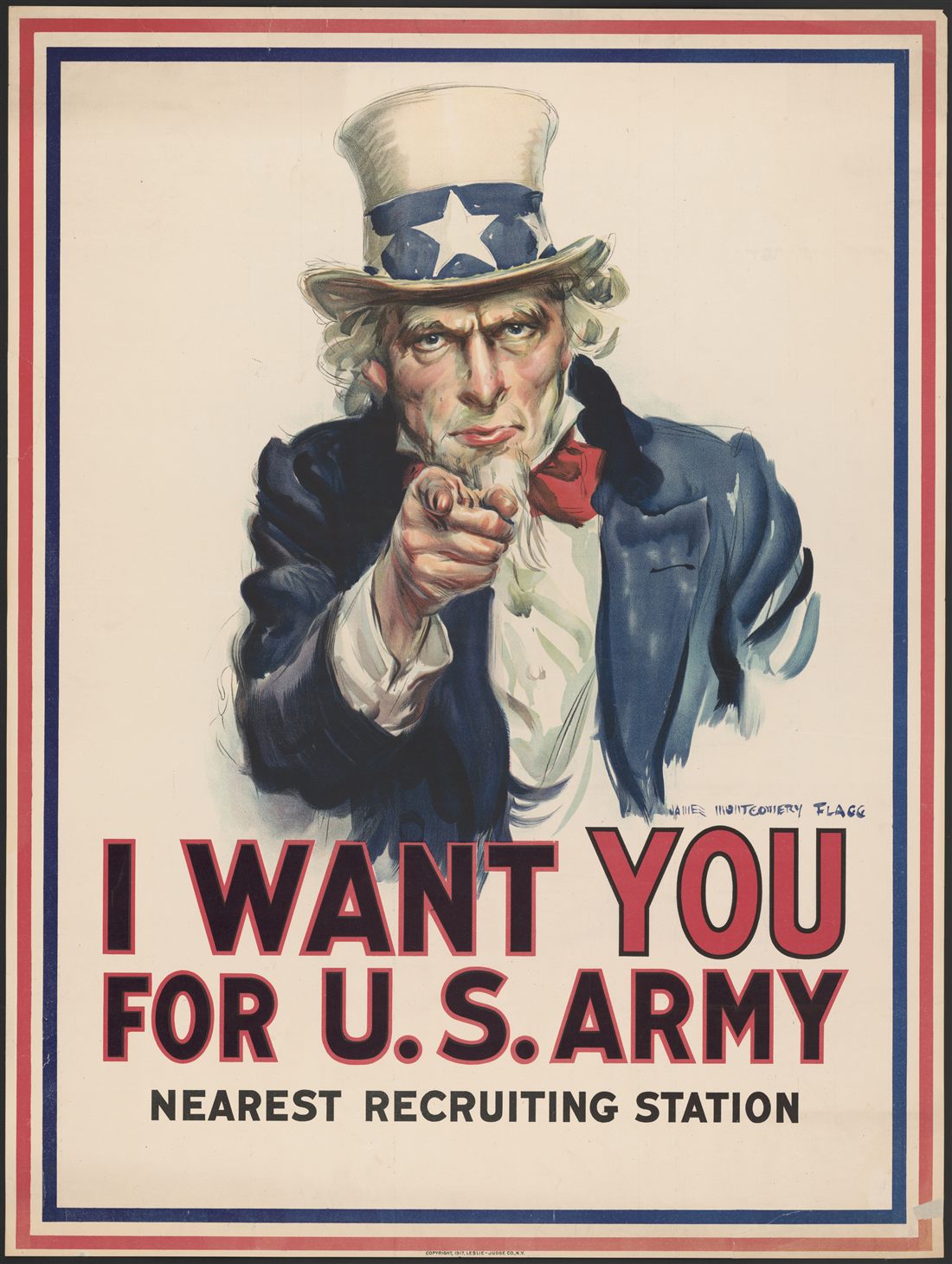
World War I became one of the great modern laboratories. In the United States, the Committee on Public Information, created in 1917 and associated with George Creel, coordinated posters, newspapers, speeches, films, visual material and mobilization campaigns. The war needed soldiers, money, obedience, sacrifice and moral narrative.
The concrete case is James Montgomery Flagg's 1917 Uncle Sam recruitment poster. It does not explain the war in detail; it points at the viewer. The finger turns a state campaign into an intimate summons. The short phrase replaces long debate. The image says: the nation is looking at you.
This is the heart of visual propaganda: reducing a complex situation to a scene the body understands before reason finishes analyzing it.
Edward Bernays helps explain the passage from wartime propaganda to civilian persuasion. A nephew of Sigmund Freud and a central figure in modern public relations, Bernays published Propaganda in 1928. His importance is not a single secret conspiracy, but a change of language: techniques used to organize wartime consent could be adapted to consumption, reputation, politics, social behavior and public opinion management.
This is where the theme links to global control. The strongest conspiratorial version claims that governments, banks, foundations, technology companies, intelligence agencies, universities and media outlets are parts of a single machine manufacturing reality. Sometimes this reading touches real facts: coordinated campaigns exist, public relations exists, wartime censorship existed, psychological operations exist, political advertising exists. The leap happens when every disagreement, newspaper, school, film and study becomes an obedient piece of the same invisible center.
mainstream media is the most obvious target of this suspicion. Newsrooms choose headlines, framing, sources, photographs and priority. That does not mean every journalist obeys a secret room, but it does mean public reality always arrives mediated. Propaganda lives in that mediation: it may appear in false news or in true news presented with emotional selection, strategic silence or disproportionate repetition.
Operation Mockingbird represents the most sensitive version of this fear: the idea that intelligence agencies influence journalists, newspapers, publishers and cultural narratives. Governments did try to influence information, especially during the Cold War. The conspiratorial layer expands this into a total reading in which almost any hostile coverage becomes proof of psychological operation.
MKULTRA enters through the suspicion that the human mind can be conditioned by invisible methods. MKULTRA was real as a secret and abusive CIA-linked experimentation program. But propaganda does not need laboratory hypnosis to work. It acts through repetition, social pressure, fear of exclusion, authority symbols, moral language and urgency. The most efficient manipulation often feels like one's own opinion.
The Cambridge Analytica case updated this conversation for the digital age. The U.S. Federal Trade Commission concluded in 2019 that the company violated consumer protection rules, and the UK Parliament discussed data, psychological profiling and political micro-targeting. The scandal does not prove every vote was controlled like a puppet, but it does show that propaganda stopped speaking only to anonymous masses: it began targeting fears, desires and identities at computational scale.
This shift is decisive. In the classic poster, everyone sees the same pointing finger. In digital propaganda, each group receives a different version of the finger, the enemy and the threat. The mechanism does not need to convince everyone of the same thing. It only needs to push each audience toward the fear already near the surface.
That is why QAnon is an important connection. QAnon does not function only as a set of claims; it functions as a participatory narrative system. The person does not merely consume a finished message: they investigate, decode, share and feel part of a community that sees hidden patterns. The format is powerful because it turns propaganda into a spiritual and political game.
Deep State appears when propaganda is no longer viewed as a campaign but as an environment. In many theories, the Deep State controls what can be known, remembered, forgotten or ridiculed. There is a legitimate question here: do powerful institutions shape public agendas? Yes. The problem begins when any correction, report, archive, fact-check or disagreement is dismissed in advance as part of the cover-up.
The Cabal / Deep State / Illuminati node takes this to its symbolic maximum. Propaganda stops being a communication technique and becomes a liturgy of domination: symbols in magazine covers, films, logos, ceremonies, architecture and music are read as messages from a hidden elite. The risk is mistaking symbolic literacy for total certainty.
Propaganda also relies on fear: fear of invasion, decay, impurity, betrayal, disease, collapse, persecution or humiliation. Fear organizes groups quickly because it reduces complexity. If there is an absolute enemy, doubt becomes weakness. If doubt becomes weakness, propaganda has already won before proving its claim.
It would be naive, however, to pretend propaganda belongs only to distant regimes or radical groups. Democracies, companies, social movements, religions, influencers, health campaigns, wars and brands all use persuasion techniques. Some are legitimate; others are abusive. The ethical difference lies in transparency, proportion, contestability and respect for the public's capacity to think.
collective consciousness closes the theme because propaganda does not act only on isolated individuals. It organizes atmospheres. It makes a society feel that something is inevitable, shameful, heroic, dangerous or ridiculous. When many people repeat the same emotional structure, the message feels like natural reality.
A mature reading of propaganda must hold two truths at once. First: elites, states, companies and movements really do try to shape public opinion. Second: not every public opinion opposed to mine is proof of brainwashing. Serious study begins by asking who pays, who benefits, what emotion is activated, what fact was omitted, what enemy was created and what behavior the message tries to produce.
Propaganda matters on AwakenMap because it is a bridge between real history and possible paranoia. The twentieth century documented mass persuasion campaigns. The twenty-first added data, platforms, algorithms and micro-targeting. The challenge is to develop immunity without becoming impermeable: to perceive manipulation without losing the ability to recognize evidence.
Simple summary
Propaganda is organized communication designed to shape perception, emotion and behavior. It can appear in war, advertising, politics, media, social networks, education, entertainment and institutional campaigns. On AwakenMap, it connects global control, mainstream media, Operation Mockingbird, MKULTRA, Cambridge Analytica, QAnon, Deep State, Cabal and collective consciousness.
References and starting points
- Library of Congress - Uncle Sam recruitment poster, 1917
- National Archives - Records of the Committee on Public Information
- Project Gutenberg - Propaganda, by Edward Bernays
- FTC - Cambridge Analytica opinion
- UK Parliament - Cambridge Analytica and micro-targeting
- Wikimedia Commons - Uncle Sam poster file
Why it belongs on AwakenMap
It belongs because no awakening journey is complete without asking how collective beliefs are manufactured. Propaganda shows that real manipulation exists, but it also teaches caution: the denunciation of manipulation can become another control technique when it abandons documents, proportion and critical humility.
Keep exploring
You can open another path
 Control systems Global Control 5/5 intensity Explore →
  Map center Great Awakening 5/5 intensity Explore →
  Esoteric practices Mainstream Media 5/5 intensity Explore →
  Control systems Chemtrails 4/5 intensity Explore →
  Esoteric practices The Guardians 4/5 intensity Explore →
  Control systems Cabal / Deep State / Illuminati 4/5 intensity Explore →
Join the conversation
Comments are moderated. Keep the discussion respectful and distinguish evidence, interpretation and personal experience.