
Connection level
18 direct connectionsOperation Mockingbird is the name that became a symbol for the suspicion that intelligence services infiltrated, co-opted or indirectly directed the press. The theme belongs on AwakenMap through the doubt about who writes public reality: when news stops looking like a window onto the world and starts looking like perception architecture.
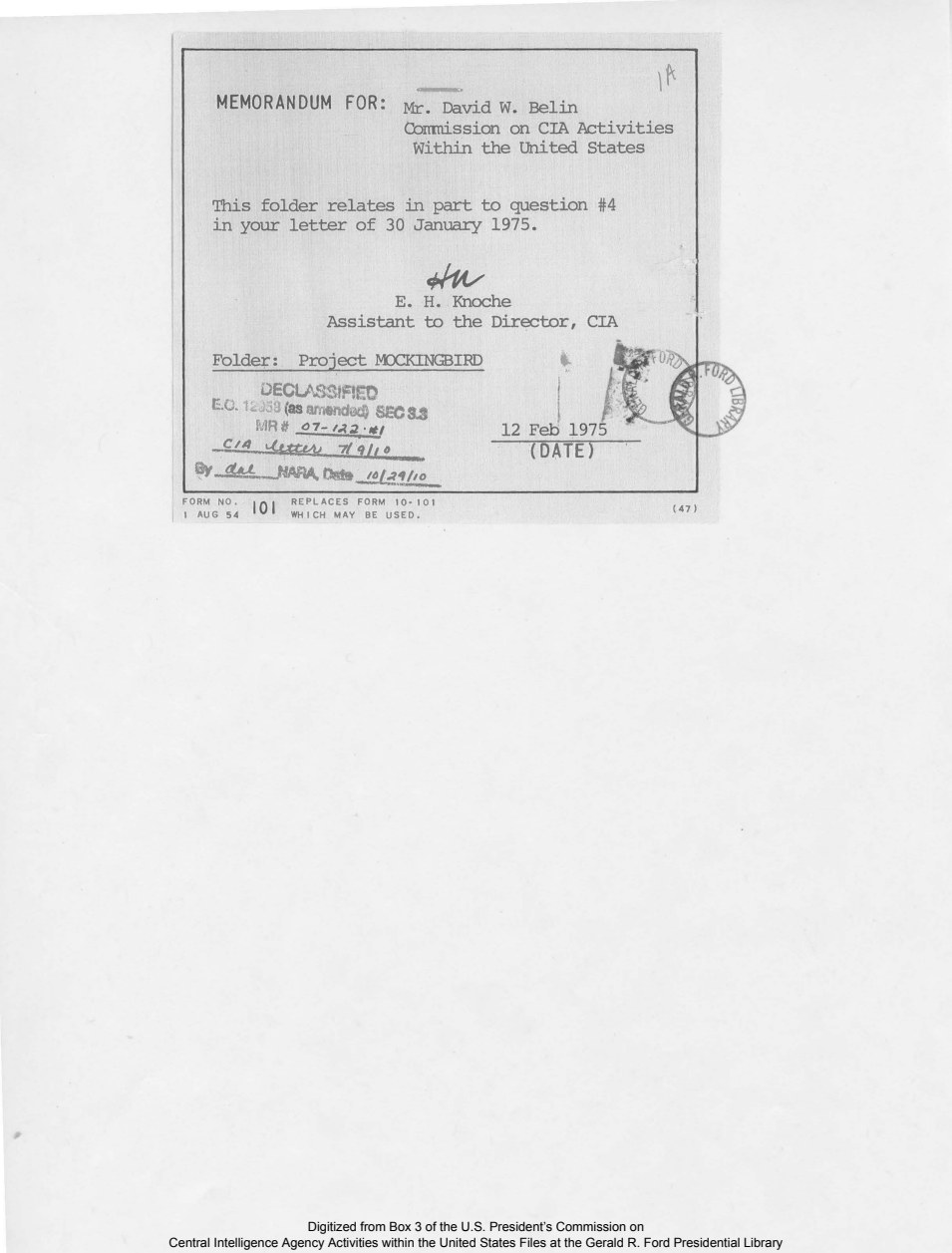
The origin needs to be separated into two layers. The first is documented: there was a Project Mockingbird connected to the CIA, cited in historical material as a telephone-intercept activity against two Washington columnists in 1963, Robert Allen and Paul Scott, because they were publishing information based on classified material. This appears in documents preserved by the Gerald R. Ford Presidential Library and in the collection known as the Family Jewels.
The second layer is broader and more controversial: the idea of Operation Mockingbird as an extensive network of influence over journalists, editors, magazines, agencies and outlets during the Cold War. This image grew through allegations, congressional investigations, books, articles and the public memory of the Church Committee, which examined intelligence abuses in the United States in the 1970s.
The delicate point is that there is real basis for suspicion about relationships between intelligence and the press, but that does not authorize the claim that all media is a theater controlled from one room. The Church Committee discussed CIA contacts with journalists and private institutions; Carl Bernstein published a famous investigation into the agency and the media; and official documents show illegal or problematic operations. But the name Mockingbird, as popularly used today, mixes facts, extrapolations and a much larger political mythology.
The conspiratorial layer appears when this history becomes a universal key: if a story is uncomfortable, it is Mockingbird; if several outlets repeat a narrative, it is central command; if a journalist makes an error, they are an agent; if a public crisis explodes, it is a psychological operation.
This reading is seductive because it answers a real anxiety: the feeling that public opinion can be manufactured. The risk is turning media criticism into an automatic reflex, where every contrary piece of information becomes programming.
On the map, Operation Mockingbird connects to mainstream media, propaganda, the Deep State, the Cabal / Deep State / Illuminati, MKULTRA, disclosure, full disclosure, whistleblowers and omniscience. The bridge with artificial intelligence has also become more important: today, narrative influence does not depend only on columnists; it moves through algorithmic recommendation, account swarms, targeting, behavioral data and manufactured consensus at scale.
The theme is powerful because it touches a democratic wound. A society needs the press to scrutinize power. But if the press can be used by power, the very instrument of scrutiny becomes a contested field. The conspiracy begins there: not in the childish idea that every journalist obeys a secret order, but in the adult question of how state, money, secrecy, access and prestige shape what becomes news.
A concrete case
In 1975, during investigations into intelligence activities inside the United States, documents related to Project Mockingbird were sent to the presidential commission examining CIA abuses. The folder preserved in the Gerald R. Ford archive identifies the subject as telephone interception of newspaper columnists and connects it to the commission on CIA activities inside the country.
This case does not prove a total network controlling world media. It proves something more specific and still serious: an intelligence agency became involved with journalists, leaks, surveillance and information control in a context of state secrecy. It is exactly this distance between documented fact and expanded legend that gives the theory its force.
For AwakenMap, the value lies in that separation: the name Mockingbird works as a symbol of legitimate suspicion, but it must be handled precisely. When everything becomes Mockingbird, nothing can be investigated properly anymore.
Why it belongs on AwakenMap
Operation Mockingbird belongs on AwakenMap because it is a central node in the war over narrative. It joins intelligence, press, propaganda, leaks, censorship, public trust and the question of who has the power to organize reality for millions of people.
The philosophical connection is simple and hard: awakening is not believing the opposite of the media; it is learning to investigate how a narrative is born, who benefits from it, what evidence supports its shape and where legitimate criticism ends and paranoia begins.
Simple summary
Operation Mockingbird is the popular name linked to suspicion about CIA influence over the press. There is a documented Project Mockingbird associated with telephone interceptions of journalists in 1963, and there are historical investigations into relationships between intelligence and media. The conspiratorial layer expands this into a permanent network of narrative control. The critical point is not to deny documented facts, but also not to turn every story, journalist or disagreement into automatic proof of total manipulation.
References and starting points
- Gerald R. Ford Presidential Library - Project Mockingbird folder
- CIA - Family Jewels collection
- U.S. Senate - CIA's use of journalists and clergy in intelligence operations
- National Security Archive - CIA's Family Jewels
- Reporters Committee - Paul Scott and Project Mockingbird
- Carl Bernstein - The CIA and the Media
Keep exploring
You can open another path
 Control systems Deep State 5/5 intensity Explore →
  Control systems CIA 5/5 intensity Explore →
  Map center Great Awakening 5/5 intensity Explore →
  Esoteric practices Mainstream Media 5/5 intensity Explore →
  Control systems Global Control 4/5 intensity Explore → Control systems CIA 4/5 intensity Explore →
Join the conversation
Comments are moderated. Keep the discussion respectful and distinguish evidence, interpretation and personal experience.