Connection level
33 direct connectionsFace on Mars belongs on AwakenMap through the question of when an ambiguous image becomes evidence of origin. Few images show the tension between science, desire and suspicion so clearly: a rock formation on Mars seemed to have eyes, nose and mouth, and that was enough to transform a Martian mesa into a possible monument from a lost civilization.

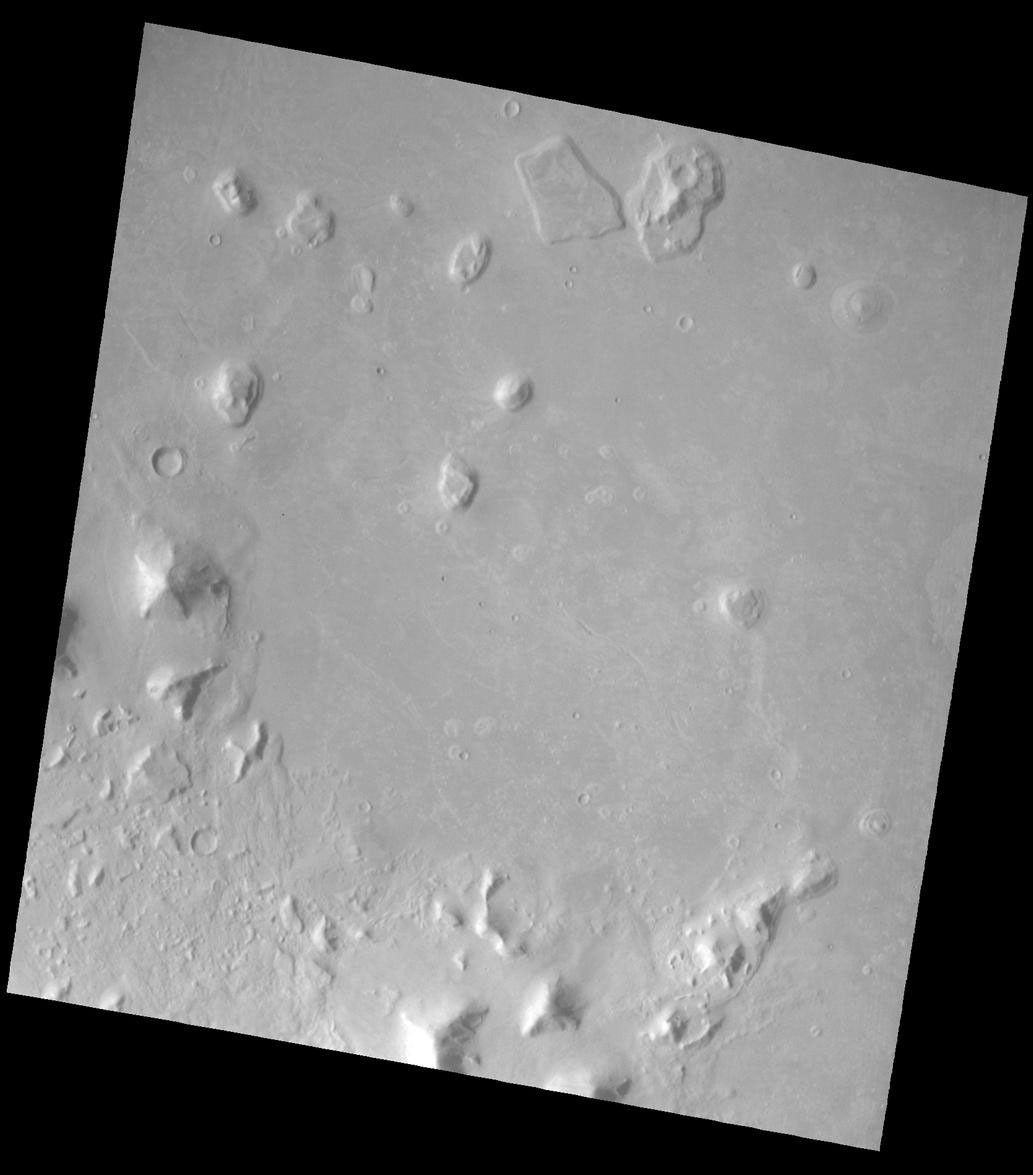
The origin of the theme is precise. On July 25, 1976, the Viking 1 orbiter photographed the region of Cydonia. A roughly two-kilometer landform, seen under a certain illumination angle, resembled a human head. Shortly afterward, the release language itself said the formation resembled a human head, while scientists were already interpreting the effect as an illusion produced by light, shadow and relief.
What happened next matters for AwakenMap. A low-resolution image, with strong shadows and ambiguous form, left geological curiosity and entered the imaginary of UFO / UAP, ancient aliens, hidden history and Martian ruins. For many, it was not only a hill. It was a signature: someone had been there, built something and NASA was reducing the discovery to a trick of light in order to prevent a massive cultural shift.
The conspiratorial layer appears when the Face stops being a visual question and becomes an institutional accusation. The strong thesis says Cydonia contains an artificial complex: face, pyramids, coded geometry, alignments, ruins and messages from a pre-human or extraterrestrial civilization. The official refusal to recognize this would be part of a cover-up tied to disclosure, the Secret Space Program, secret bases on Mars and narratives of ancient contact.
The delicate point is that seeing a face is not a sign of ignorance. The human brain is trained to recognize faces extremely quickly. That protects us, creates bonds and organizes the social world. The same mechanism, in ambiguous images, can find intention where there is erosion, shadow and noise.
This phenomenon is called pareidolia: recognizing familiar patterns in uncertain stimuli. The Face on Mars is one of the most famous examples because it combines planetary distance, low resolution, space mystery and the human wish not to be alone.

This does not make the theme small. The real question is larger than “does it look like a face?”. The question is: what kind of evidence would be needed to affirm an artificial construction on another planet? Is a suggestive form enough? Is a geometric alignment enough? Is a shadow enough? Or would we need structural repetition, materials, archaeological context, engineering marks, dating, independent images and an insufficient geological explanation?
The scientific answer tends to be demanding because the claim is enormous. Saying that a hill resembles a face is simple. Saying that the hill was sculpted by a Martian civilization changes history, biology, religion, space policy and philosophy. The larger the claim, the stronger the evidence needs to be.
A concrete case
The concrete case is the comparison between the Viking 1 image and the high-resolution image taken by Mars Global Surveyor on April 8, 2001. NASA/JPL reports that the camera obtained a view at about 2 meters per pixel, enough to distinguish objects the size of passenger jets if they were present. In this image, the formation appears as an eroded natural hill, without the facial clarity that light and low resolution suggested in 1976.

This case is powerful because it does not depend only on opinion. It shows the same visual promise across two technical conditions: first, an old, grainy, dramatically lit image; then, a targeted observation with much higher resolution. For those who see pareidolia, the second image resolves the myth. For those who see cover-up, it only shifts the suspicion: the image must have been manipulated, chosen at an unfavorable angle or interpreted conveniently.
This is where the Face on Mars approaches the Anunnaki, the Galactic Federation, hyperdimensional physics and even the Moon. All of these themes deal with the same desire: to find architecture where science sees geology, to find intention where institutions see natural process, to find cosmic memory where the official archive sees data.
The challenge is not to mock that desire. It comes from a legitimate question: if intelligent life existed beyond Earth, how would we recognize its traces? The challenge is not letting the desire to find traces turn every resemblance into proof.
Why it belongs on AwakenMap
Face on Mars belongs on AwakenMap because it is one of the clearest icons of impossible archaeology: the idea that ruins, monuments and messages from a lost civilization may be in front of us, but are dismissed by institutions, scientists or governments.
The philosophical connection lies in seeing. Awakening here does not mean denying mystery, nor believing every suggestive form. It means learning to ask how the image was made, what the resolution was, where the light came from, what other images exist, what explanations compete and where interpretation begins to carry more weight than the data.
Simple summary
Face on Mars is the Cydonia formation photographed by Viking 1 in 1976 that looked like a human head. The image fed theories about Martian civilization, artificial ruins and NASA cover-up. Later high-resolution images, especially from 2001, showed a natural hill whose face-like appearance depended on light, shadow and low resolution. The theme matters because it reveals how ambiguous image, desire for contact and institutional distrust can form a lasting theory.
References and starting points
- NASA Science - highest-resolution view of the Face on Mars
- JPL - PIA03225 Face on Mars image
- ESA - Cydonia and Face on Mars 3D animation
- ESA - original Viking 1 image
- The Planetary Society - A face on Mars
- Malin Space Science Systems - Mars Orbiter Camera and the Face
Keep exploring
You can open another path
 AwakenMap theme Cydonia 5/5 intensity Explore →
  Map center Great Awakening 5/5 intensity Explore →
  Esoteric practices Mars 5/5 intensity Explore → AwakenMap theme Cydonia 5/5 intensity Explore →
  Esoteric practices Human Face 5/5 intensity Explore →
  Ancient civilizations Ancient Builder Race 5/5 intensity Explore →
Join the conversation
Comments are moderated. Keep the discussion respectful and distinguish evidence, interpretation and personal experience.