Connection level
4 direct connectionsAncient Builder Race and Pyramids explores the idea of a global architectural memory: Egypt, Saqqara, Giza, the Americas, alignments, engineering, Atlantean myth and critical reading.

The question behind pyramids
Few architectural forms provoke as much as the pyramid. It appears in Egypt, Nubia, Mesoamerica, parts of Asia, ceremonial platforms, royal tombs, temples, artificial mounds and geometries of power. For that reason, in alternative imagination, the repetition of the form became a question: was there an ancient builder race, a lost global memory or an earlier civilization teaching the same code to distant peoples?
The easy answer would be to choose an extreme. On one side, say everything is coincidence and there is no mystery at all. On the other, claim that all pyramids in the world come from one lost Atlantean or extraterrestrial civilization. AwakenMap's premium path needs to be better: the pyramid form can arise from universal human logics, technical needs, local cosmologies and also a symbolic memory worth studying.
This theme is central because it unites real archaeology and deep myth. It speaks of engineering, power, death, sky, sacred mountain, alignment, collective labor and the modern desire to find a lineage older than known historical peoples.
Egypt as starting point, not the only answer
The pyramids of Giza belong to Egypt's Old Kingdom, especially the Fourth Dynasty. Britannica places the Giza group around 2575 to 2465 BCE, and UNESCO includes Memphis and its necropolis, from Giza to Dahshur, as World Heritage. This places the pyramids in a very specific historical context: pharaohs, centralized state, funerary cult, administration, specialized workers, quarries and the Nile landscape.
The Great Pyramid, associated with Khufu, impresses through scale, precision and permanence. Britannica notes that it originally reached about 147 meters in height and had sides of roughly 230 meters. These numbers feed fascination, but they also show the capacity of a concrete, organized and deeply religious human society.
Egypt does not need to be explained by an external race in order to be extraordinary. The most respectful reading begins by recognizing Egyptian genius. Then, yes, we can ask why this form speaks so loudly to different cultures.
Saqqara, Imhotep and the invention of verticality
Before Giza, Saqqara and the Pyramid of Djoser show a fundamental transition. Smithsonian notes that Djoser's step pyramid, associated with the architect Imhotep, transformed the mastaba tomb into a vertical form of successive layers. What had been a low tomb became an artificial mountain.
This transformation is crucial for dismantling simplistic readings. Egyptian pyramids do not drop fully formed from the sky; they evolve. There are mastabas, step pyramids, experiments, mistakes, transitions at Meidum, the Bent Pyramid, the Red Pyramid and finally Giza. Archaeology shows a history of learning, not only an isolated miracle.
At the same time, that evolution does not diminish the mystery. On the contrary, it makes it more human and more interesting: a whole civilization learns to turn stone into ascent, tomb into cosmos, dead king into axis between earth and sky.
Why do so many cultures build pyramids?
The pyramid form has obvious advantages. It is stable, distributes weight, grows in layers, allows monumentality with relatively simple technology and creates the image of an artificial mountain. In societies without modern steel or reinforced concrete, stacking and stepping back successively is a powerful solution.
But technique does not explain everything. The pyramid is also symbol. It points upward, creates a center, organizes procession, separates elite and people, brings temple and horizon together. In many cultures, mountains are dwellings of gods, ancestors or cosmic forces. Building a pyramid may be building a mountain where landscape does not provide one, or domesticating the mountain inside a sacred city.
For that reason, global repetition does not necessarily require a single builder race. It may reveal something equally deep: different humans, facing similar problems of power, death and sky, reached a form the body recognizes as ascent.
The ancient builder race as modern myth
The idea of an Ancient Builder Race appears in many alternative traditions as an explanation for megaliths, pyramids, cyclopean ruins, ancient maps and knowledge that seems displaced in time. It may mix with Atlantis, Lemuria, Mu, Anunnaki, pre-Adamites, giants, ascended masters or star visitors.
As myth, the idea is powerful. It organizes the feeling that there are marks too old, too large or too aligned to fit a simple schoolbook narrative. It also offers a spiritual genealogy: perhaps present humanity inherited an earlier builder lineage, wiser or more technological.
As historical claim, however, the Ancient Builder Race needs evidence. Without texts, artifacts, dating, stratigraphy, tools, settlement remains and material continuity, it remains an interpretive lens, not a proven conclusion.
How the pyramids were built
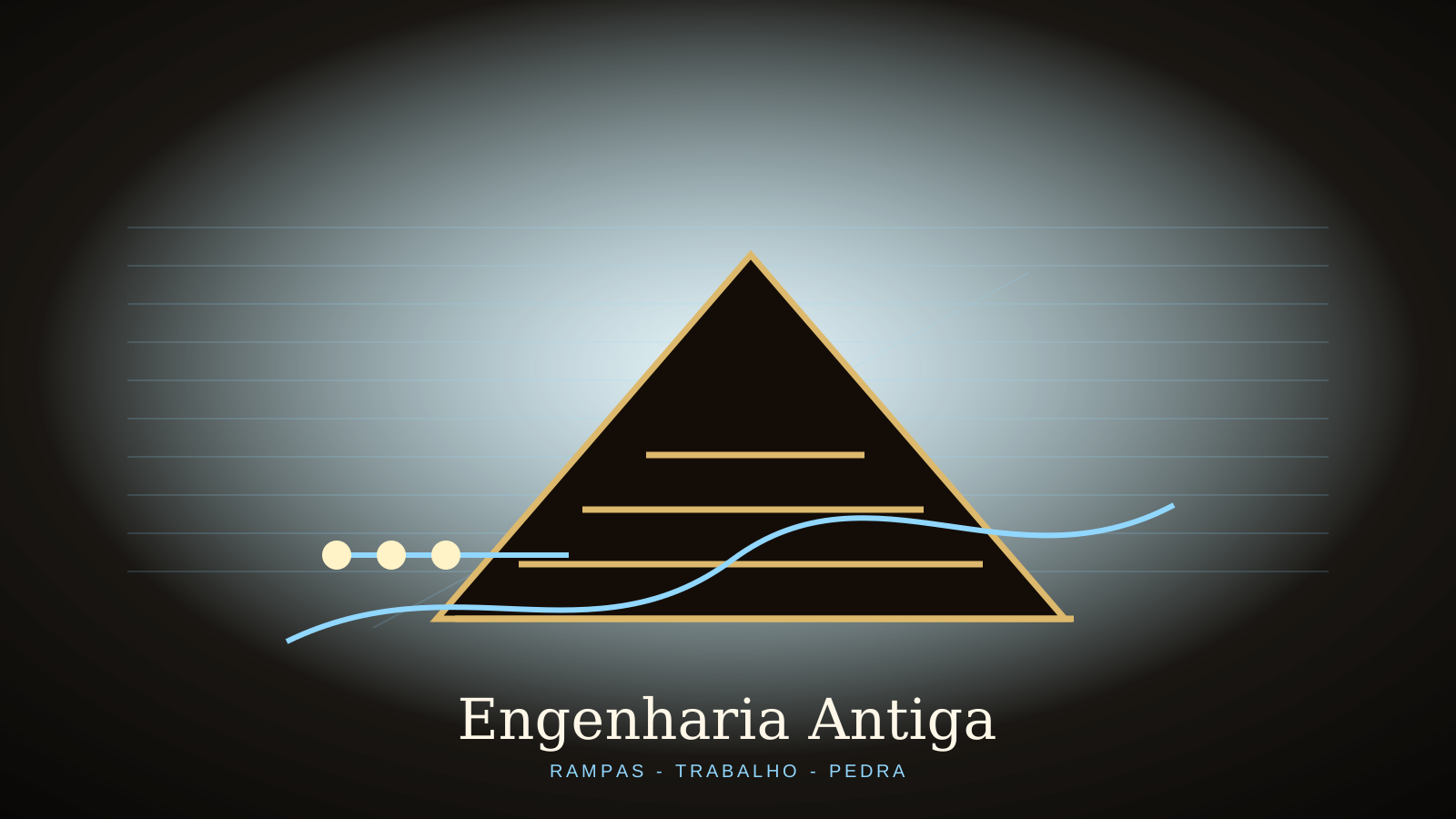
The technical question remains open in details, but not in emptiness. National Geographic summarizes that many scholars consider ramps, sledges, ropes, rollers, levers, water or wet clay to reduce friction, and the organization of large teams. There are debates over external ramps, spiral ramps, internal ramps, combined methods and phased approaches.
The important point is that difficulty is not impossibility. Moving large blocks requires organization, but ancient societies could organize work at enormous scale. There was administration, food supply, supervision, quarries, routes and empirical engineering knowledge.
Alternative reading often turns technical gaps into proof of antigravity or lost technology. That can be imagined, but it must be proven. The fact that details of ramps remain debated does not authorize jumping directly to an unidentified civilization.
Alignments, astronomy and geometry
Pyramids often dialogue with sky, cardinal directions, solar cycles, stars, horizon and funerary rites. In Egypt, orientation and landscape were not accessories; they were part of royal theology. The dead king, the Sun, the imperishable stars and the western bank of the Nile belonged to the same symbolic universe.
This astronomical dialogue feeds theories about advanced knowledge. Some observations are legitimate: precise orientations, relationship with landscape, site selection and practiced mathematics. Others extrapolate: turning every proportion into a universal secret code, every numerical coincidence into an Atlantean message, every orientation into proof of star contact.
The best reading keeps wonder without losing method. Ancient geometry and astronomy are real. The question is what level of intention we can demonstrate in each case.
Pyramids outside Egypt
Smithsonian reminds us that pyramids appear in several regions of the world, in different ways. Mesoamerica has temple-pyramids linked to ritual, cities and calendars. Nubia has its own tradition of royal pyramids. Mesopotamian ziggurats rise in platforms. Pyramidal structures in Asia and the Americas show that the form traveled, reappeared or was reinvented.
Comparing these forms is useful, but requires care. An Egyptian royal tomb pyramid is not the same thing as a Maya temple-pyramid. A ceremonial platform does not have the same function as a funerary structure. Visual resemblance does not automatically mean common origin.
Still, the global pattern has symbolic value. The pyramid seems to be one of the great human answers to an old question: how to build an axis between earth, community, elite, ancestors and sky?
Atlantis and the lost lineage
In modern esotericism, pyramids are often linked to Atlantis. The idea is that an earlier civilization mastered energy, crystals, geometry and planetary alignments, leaving pyramids as machines, temples or archives of knowledge. This reading appears in occult authors, channelings and alternative archaeology.
The force of this narrative comes from its beauty: pyramids as planetary network, memory of cataclysm and spiritual technology. But narrative beauty is not enough as historical proof. Atlantis, in its main ancient source, comes from Plato; modern energetic readings belong to another layer.
In AwakenMap, the connection with Atlantis should be treated as a powerful interpretive myth, not an established fact. It helps explain why pyramids seem to call forth memories of fall, ascent and lost knowledge.
The risk of stealing human authorship
An ethical caution is indispensable: theories about an ancient builder race can unintentionally remove authorship from real peoples. When we say Egyptians, Maya, Nubians or Andean peoples could not have built their works, we may repeat a form of cultural erasure.
Questioning techniques and chronologies is legitimate. Underestimating ancient civilizations is not. Wonder should lead us to study those societies more, not replace their achievements with a vague superior entity.
The best page on this theme needs to honor human builders and, at the same time, explore the myth of an ancient lineage as a question about global memory. Discernment does not kill mystery; it protects mystery from becoming simplification.
How to test diffusion between cultures
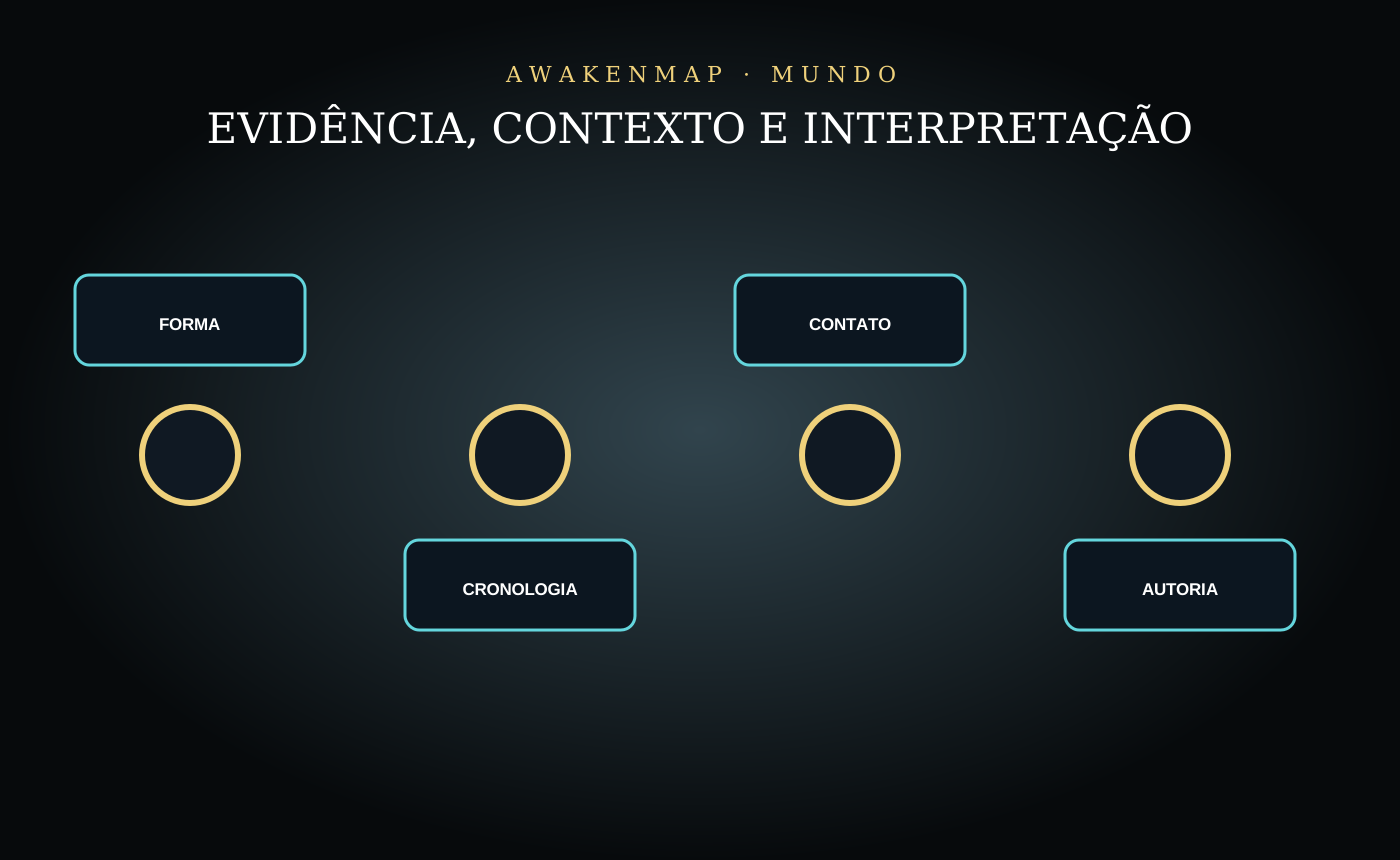
Real cultural contact leaves packages of evidence: imported objects, plants, animals, techniques, words, iconography, DNA, routes and compatible chronologies. A shared architectural form is weak evidence when it stands alone.
A global builder civilization would require continuous transmission or verifiable contacts across regions and periods. Without them, independent solutions remain the more economical explanation for structures broad at the base and narrow at the top.
Internal evolution of monuments
In Egypt, mastabas, the Step Pyramid, Sneferu's experiments and later complexes reveal development. In Mesoamerica, platforms and temples follow their own local histories. Intermediate sequences weaken the idea of a perfect design delivered from outside.
Errors, repairs and changing slopes are especially valuable because they reveal learning. A technology inherited from superior masters should explain why builders tested solutions, encountered failure and improved methods over time.
Labour, power and collective agency
Pyramids are not only calculations; they organize quarries, transport, food, housing, specialists and political authority. Worker settlements and crew marks return concrete people to the monumental landscape.
The language of a “builder race” can erase thousands of artisans and communities. Recognizing human authorship does not make the work less mysterious; it relocates wonder in cooperation, planning and social capacity.
In AwakenMap
In AwakenMap, Ancient Builder Race and Pyramids connects to Ancient Egypt, Giza Complex, Sphinx, Gobekli Tepe, Megalithic Sites, Atlantis/Lemuria/Mu, Ley Lines, Sacred Geometry, Earth, Stone Circles and Ancient Civilizations. It is a node where architecture, myth and cosmology cross.
As World, it speaks of stone, monument, landscape, quarries, labor and ruins. As Knowledge, it speaks of archaeology, engineering, astronomy, chronology and history of ideas. As Cosmic, it speaks of ascent, lost memory, ancient lineages and planetary symbolic network.
The strongest reading does not ask only who built the pyramids. It asks why humans still need to imagine that pyramids preserve something we have not yet recovered.
How to read this theme
Start with what is documented: Egypt, Saqqara, Giza, Djoser, Imhotep, Khufu, Fourth Dynasty, Memphis, quarries, ramps, workers and funerary context. Then compare with other pyramid traditions without erasing their differences.
When the Ancient Builder Race appears, ask: is there specific material evidence or only visual resemblance? Does the theory respect the builder peoples? Does it distinguish spiritual myth from archaeological data? Does it explain more than it complicates?
Pyramids remain powerful because they are engineering and symbol at the same time. They show that ancient humanity was capable of raising mountains to converse with the invisible.
Critical reading
The idea of an Ancient Builder Race should be read as interpretive myth and extraordinary hypothesis. Real pyramids require local context, material evidence and respect for the peoples who built them.
References and starting points
- Britannica - Pyramids of Giza
- Britannica - Great Pyramid of Giza
- UNESCO - Memphis and its Necropolis
- Smithsonian Magazine - Ancient Pyramids Around the World
- National Geographic - How were the Pyramids of Giza built?
- National Geographic Education - Pyramids
FAQ
Do pyramids prove an ancient builder race?
Not by itself. The repetition of the form is fascinating, but can be explained by stability, mountain symbolism, political power and local cosmologies. A global race would require specific material evidence.
Does this diminish the mystery of pyramids?
No. The mystery becomes stronger when we recognize the real intelligence of human builders and distinguish archaeology from modern myth.
Keep exploring

Join the conversation
Comments are moderated. Keep the discussion respectful and distinguish evidence, interpretation and personal experience.