Connection level
5 direct connectionsAnnunaki is a spelling used in the map for the group better known as the Anunnaki: deities of ancient Mesopotamia who, in Sumerian and Akkadian texts, appear connected with the great gods, human fate, the underworld and the divine assembly. The theme grips people because it has two lives: an ancient life in Mesopotamian texts and seals, and a modern life in ufology, Nibiru and ancient astronaut theories.
First: Mesopotamian gods
Before any extraterrestrial reading, the Anunnaki belong to Mesopotamian religion. Oracc, connected with the University of Pennsylvania, presents Anunna, Anunnaku or Anunnaki as a group of gods in the Mesopotamian pantheon. In some contexts they appear among the highest gods; in others they are linked with the underworld and judgment.
On AwakenMap, the theme connects to ancient civilizations, ancient ruins, ancient aliens, ancient Egypt, Ancient India, Atlantis, Akasha and NASA. It works as a bridge between ancient religion, cuneiform writing, celestial gods and modern extraterrestrial imagination.
The name and spellings
The most common form in books and searches is Anunnaki. Anunna, Anunnaku and, in modern materials, Annunaki also appear. This variation happens because we are dealing with ancient languages, transliteration of cuneiform signs and translations made in different periods.
For the reader, the main point is simple: one does not need aliens for the name to make sense. The name already belongs to an ancient world of gods, temples, kings, fate, rituals and ordered cosmos.
The real image of the world that produced the theme
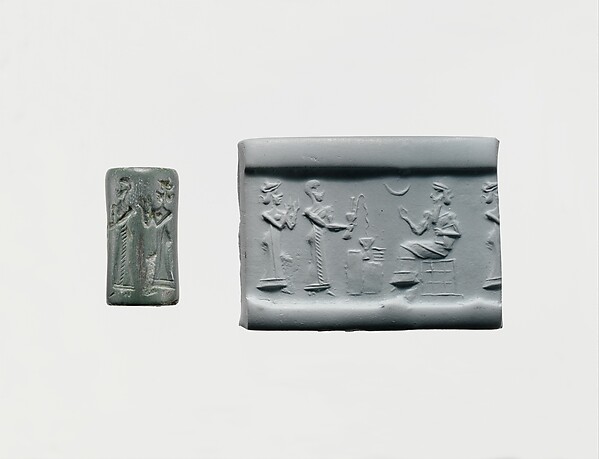
This Neo-Sumerian cylinder seal shows a worshiper pouring a libation before a seated god. The scene helps visualize the real environment in which ideas about gods, authority and cult circulated: temples, rites, divine images and administration.
The seal does not represent "the Anunnaki" as a group and does not prove space visitors. It shows something more important for the article: the Mesopotamian material culture in which these names and religious images made sense.
Fate, assembly and the underworld
In Mesopotamian texts, gods are not decorative characters. They decide, judge, dispute, protect cities and organize the order of the world. The Anunnaki can appear as a group of great gods or as judges connected with the underworld, depending on the text and period.
This is more interesting than a simple answer. The same name crosses different layers of Mesopotamian religion. In a culture of temple-cities, each god had place, function, power and relationship with kings and communities.
Why they became extraterrestrials in modern culture
The modern turn happens mainly with Zecharia Sitchin. In The 12th Planet, published in 1976, he reinterpreted the Anunnaki as beings from another planet, connected with Nibiru, who came to Earth in search of gold and influenced the origin of humanity.
This reading exploded because it joined Mesopotamia, the Bible, astronomy, genetic engineering and ancient mystery into a story that is easy to remember. Ancient gods stopped being only deities and began to be read as astronauts, miners, genetic creators and visitors from a distant planet.
What Sitchin added
Sitchin's version is not only generic "ancient aliens". It has specific details: Nibiru as a long-orbit planet, Anunnaki as technological beings, arrival on Earth to mine gold, creation of humans as workers and connections with biblical accounts and Sumerian-Akkadian myths.
These details explain why the theme became so strong in videos, books and online debates. It offers a complete narrative: origin, planet, reason for the visit, technology, genetics, gods, kings and future return.
The necessary care
The problem is that Assyriologists, historians and archaeologists do not treat Sitchin's reading as an accepted translation of Mesopotamian texts. Academic consensus works with the Anunnaki as gods of an ancient religious tradition, not as a documented extraterrestrial species.
That does not make the theme less interesting. On the contrary: it becomes better when the layers are separated. One thing is ancient Mesopotamia. Another is Sitchin's modern reinterpretation. Another is the pop culture that came afterward.
Why this theme grips people
Annunaki grips people because it seems to offer a key to everything: human origin, gods, hidden planet, lost technology, gold, flood, ancient kings and sacred texts. It is a modern mythology built on top of an ancient mythology.
The force of the theme lies in that overlap. The reader feels they are looking at ancient tablets and, at the same time, at cosmic science fiction. Few themes join clay, temple, star and conspiracy so well.
Connections to continue
After this theme, open ancient aliens, ancient civilizations, ancient ruins, ancient Egypt, Ancient India, Atlantis and Akasha. This path shows how ancient gods can become questions about origin, memory, technology and cosmos.
Simple summary
Annunaki or Anunnaki are, at the ancient base, gods of Mesopotamian religion. In modern culture, especially after Zecharia Sitchin, they were reinterpreted as extraterrestrials connected with Nibiru and the origin of humanity. The theme becomes stronger when these two layers are explained without confusing ancient text with modern theory.
References and starting points
- Oracc / University of Pennsylvania - Anunna (Anunnaku, Anunnaki)
- Electronic Text Corpus of Sumerian Literature - Oxford
- The Met - Cylinder seal and modern impression: worshiper pouring a libation before a seated god
- The Met - Cylinder Seals: Tiny Treasures That Leave a Big Impression
- The Met Publications - Ancient Art in Miniature: Ancient Near Eastern Seals
- Simon & Schuster - Zecharia Sitchin, The 12th Planet
- Smithsonian Magazine - The Idiocy, Fabrications and Lies of Ancient Aliens
- Bible Archaeology - Debunking Ancient Aliens / Michael Heiser participation
FAQ
Are Annunaki and Anunnaki the same thing?
In modern use, yes. Anunnaki is the most common form; Annunaki appears as an alternative spelling.
Were the Anunnaki aliens?
In Mesopotamian studies, they are ancient gods. The extraterrestrial reading comes from modern authors, especially Zecharia Sitchin.
What is Nibiru in this theme?
In Sitchin's version, Nibiru is the planet associated with the Anunnaki. This idea belongs to the modern reinterpretation, not to the common academic reading of Mesopotamian texts.
Keep exploring
You can open another path
 Ancient civilizations Ancient Egypt 4/5 intensity Explore →
  Esoteric practices Sumerian Creation Story 4/5 intensity Explore →
  Ancient civilizations Ancient Aliens 3/5 intensity Explore →
  Ancient civilizations Pre-Adamites, Elongated Skulls and Giants 3/5 intensity Explore →
  Esoteric practices Book of Enoch 2/5 intensity Explore →
Join the conversation
Comments are moderated. Keep the discussion respectful and distinguish evidence, interpretation and personal experience.