Connection level
15 direct connectionsVatican controls all world currency belongs on AwakenMap through the question of when financial distrust becomes a myth of absolute power. The phrase is deliberately extreme: it turns a real religious institution, with diplomatic history, property, its own financial institute and documented financial scandals, into a totalizing thesis in which Rome supposedly stands above all currency issuance, public debt, central banking and circulation of wealth on the planet.
The origin of this imaginary does not come from one single author. It is born from three overlapping layers: the historical wealth of the Catholic Church, the political sovereignty of Vatican City and the opacity that long surrounded ecclesiastical finances and archives. When an institution is ancient, international, ritualized, diplomatic and not transparent to the ordinary public, it naturally attracts suspicion. The conspiracy begins when that suspicion becomes an explanation for the entire world monetary system.
The basic fact is simpler. The Vatican is a tiny sovereign state, sovereign since the Lateran Pacts of 1929, linked to the Holy See and to the central government of the Catholic Church. It does not control the dollar, the euro, the yuan, the Brazilian real or central-bank reserves. What exists is religious, diplomatic, patrimonial and financial influence, plus institutions created to administer resources connected to the Church's mission.
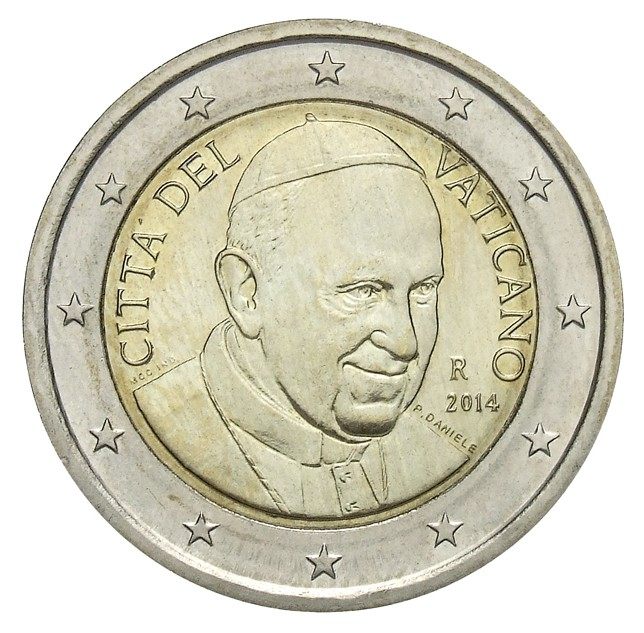
The image beside this text shows a Vatican 2 euro coin with the effigy of Pope Francis. It is useful because it reveals the difference between fact and exaggeration: the Vatican can issue its own euro coins under a limited monetary agreement, but that does not mean it commands the euro or controls world currency.
Vatican coinage has strong symbolic and collector value. Euro monetary policy, however, belongs to the European system, not to the Vatican.
The Institute for the Works of Religion, known as the IOR and often called the Vatican Bank, is the most concrete center of this story. It was created in 1942, during the pontificate of Pius XII, to administer resources linked to religious and charitable works. Its 2025 annual report states that it had more than 12,000 clients, relationships reaching 112 countries, around 5.9 billion euros in client assets and net profit of 51 million euros. These are relevant numbers, but very far from the idea of global financial command.
The concrete case feeding suspicion is the reform history of the IOR itself. For decades, the institute was associated with opacity, controversy and investigations around money laundering. The 2025 report acknowledges past difficulties caused by unclear management practices and presents the recent phase as a process of stabilization, integration with financial bodies and governance strengthening. In other words: there is historical basis for distrust; there is no proportional basis for saying that the Vatican owns all world currency.
The euro layer is another important point. Vatican City uses the euro as its official currency through an agreement with the European Union and can issue coins in controlled quantities. It does not issue euro banknotes and does not decide interest rates, monetary policy or monetary-base expansion. The European Central Bank displays the Vatican coin series in circulation, but the existence of those coins proves symbolic and legal participation in the euro system, not dominion over it.
The conspiracy grows when that difference disappears. A person sees the face of a pope on a coin, remembers the Vatican Bank, associates this with Church wealth, then connects it with central banks, public debt, banking families, old treaties and religious symbols. In a few steps, the Vatican stops being a powerful, complex and historically ambiguous institution and becomes the alleged secret vault of the Earth.
The connection with the Cabal, Deep State and Illuminati appears because the theory needs a summit. In popular versions, the Holy See is the spiritual facade of a network including banks, European nobility, religious orders, initiatory societies and international organizations. Sometimes the Vatican appears as the chief; at other times, as the religious arm of a larger structure. The pattern is the same: turning old institutions into characters of one single machine.
secret societies and the Jesuits enter because of the image of discipline, hierarchy and global action. The Society of Jesus was founded in 1540 and played a major role in education, missions, science, diplomacy and cultural politics. This real history of international presence makes the fantasy of invisible control easier to imagine. The serious question is: is global educational and religious influence the same thing as planetary financial control? It is not.
The relationship with the Vatican Library reinforces the atmosphere of secrecy. The Vatican Library and the Apostolic Archive preserve immense historical documents, many inaccessible to the public because of preservation, cataloguing, diplomacy or documentary restriction. The conspiratorial imagination turns archive into proof vault: hidden contracts, property titles over the Earth, elite genealogies, secrets about banks and currencies. The seductive part is imagining that one closed room contains the key to everything.
The link with hidden history comes from there. The Vatican crossed empires, wars, colonization, Reformation, counter-Reformation, fascism, the Cold War and globalization. Few institutions have survived that long with so much documentation. This produces a correct intuition: there is immense historical memory there. The distortion is concluding that long memory equals secret command over every event.
Freemasonry and the Illuminati appear because the theme mixes historical enemies. In many periods, Church, Freemasonry, liberalism, discreet societies and revolutionary projects were in conflict. The conspiratorial field, however, sometimes inverts everything: public enemies become secret allies; formal condemnations become theater; Vatican, Freemasonry and Illuminati become parts of the same pyramid. This reading is powerful because it turns contradiction into disguise.
Kabbalah, Saturn and the black cube appear in more esoteric versions. Symbols of Rome, liturgy, architecture, vestments, obelisks, keys, mitres and rites are reinterpreted as astrological, Saturnian or Kabbalistic code. The problem is not studying religious symbolism; the problem is using visual resemblance as automatic proof that an institution controls money, governments and the spiritual destiny of humanity.
The mainstream media also plays a role. Real Vatican financial scandals often appear in fragmented reports: an investigation, a resignation, a reform, a conviction, an audit. Without context, each story becomes a piece confirming the larger thesis. With context, they show something less cinematic and more human: old institutions trying to reform internal structures, sometimes after serious failures.
International monitoring confirms this tension. MONEYVAL, the Council of Europe body that evaluates measures against money laundering and terrorist financing, published a positive 2024 assessment of progress by the Holy See and Vatican City State. This does not mean perfection or eternal innocence. It means there is external evaluation, regulatory language and pressure toward compliance, which is different from the image of a power immune to scrutiny.
The link with global control is inevitable because money feels like the invisible language of the modern world. Whoever controls currency controls prices, debt, war, hunger, technology and the future. This is why monetary conspiracy theories always search for a supreme center: a family, a bank, a city, an order, a religion. The Vatican enters that place because it combines symbolic gold, antiquity, spiritual authority and state sovereignty.
The mature reading separates four things. First, the historical wealth and cultural patrimony of the Church. Second, real financial institutions of the Holy See, with reforms, risks, reports and controversies. Third, global diplomatic and religious influence. Fourth, the conspiratorial claim of total monetary dominion. The first three deserve serious analysis. The fourth requires extraordinary evidence because it makes an extraordinary claim.
The theme matters because it shows how a partial truth can become an absolute myth. Yes, the Vatican has money. Yes, it has a history of power. Yes, it has had real financial problems. Yes, it issues euro coins under agreement. None of this proves that it controls all world currency. The central question is finer: why do ancient religious institutions still seem, to so many people, like guardians of an economic and spiritual key that would explain the whole world?
Simple summary
“Vatican controls all world currency” is a theory that turns real facts about Church wealth, Vatican sovereignty, the Vatican Bank, euro coins and financial scandals into a total claim of planetary monetary control. The theme connects to the Vatican, central banks, Cabal, Jesuits, secret societies, Vatican Library, hidden history, Freemasonry, Illuminati, Kabbalah, Saturn, black cube and global control. The conspiratorial part appears when influence and opacity are treated as proof of absolute domination.
References and starting points
- Institute for the Works of Religion - 2025 annual report
- IOR 2025 annual report PDF
- European Central Bank - Vatican City euro coins
- Monetary agreement between the European Union and Vatican City
- Council of Europe - 2024 MONEYVAL evaluation of the Holy See
- Wikimedia Commons - Vatican 2 euro coin
Why it belongs on AwakenMap
It belongs because it is a clear example of how real power, institutional secrecy and religious symbol can be amplified into a myth of total control. The theme helps separate serious investigation into money and Church history from the fantasy that all currency in the world has one hidden hand.
Keep exploring
You can open another path
 Control systems Cabal / Deep State / Illuminati 5/5 intensity Explore →
  Control systems Central Banking 5/5 intensity Explore →
  Control systems Global Control 5/5 intensity Explore →
  Map center Great Awakening 5/5 intensity Explore →
  Control systems Freemasonry 4/5 intensity Explore →
  Esoteric practices Hidden History 4/5 intensity Explore →
Join the conversation
Comments are moderated. Keep the discussion respectful and distinguish evidence, interpretation and personal experience.