Connection level
24 direct connectionsFree Masons touches the fear that invisible bonds govern more than visible institutions: when a fraternity uses rituals, symbols, oaths and reserved networks, it can look like a moral school to some and a secret architecture of power to others.
What Free Masons are
Free Masons, or Freemasons, are members of Freemasonry, an initiatory fraternity organized in lodges. Modern Freemasonry presents itself as an association of moral improvement, philanthropy, sociability and symbolic teaching through ritual.
The term “free mason” is tied to the imagery of stonemasons and builders. Masonic tradition uses building tools as moral language: square, compasses, level, plumb, rough ashlar, polished stone and temple. External building becomes a metaphor for inner building.
Origin: operative and speculative
The most common explanation distinguishes operative and speculative masonry. Operative masonry points to guilds of stonemasons, artisans and builders connected with stone architecture. Speculative masonry transforms that vocabulary into moral philosophy, using construction as a symbol for forming character.
According to the United Grand Lodge of England, the history of Freemasonry traces back to the early seventeenth century, and the formation of the Grand Lodge of England in 1717 is a decisive turning point. That year is usually treated as the institutional marker of organized modern Freemasonry.
1717 and the first Grand Lodge
On June 24, 1717, four London lodges gathered and constituted the first Grand Lodge. This event did not create every Masonic rite and symbol from nothing, but it gave institutional form to a network that would expand through England, the colonies and many countries afterward.
The eighteenth century matters because it was also the century of the European Enlightenment, coffeehouses, clubs, scientific societies, salons, academies and private associations. Freemasonry grew in that environment: reason, morality, fraternity, ritual secrecy, male sociability and prestige networks.
How a lodge works
A Masonic lodge is the basic unit of meeting. Initiations, ritual work, lectures, internal administration and social life happen there. Traditional Freemasonry organizes members in degrees, especially Entered Apprentice, Fellow Craft and Master Mason.
These degrees are not merely ranks. They structure a symbolic pedagogy. The person enters as rough stone, learns moral tools and moves through a language of death, rebuilding, secrecy, fidelity and improvement.
The temple and the city
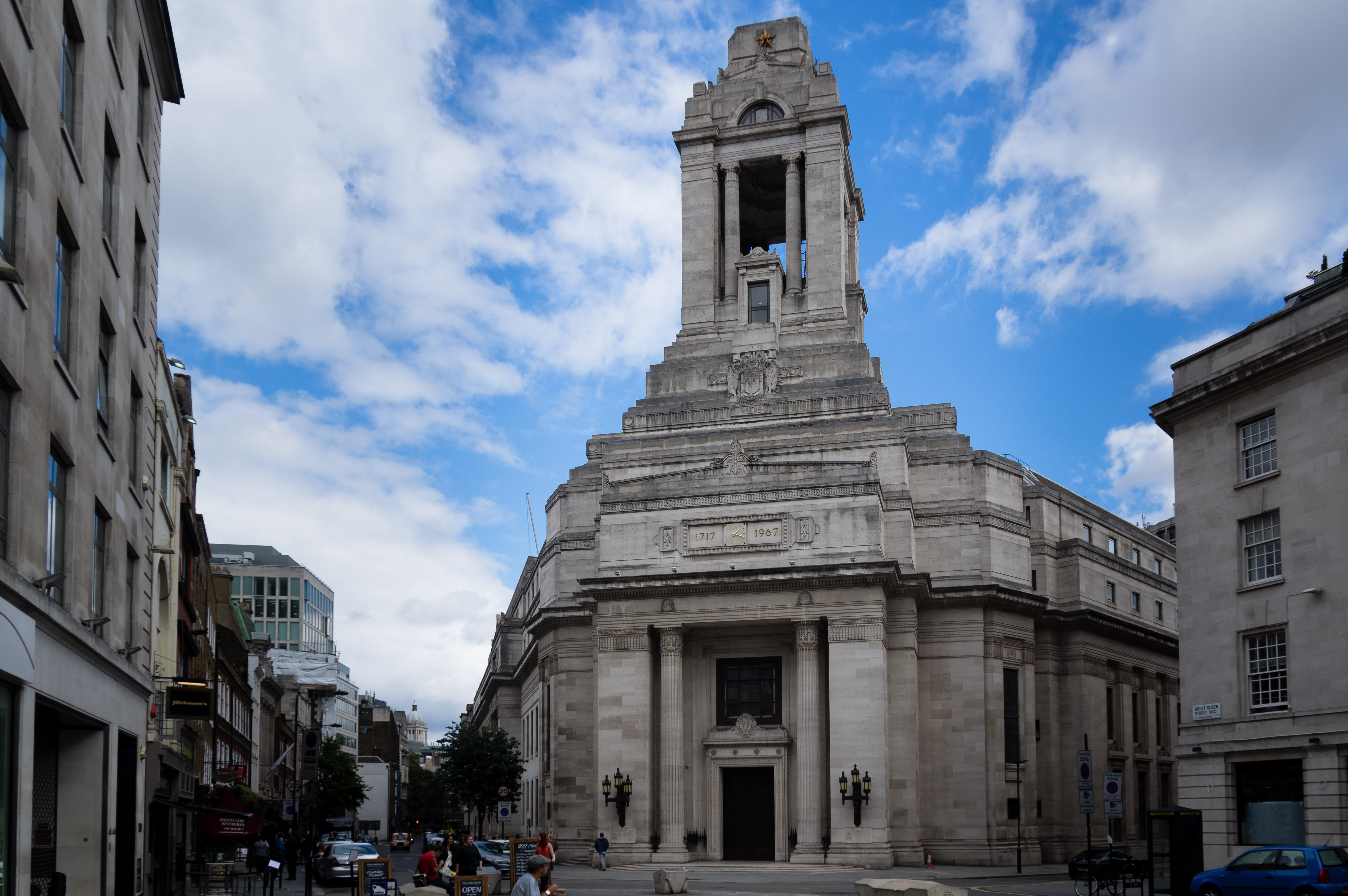
Freemasons' Hall in London, headquarters of the United Grand Lodge of England, shows the public and institutional dimension of modern Freemasonry. It is not only underground rumor; it is also building, archive, museum, association and social history.
The editorial problem is holding both things together: real institution and secret imagination.
Symbols: square, compasses and the letter G
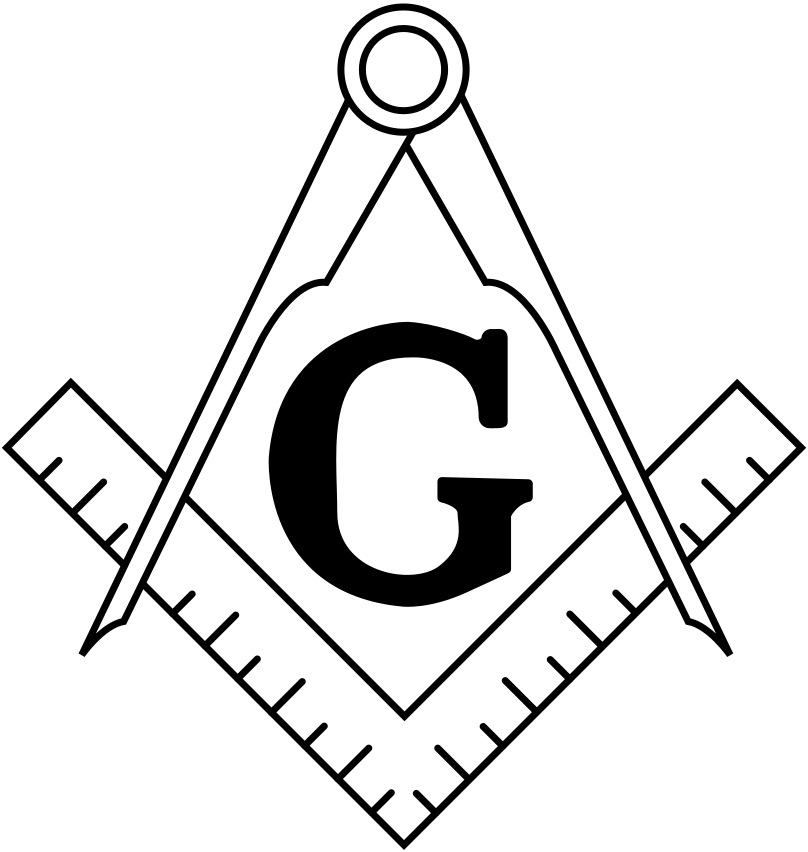
The most recognized symbol is the Square and Compasses. In Masonic readings, the square often points to rectitude, correct conduct and ethical relationship with others. The compasses suggest measure, limit, self-control and mastery of desires.
In many American versions, the letter G appears in the center. It can be interpreted as God or Geometry. That ambiguity matters: Freemasonry mixes moral language, reference to the Great Architect of the Universe and fascination with geometric order.
That is why the theme connects with sacred geometry, Flower of Life and Tree of Life. But symbol is not automatically proof of hidden control. It is ritual language.
Freemasonry and politics
Freemasonry had politically relevant members. George Washington, for example, was a Mason, and the presence of Masons among political, military and intellectual elites of the eighteenth and nineteenth centuries fed many interpretations about influence.
This influence needs precision. Powerful members existed. Social networks matter. Lodges could create trust, circulation of ideas and patronage relations. But that does not prove that “Freemasonry” as one block controlled governments. The difference between elite network and secret central command is enormous.
Anti-Masonry and public fear
Suspicion toward Freemasonry is almost as old as its modern expansion. Ritual secrecy, oaths and closed sociability created anxiety among churches, monarchies, popular movements and political rivals.
In the late eighteenth century, authors such as John Robison helped link Freemasonry, the Illuminati and the French Revolution into a narrative of revolutionary conspiracy. This kind of reading created a lasting fusion: Masonic lodge, hidden elite, anti-Christianity, political manipulation and world project.
Freemasons and Illuminati
Freemasonry and the Illuminati are often mixed in popular imagination, but they are not the same thing. The Bavarian Illuminati were a specific order, founded in 1776 and suppressed only a few years later. Freemasonry is a much broader fraternal tradition, with distinct lodges, rites and obediences.
The confusion persists because both use secrecy, initiation, Enlightenment language and member networks. For AwakenMap, the point is not to deny every influence, but to prevent different categories from becoming one dark mass called Cabal / Deep State / Illuminati.
Conspiracy: where there is smoke and where there is projection
There are real reasons to study Freemasonry seriously: elite sociability, discreet networks, symbols, cultural influence, religious conflicts and the participation of members in important historical moments. That is social history.
The weak leap happens when every building, dollar bill, revolution, court, war or political decision is automatically attributed to Masons. Then Freemasonry stops being a historical object and becomes a screen for explaining everything that feels opaque.
Why it belongs on AwakenMap
The main fracture here is between fraternity and suspicion. Free Masons shows how an association of moral improvement and reserved sociability can be perceived as school of virtue, influence club or secret machine of control.
The philosophical connection on AwakenMap lives in this question: when real networks of belonging exist among powerful people, how do we distinguish sociability, influence, conflict of interest and total conspiracy? Awakening, here, means learning to investigate bonds without turning every symbol into a verdict.
How to continue on the map
After this theme, explore Secret Societies, Illuminati, Cabal / Deep State / Illuminati, Knights Templar, CFR, Deep State, global control, sacred geometry, Flower of Life and Tree of Life.
Simple summary
Free Masons are members of Freemasonry, a modern initiatory fraternity organized in lodges, with symbolic roots in builders and an important institutional marker in 1717. Its rituals and symbols work with morality, measure, inner construction and sociability. Freemasonry had influential members and real networks, but that does not prove centralized world control. The theme is strongest when it separates history, symbol, social elite and conspiratorial myth.
References and starting points
- United Grand Lodge of England - What is Freemasonry?
- United Grand Lodge of England - History of Freemasonry
- Mount Vernon - Freemasonry and George Washington
- Mount Vernon - Masonic Associations
- History - Freemasons and Illuminati differences
- The History Press - The first Masonic Grand Lodge
- Freemason.com - Square and Compasses symbolism
- Public Domain Review - John Robison and the Illuminati conspiracy
- Wikimedia Commons - Square and Compasses
- Wikimedia Commons - Freemasons' Hall, London
FAQ
Is Freemasonry a religion?
It generally presents itself as a fraternity, not a religion. But it uses spiritual, moral and symbolic language, including the idea of the Great Architect of the Universe.
Do Freemasons control governments?
There is no proportional evidence of centralized world control. Historically influential members and real social networks exist, but that is different from one secret command.
Are Freemasons and Illuminati the same thing?
No. They merge in conspiratorial imagination, but they have different histories and structures.
Keep exploring
You can open another path
 Control systems Illuminati 5/5 intensity Explore → Control systems Illuminati 5/5 intensity Explore →
  Esoteric practices Jordan Maxwell 5/5 intensity Explore →
  Esoteric practices Luciferian Force 5/5 intensity Explore →
  Esoteric practices Secret Societies 5/5 intensity Explore →
  Control systems Cabal / Deep State / Illuminati 4/5 intensity Explore →
Join the conversation
Comments are moderated. Keep the discussion respectful and distinguish evidence, interpretation and personal experience.