Connection level
14 direct connectionsEarth is the central World node in AwakenMap: living planet, interconnected system, crust, mantle, core, oceans, climate, biosphere, magnetic field and school of consciousness.
The planet as living map
Earth is the simplest and most difficult theme in AwakenMap. Simple because every reader knows where they are: here, underfoot, breathing the atmosphere, drinking water, looking at the sky. Difficult because Earth does not fit in a single category. It is physical planet, living system, geological archive, biological home, magnetic field, cultural memory and, for many traditions, a school of consciousness.
NASA observes Earth as a system through satellites: land, water, air, temperature, climate, agriculture, greenhouse gases, fires, sea level and many other connected processes. This view is essential: Earth is not a static ball where things happen on top. It is a set of cycles affecting one another.
In AwakenMap, Earth functions as root node. Almost every other theme returns to it: ancient civilizations, ley lines, Antarctica, underground worlds, climate, free energy, frequency, collective awakening, off-world colonies and the larger question of what it means to inhabit this place.
Crust, mantle and core: the deep body
USGS describes Earth's internal structure in three great layers: crust, mantle and core, with important subdivisions. The crust is thin and rigid compared with the whole planet. The mantle occupies most of the volume. The core, divided into liquid outer core and solid inner core, participates in generating the magnetic field.
This deep architecture changes how we imagine the planet. We live on an extremely thin skin, like beings walking on the shell of something immense. Mountains, volcanoes, earthquakes and ocean ridges are signs that the interior remains active.
For AwakenMap, this depth connects Earth to Hollow Earth, underground bases, Agartha, tunnels, crystals, volcanism and telluric lines. Critical reading separates known geophysics from underground speculation, but understands why the planet's interior has always ignited imagination.
Oceans, atmosphere and biosphere
Earth is a water planet. Oceans regulate temperature, store carbon, feed climate cycles, create habitats and connect continents. The atmosphere protects, distributes heat, transports moisture and allows breathing. The biosphere transforms solar energy into life, soil, food and complexity.
These layers do not live separately. A forest changes humidity and soil. An ocean changes climate. Ice reflects light. Microorganisms modify chemistry. Humans burn fuels, move species, build cities, divert rivers and alter planetary cycles.
This interconnection is the heart of Earth system science. The planet must be read as a network, not as a collection of objects. The same is true symbolically: each theme on the map is a node in a larger network.
Magnetic field and invisible protection
Earth has a magnetic field generated by motion in the liquid outer core. This field helps protect the planet from part of the solar wind and charged particles, while also creating phenomena such as auroras. Without it, the relationship between atmosphere, radiation and life would be far more hostile.
For this reason, the magnetic field appears in many alternative narratives: pole shift, resonance, energy grids, spiritual protection, portals and force lines. Some questions have scientific basis; others enter symbolic or speculative territory.
Mature reading recognizes the real value of terrestrial magnetism without turning every sensation or theory into physical fact. Magnetism exists. Spiritual grids are interpretations. Confusing the two weakens both.
Earth as a system of memory
Earth holds memory in layers: rocks, fossils, ice, sediments, tree rings, DNA, languages, ruins, myths and routes. Each layer records a kind of time. An ice core speaks of ancient atmosphere. A ruin speaks of human organization. A flood myth may hold trauma, morality or echo of disaster.
This memory is not perfect. It breaks, erases, mixes and requires interpretation. That is why archaeology, geology and history work as readings of traces. The planet does not hand us a finished book; it gives signs.
In AwakenMap, Earth is the archive where all themes leave marks. Atlantis asks about submerged memories. Antarctica asks about ice and maps. Pyramids ask about engineering and alignment. Ley lines ask about landscape and pattern.
Gaia, living planet and spiritual language
The idea of Earth as a living organism appears in many traditions and also in modern language inspired by Gaia. Scientifically, the Gaia hypothesis was debated as a model of regulation between life and environment. Spiritually, Gaia became a name for Earth as presence, mother, consciousness or field of learning.
These languages are not identical. Science seeks testable mechanisms. Spirituality works with relationship, reverence, experience and meaning. The mistake is forcing one language to prove the other too simply.
A premium page can hold both layers without confusing them: Earth is a real, measurable and vulnerable physical system; and also a symbolic matrix where humans learn belonging, limit, care and responsibility.
Crisis as collective initiation
Climate change, biodiversity loss, pollution, fires, water scarcity and habitat collapse show that Earth is not only a stage. It responds. NOAA and other institutions track data and risks to help societies understand, prepare and adapt to a changing climate.
In the Great Awakening universe, planetary crisis is often read as collective initiation: humanity would be forced to leave sleep, unconscious consumption and separation from nature. This reading can inspire responsibility, but it can also become passivity if everything is treated as an inevitable plan.
The stronger posture is to unite consciousness and action. Awakening is not watching the planet become ill while waiting for external salvation. It is recognizing interdependence and changing our relationship with energy, food, technology, territory and community.
Earth and underground narratives
Earth's interior has always produced myths: underworlds, hidden kingdoms, ancestors in caves, underground cities, dragons, Agartha, Shambhala, deep military bases and Hollow Earth. Depth symbolizes the unknown, the unconscious, death, origin and secrecy.
Geologically, we know the interior is hot, dense, layered and inaccessible at ordinary human scale. This limits literal readings about civilizations living in the core or vast hollow worlds. But caves, tunnels, mines, aquifers and real underground systems show that the subsurface is indeed a world of its own.
AwakenMap can build that bridge: respecting geophysics while studying why humanity has always imagined that truth might be buried.
Earth, technology and responsibility
Human technology has become a planetary force. Satellites observe the atmosphere, sensors measure oceans, models simulate climate, mining removes mountains, agriculture redraws biomes, digital networks change behavior and energy transforms societies. Modern Earth is also technosphere.
This creates an ethical question: will technology be an instrument of domination or care? Free energy, regenerative cities, resilient agriculture, environmental monitoring and open science can appear as paths of healing. But technology without wisdom repeats the Atlantis myth: power growing faster than consciousness.
Earth, in this sense, is a test. It tests whether humanity can use knowledge without destroying the conditions that make knowledge possible.
Habitability: a balance built through time
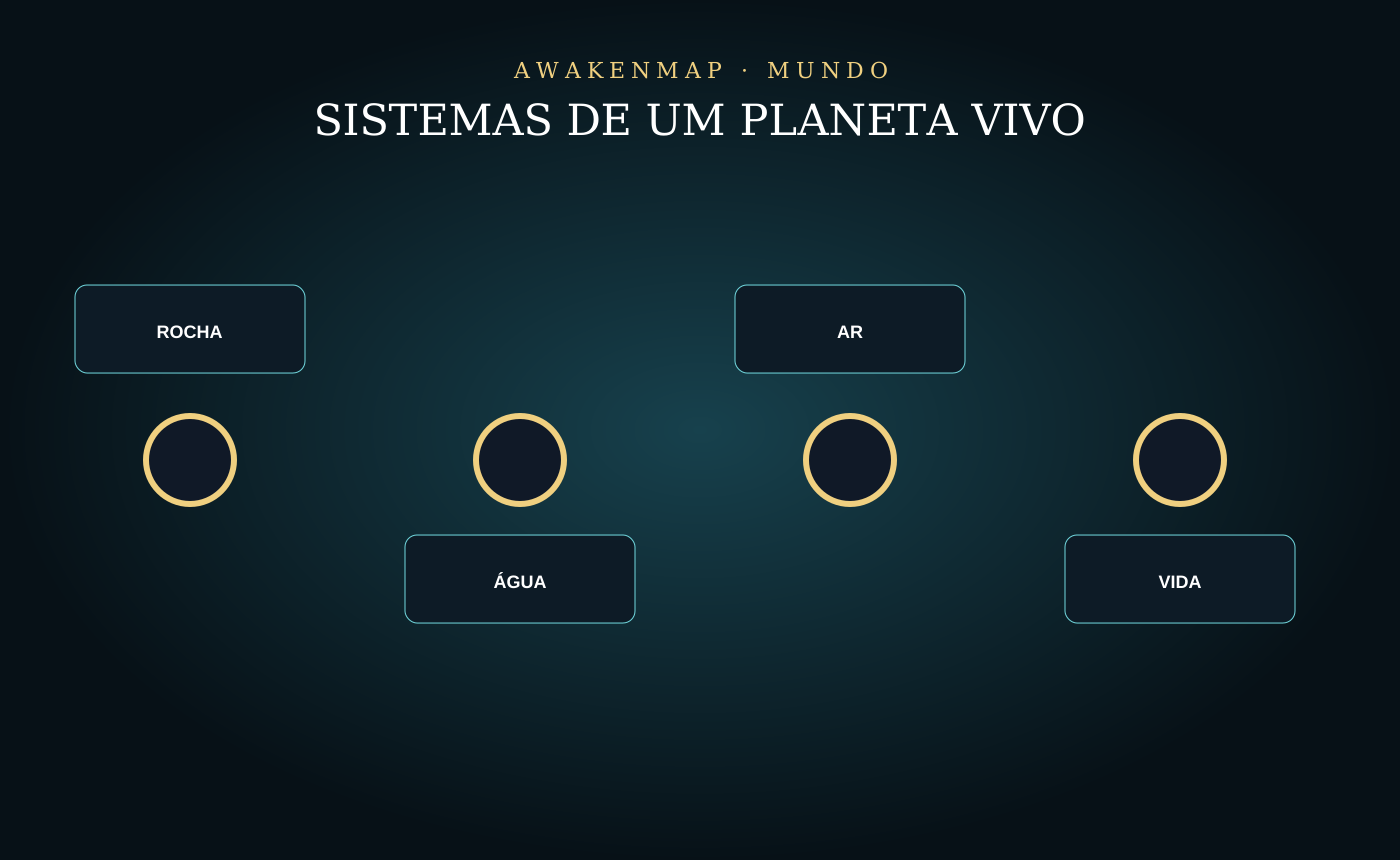
Earth is not habitable merely because it lies at a suitable distance from the Sun. Liquid water, atmosphere, carbon cycling, tectonics, magnetic field and biology have interacted for billions of years. Habitability is a process, not a fixed address.
The Moon partly stabilizes axial tilt while Earth’s gravity retains an atmosphere. Volcanism returns gases to the air, weathering removes carbon and oceans distribute heat. No element acts alone. Small changes can be absorbed, while large disturbances reorganize the system.
Extinction and the history of vulnerability
The geological record contains mass extinctions driven by volcanism, climate shifts, ocean change and asteroid impact. Life persisted, but not without immense loss. Saying that Earth will survive does not mean ecosystems or human societies will remain intact.
This distinction changes environmental ethics. The physical planet will continue; what is at stake is habitability, biodiversity, water, agriculture and justice among populations that contribute to and suffer from change unequally.
Anthropocene and planetary boundaries
Anthropocene is used to discuss the geological scale of human influence, although its formal stratigraphic status remains debated. Emissions, plastics, concrete, fertilizer and radionuclides have left widespread signatures in Earth systems.
The planetary-boundaries framework identifies processes supporting a relatively stable space for human societies. It is not a prophecy of instant collapse but a tool for understanding systemic risks and preventing pressures from reinforcing one another.
This reading also corrects the idea that nature and humanity are separate domains. Cities, agriculture, digital networks and economies still depend on soil, climate, minerals and biological cycles. Technology changes our relationship with Earth but does not cancel our terrestrial condition.
Seeing Earth from space intensified the image of one shared world without visible borders. Yet planetary unity must not erase political difference: responsibility, exposure and capacity to respond are distributed unequally. A global perspective becomes ethical only when it includes those inequalities and asks who receives protection, resources, representation and a meaningful voice in collective planetary decisions today and tomorrow.
Earth in AwakenMap
In AwakenMap, Earth connects to Antarctica, Inner Earth, Hollow Earth, Agartha, Ley Lines, Resonance, Free Energy, Ancient Civilizations, Great Awakening, Pole Shift, Sun, Moon, Mars, underground bases and unified field. It is not merely one theme among others; it is the plane where the whole network incarnates.
As World, it is physical planet: crust, water, climate, biosphere, rocks and territory. As Knowledge, it is Earth system science, geology, ecology, archaeology and technology. As Cosmic, it is school, consciousness, frequency, memory and relationship between humanity and universe.
The best reading of Earth is both humble and grand. Humble because we live on a thin layer and depend on cycles we do not control. Grand because this small planet managed to produce oceans, forests, thought, music, telescopes, myths and questions about itself.
How to read this theme
Start with the real planet: NASA, USGS, NOAA, geology, climate, oceans, atmosphere and biosphere. Then observe the symbolic layers: Gaia, spiritual school, energy lines, underground world and ancestral memory.
When a theory about Earth appears, ask what language it uses. Is it measurable physics? Spiritual experience? Myth? Metaphor? Historical claim? Each requires a different standard.
Earth is the center because everything returns to it. Before seeking other worlds, AwakenMap must ask whether we have learned to inhabit this one.
Critical reading
Earth should be read in layers: physical planet, living system, historical archive and spiritual symbol. The page separates science, myth and experience without reducing one to another.
References and starting points
- NASA Science - Earth
- NASA Earth Science Division
- USGS - The Interior of the Earth
- USGS - Inside the Earth
- NOAA - Climate
- National Academies - Earth System Science
FAQ
Why is Earth a premium World theme?
Because every other theme incarnates within it: places, climate, ruins, lines, oceans, underground, technology and human consciousness.
Is Earth only a physical planet in AwakenMap?
No. It is treated as a real planet and also as symbolic, spiritual and historical matrix, while separating evidence from metaphor.
Keep exploring
You can open another path
 Earth and Antarctica Antarctica 5/5 intensity Explore →
  Ancient civilizations The Grand Experiment 5/5 intensity Explore →
  Esoteric practices Sun 5/5 intensity Explore →
  Earth and Antarctica Inner Earth Civilizations 4/5 intensity Explore →
  Esoteric practices Dolphins and Whales 4/5 intensity Explore →
  Earth and Antarctica Global Warming 4/5 intensity Explore →
Join the conversation
Comments are moderated. Keep the discussion respectful and distinguish evidence, interpretation and personal experience.