
Connection level
10 direct connectionsSasquatch belongs on AwakenMap through the question of when an ambiguous image becomes proof, myth or collective mirror. The topic describes a tall, hairy, bipedal and elusive being associated mainly with the forests of northwestern North America. To some, it is Indigenous folklore reinterpreted by popular culture. To others, it is an unknown hominin, surviving species, spiritual guardian, interdimensional being or evidence hidden by authorities.
The word Sasquatch is usually linked to adaptations of Indigenous terms from British Columbia, especially accounts of large wild beings in forested places. Care is needed: there is no single homogeneous Indigenous tradition here. Different peoples preserved different stories, some spiritual, territorial, pedagogical or liminal.
The modern Bigfoot version gained force in 1958 in northern California. Road workers near Bluff Creek reported huge tracks. Jerry Crew brought a plaster cast to the press, and the Humboldt Times helped turn the story into a national phenomenon.
The image beside this text is a frame from the Patterson-Gimlin film, recorded on October 20, 1967 at Bluff Creek, California. Roger Patterson and Bob Gimlin said they filmed a creature walking near the creek bed.
This frame became the central icon because it seems to show something concrete, but it never ended the dispute.
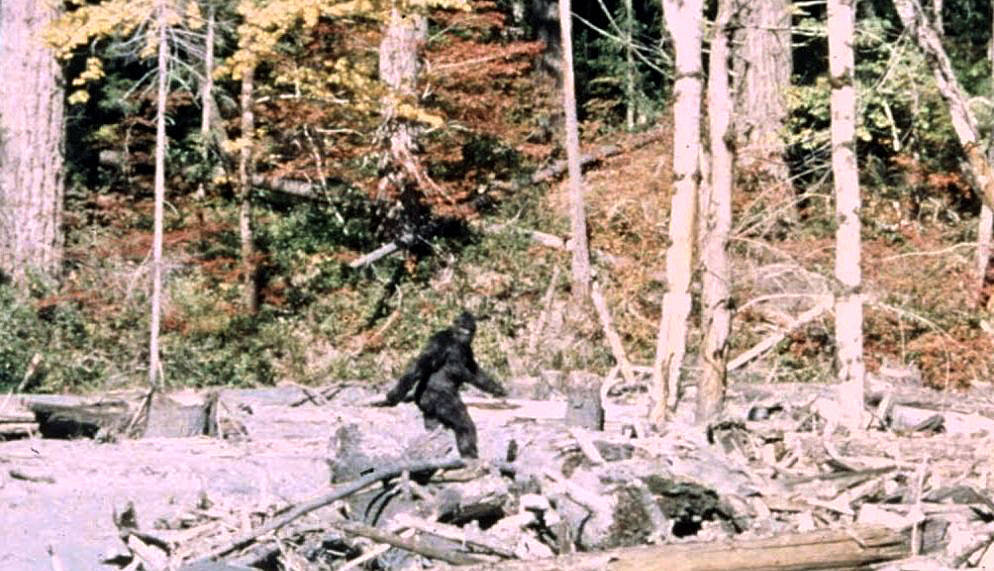
The Patterson-Gimlin case is the modern center of the debate. Supporters study body proportion, movement, apparent musculature, gait and tracks. Critics point to costume possibility, timeline problems, commercial motive and lack of later biological proof. Its ambiguity is exactly what makes it powerful.
Scientifically, the problem is hard: there is still no confirmed body, bone, tissue, scat, unequivocal genetic material or environmental sequence establishing an unknown large North American primate. A 2014 Proceedings of the Royal Society B study analyzed hair samples attributed to anomalous creatures, including Bigfoot and yeti, and mostly found known animals.
The conspiratorial layer begins when lack of proof is explained as coverup. The theory says governments, national parks, universities, logging interests or military groups possess bodies, bones, clear images or genetic studies but hide them to avoid panic, protect land access or preserve official narratives.
The connection with hidden history appears when Sasquatch is treated as a survivor of erased human history. In some versions, it is related to ancient hominins, giant memories or a lineage omitted from official books.
The bridge with giants is direct: great height, unusual strength, enormous footprints and liminal presence. Conspiratorial tradition blends Sasquatch with giant skeleton lore, pre-human lineages and earlier civilizations.
hyperdimensional physics enters when the being stops being only biological. Many modern accounts claim Sasquatch appears and disappears strangely, avoids cameras, emits impossible sounds, affects electronics or appears alongside lights in the sky.
The link with UFO / UAP and Cosmic Disclosure comes from that hybrid zone. Some accounts connect Sasquatch sightings with lights, discs, telepathy, forest symbols and the feeling of being watched.
Hollow Earth appears in narratives linking hidden creatures to caves, tunnels, mountains and entrances into subterranean systems. The forest becomes only the surface.
collective consciousness helps explain why the topic endures. Sasquatch is more than a monster. It carries the desire that something ancient and uncontrolled still exists beyond satellites, cameras and maps.
global control enters when forest becomes political territory. If an intelligent or protected species were recognized, land use, park protocols, industry access and Indigenous authority over places and stories could change.
propaganda moves in the opposite direction: turning every shadow into a click. Blurry photos, edited sounds, uncustodied tracks and short videos are packaged as revelation.
A mature reading holds three things at once: Indigenous traditions and local testimonies deserve context; biological existence requires proportional evidence; the myth has value even without conclusive proof because it reveals our relationship with forest, frontier, fear, memory and mystery.
Simple summary
Sasquatch is the figure of a large, hairy, bipedal being associated with North American forests. The topic combines Indigenous traditions, 1958 newspaper culture, footprints, the 1967 Patterson-Gimlin film, cryptozoology, genetic studies without definitive confirmation and theories about government coverup, interdimensional beings, giants, Hollow Earth and non-human contact.
References and starting points
- University of Chicago - historical study of the Bigfoot legend
- History.com - modern newspaper origin of Bigfoot in 1958
- High Desert Museum - Sasquatch through an Indigenous lens
- Proceedings of the Royal Society B - genetic analysis of samples attributed to anomalous primates
- Wikimedia Commons - Patterson-Gimlin frame in public domain
- Wikimedia Commons - Bigfoot visual materials category
Why it belongs on AwakenMap
It belongs because it shows how an ambiguous presence can move through folklore, science, media, spirituality and coverup theory. Sasquatch helps examine what happens when an image, footprint or testimony seems to challenge the boundary between known nature, ancestral memory and collective imagination.
Keep exploring
You can open another path
 Map center Great Awakening 5/5 intensity Explore →
  Esoteric practices Hidden History 5/5 intensity Explore →
  Consciousness and symbols Collective Consciousness 4/5 intensity Explore →
  Ancient civilizations Giants 4/5 intensity Explore →
  Esoteric practices Hyperdimensional Physics 4/5 intensity Explore →
  Esoteric practices Cosmic Disclosure 3/5 intensity Explore →
Join the conversation
Comments are moderated. Keep the discussion respectful and distinguish evidence, interpretation and personal experience.