Connection level
8 direct connectionsHollow Earth is one of the great underground mythologies: Halley, Symmes, polar openings, Jules Verne, Agartha, caves, geophysical science and imagination of the inner world.
The desire for a world inside the world
Hollow Earth is the idea that the planet is not solid as modern geology describes it, but contains vast internal cavities, concentric shells, underground continents, inner suns or entrances through the poles. In some versions, this interior is inhabited by ancient peoples, advanced civilizations, spiritual beings or survivors of lost ages.
The force of this myth does not come only from scientific error. It comes from a powerful narrative intuition: perhaps there is a world inside the world, a hidden layer where what was lost continues alive. Earth's interior becomes archive, refuge, initiatory kingdom, secret base and planetary unconscious.
In AwakenMap, Hollow Earth connects to Agartha, Inner Earth, Antarctica, Operation Highjump, underground bases, Shambhala, tunnels, crystals, ancient civilizations and escape narratives. The theme must be treated with fascination and discernment: modern science does not support a literal hollow planet, but underground imagination is historically deep.
Edmond Halley and the Earth of concentric shells
One of the most famous versions came from Edmond Halley, the astronomer associated with the comet that bears his name. In 1692, Halley presented a speculative model of Earth formed by an outer shell and inner concentric spheres. The Royal Society remembers this diagram as part of Halley's attempt to explain observed magnetic variations.
Halley was not a fantasy writer trying to sell mystery. He was a scientist trying to answer data with the tools of his time. His error shows something important: ideas that seem strange today can be born inside legitimate science when fundamental information about the planet's interior is missing.
This origin differentiates Hollow Earth from simple fable. It entered modern imagination through a scientific door, then migrated into polar exploration, literature, esotericism, ufology and conspiracy. The myth grew because a physical hypothesis became a map for cultural desires.
John Cleves Symmes and polar openings
In the nineteenth century, John Cleves Symmes Jr. popularized another version: Earth would be hollow and open at the poles. In 1818, he announced his theory and defended expeditions to find polar passages toward the inner world. The so-called Symmes openings became one of the most enduring images of Hollow Earth.
The idea worked because the poles were still poorly known in public imagination. The map had blanks. Where there was blankness, passage could fit. Antarctica and the Arctic became perfect frontiers for geographic fantasy: cold, distant, dangerous and difficult for ordinary citizens to verify.
In AwakenMap, this layer connects Hollow Earth to Antarctica and Operation Highjump. Even when the literal version does not hold, it reveals the role of inaccessible places in the creation of myths: the less the public can see, the more imagination builds.
Geophysics: why literal Earth is not hollow
Modern geophysics describes Earth as a planet differentiated into layers: crust, mantle, liquid outer core and solid inner core. USGS explains this structure through evidence such as seismic waves, density, gravity, magnetism, volcanism and the behavior of materials under extreme pressure and temperature.
If Earth had enormous internal cavities or giant polar openings, this would leave physical signs incompatible with known observations. Seismic-wave propagation, gravitational field, planetary mass, orbital dynamics and thermal structure do not match a large-scale habitable hollow world.
This part needs to be clear for quality. Hollow Earth, as a literal physical model, has been superseded. But saying this does not end the theme, because Hollow Earth is also history of ideas, literature, esotericism, psychology of the unknown and underground imagination.
Jules Verne and the initiatory descent
Jules Verne's Journey to the Centre of the Earth helped popularize the fantasy of descent into the planet's interior. Britannica notes that the novel was born in a nineteenth-century context where Hollow Earth theories circulated alongside growing interest in geology, paleontology and evolution.
In literature, descending to Earth's center is not only exploring a space. It is going back in time. The interior holds fossils, underground seas, ancient monsters, lost languages and proof that the visible world is only the surface. The descent becomes initiation.
This structure appears in many traditions: enter the cave, cross the underworld, die symbolically, meet ancestors or monsters, return transformed. Hollow Earth is less about cartography and more about the promise that there is truth beneath the crust of ordinary reality.
Agartha, Shambhala and inner kingdoms
In esotericism, Hollow Earth often mixes with Agartha, Shambhala and underground realms of masters, ancient lineages or spiritually advanced civilizations. These narratives speak of continental tunnels, entrances in the Himalayas, Tibet, the Andes, Antarctica or deep caves.
Agartha functions as a symbolic inversion. Instead of seeking the sky, the seeker descends. Wisdom would not be above, but below; not in the future, but preserved in the interior; not exposed, but guarded. This spiritual geography has strong initiatory appeal.
Critical reading should separate spiritual myth from physical claim. Agartha can be studied as an image of hidden center, inner kingdom and concealed wisdom. That does not prove global tunnels or literal civilizations living in planetary cavities.
Real caves and the underground that exists
Part of the myth's resilience comes from the fact that real underground worlds exist at human scale: enormous caves, subterranean rivers, karst systems, mines, bunkers, excavated cities, military tunnels, aquifers, lava tubes and ecosystems without direct sunlight.
These places prove that the subsurface is not empty of experience. It holds life, danger, water, minerals, human memory and architecture. But real caves are not the same as a hollow planet. The passage from real to gigantic needs proportional evidence.
In AwakenMap, this distinction is valuable. It allows Hollow Earth to connect to underground bases, D.U.M.B.s, crystals, Agartha and Inner Earth without confusing every hole with proof of an inner civilization.
Hollow Earth and modern conspiracy
In the twentieth and twenty-first centuries, Hollow Earth entered conspiracy narratives involving escaped Nazis, Antarctic bases, flying saucers, Operation Highjump, secret maps, geographic censorship and intraterrestrial civilizations. Antarctica became one of the favorite entrances precisely because it is remote and politically regulated.
These narratives work as collages. They take real facts, such as polar exploration, research bases, military secrecy and extreme geography, and connect them to speculative leaps: hidden entrances, exotic technology, treaties with underground beings or internal continents.
The page needs to give the reader tools to dismantle the collage. Which parts are documented fact? Which are inferences? Which depend on isolated testimony? Which are fiction recycled as if it were a report?
Psychology of depth
Hollow Earth survives because depth has meaning. What is below seems older, more dangerous, more true or more forbidden. Caves have been shelters, temples, tombs, mines, hiding places and ritual spaces. The underground is literally where we bury the dead and symbolically where we keep fears.
For this reason, the idea of an inner world speaks to the unconscious. To descend is to encounter what was repressed. Finding an underground civilization can represent finding a hidden part of humanity: older, wiser, more monstrous or purer.
This symbolic reading does not need to fight science. On the contrary, it saves the value of the myth without requiring Earth to be physically hollow. The myth keeps speaking, but in another language.
How seismic waves reveal the interior
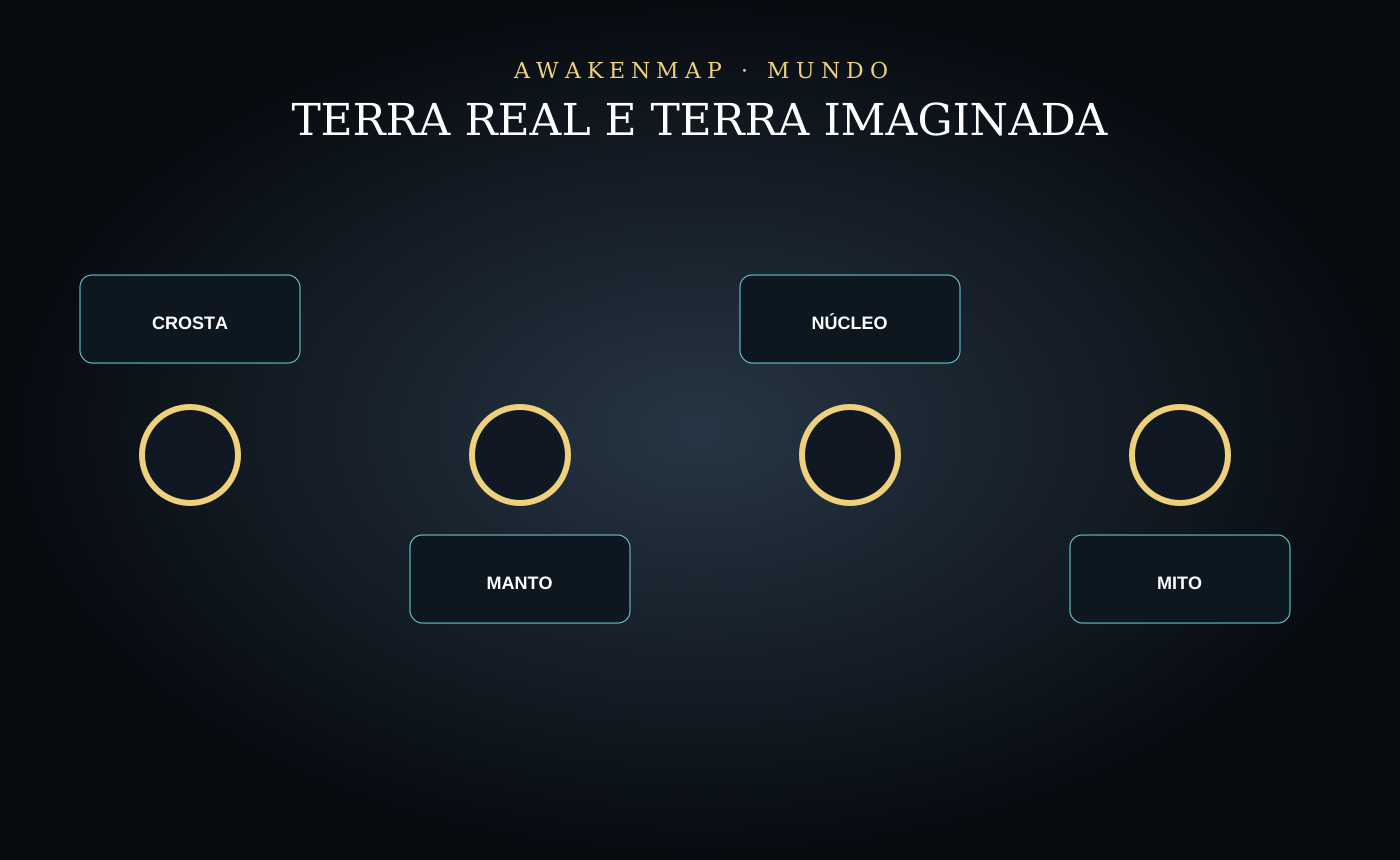
Earthquakes produce P and S waves that cross the planet. P waves pass through solids and liquids; S waves do not cross liquids. Velocity, refraction and shadow zones reveal boundaries among crust, mantle, outer core and inner core.
Global seismic networks repeat these observations. A large hollow space would alter paths, arrival times, gravity and moment of inertia in ways incompatible with measurement. The interior is not directly photographed, but multiple independent forms of evidence test it.
The alleged secret diary of Richard Byrd
Texts circulated as Richard E. Byrd’s diary describe a flight beyond the pole, green landscapes, animals and an encounter with an inner civilization. They are often presented as a hidden confession.
The document’s provenance is deeply problematic: versions circulated long after the events without a reliable archival chain and conflict with known flight, logistical and communication records. A first-person narrative is not authenticated simply because it imitates a diary.
Polar photographs and the hole myth
Composite Earth images can show dark or missing polar areas because of orbit, illumination, mosaicking and processing. Such visual gaps have been reinterpreted as giant openings.
Satellites, aviation, scientific stations, GPS and gravimetry cover polar regions through different methods. An opening hundreds of kilometres wide would create obvious topographic, gravitational and atmospheric signals. Absence from one image does not erase the wider observational record.
Real caves and depth limits
Cave systems may extend hundreds of kilometres horizontally, but depth is limited by pressure, temperature, water and rock behaviour. Deep mines demonstrate how heat rises rapidly.
The real subsurface remains extraordinary: microbial biospheres, aquifers, lava tubes and isolated ecosystems expand imagination. Recognizing these worlds does not require turning the planet into an empty shell.
Hollow Earth in AwakenMap
In AwakenMap, Hollow Earth connects to Inner Earth, Agartha, Antarctica, Operation Highjump, Underground Bases, D.U.M.B.s, Anshar, Pre-Adamites, crystals, tunnels, Shambhala and ancient civilizations. It is a transition node between physical world, polar myth, esotericism and conspiracy.
As World, it speaks of poles, caves, geology, subsurface and exploration. As Knowledge, it speaks of Halley, Symmes, history of science, literature and geophysics. As Cosmic, it speaks of hidden realms, initiation, inner memory, underground masters and planetary secrecy.
The best page about Hollow Earth should not pretend current science supports the literal model. It also should not throw the myth away as trash. It should show why intelligent people imagined this, why geophysics superseded the idea and why the image of the inner world remains alive.
How to read this theme
Start by separating levels: old scientific hypothesis, modern geophysics, adventure literature, esotericism, ufology, conspiracy and psychological symbolism. Each level has different rules.
When a literal claim appears, ask whether it matches seismic waves, gravity, planetary mass, polar images, geographic exploration and geological data. When a symbolic reading appears, ask what it reveals about fear, origin, secrecy and desire for initiation.
Hollow Earth is powerful because it shows the boundary between map and myth. Earth does not need to be hollow for the interior to keep calling.
Critical reading
Hollow Earth should be read as superseded historical hypothesis, underground myth, literature, esotericism and symbol of depth. Modern geophysics does not support the literal model, but the image of the inner world remains culturally powerful.
References and starting points
- Royal Society - Magnetic Halley
- Library of Congress - Hollow Earth Theories: A List of References
- Geophysical Institute - The Hollow Earth Theory
- USGS - Inside the Earth
- Britannica - A Journey to the Centre of the Earth
- History Today - The Worlds at the Earth's Core
FAQ
Is Earth literally hollow?
Not according to modern geophysics. Seismic waves, gravity, density and internal structure indicate crust, mantle and core, not a large habitable hollow world.
Why does the myth remain strong?
Because the underground symbolizes origin, secrecy, death, initiation and hidden knowledge. The idea works as myth even when it does not work as geology.
Keep exploring
You can open another path
 Esoteric practices Library of Porthologos 5/5 intensity Explore →
  Esoteric practices Operation Highjump 4/5 intensity Explore →
  Ancient civilizations Lemuria 4/5 intensity Explore →
  Esoteric practices Inner Earth Civilization 4/5 intensity Explore →
  Esoteric practices Agartha 4/5 intensity Explore →
  Control systems Vril Society 4/5 intensity Explore →
Join the conversation
Comments are moderated. Keep the discussion respectful and distinguish evidence, interpretation and personal experience.