Connection level
10 direct connectionsAgartha is the legendary underground kingdom of modern esotericism: Himalayas, Shambhala, King of the World, Hollow Earth, inner initiation and the risk of confusing depth myth with literal geography.
The realm beneath the surface
Agartha, also written Agarttha or Agharta, is one of modern esotericism's most persistent images: a hidden realm beneath the Earth, often associated with the Himalayas, Tibet, Central Asia, underground cities, ancient libraries, invisible masters and a spiritual center influencing surface history.
In popular imagination, Agartha appears as an inner civilization, refuge of sages, capital of a previous humanity or secret spiritual government. In more conspiratorial versions, it connects to polar entrances, underground bases, occult Nazism, Hollow Earth, Shambhala, Vril and lost technologies.
In AwakenMap, Agartha needs to be read as a myth of depth before being treated as geographical map. The mature question does not begin with where is the door?, but with why so many modern traditions imagined true wisdom hidden beneath the surface.
Saint-Yves d'Alveydre and the modern form of the myth
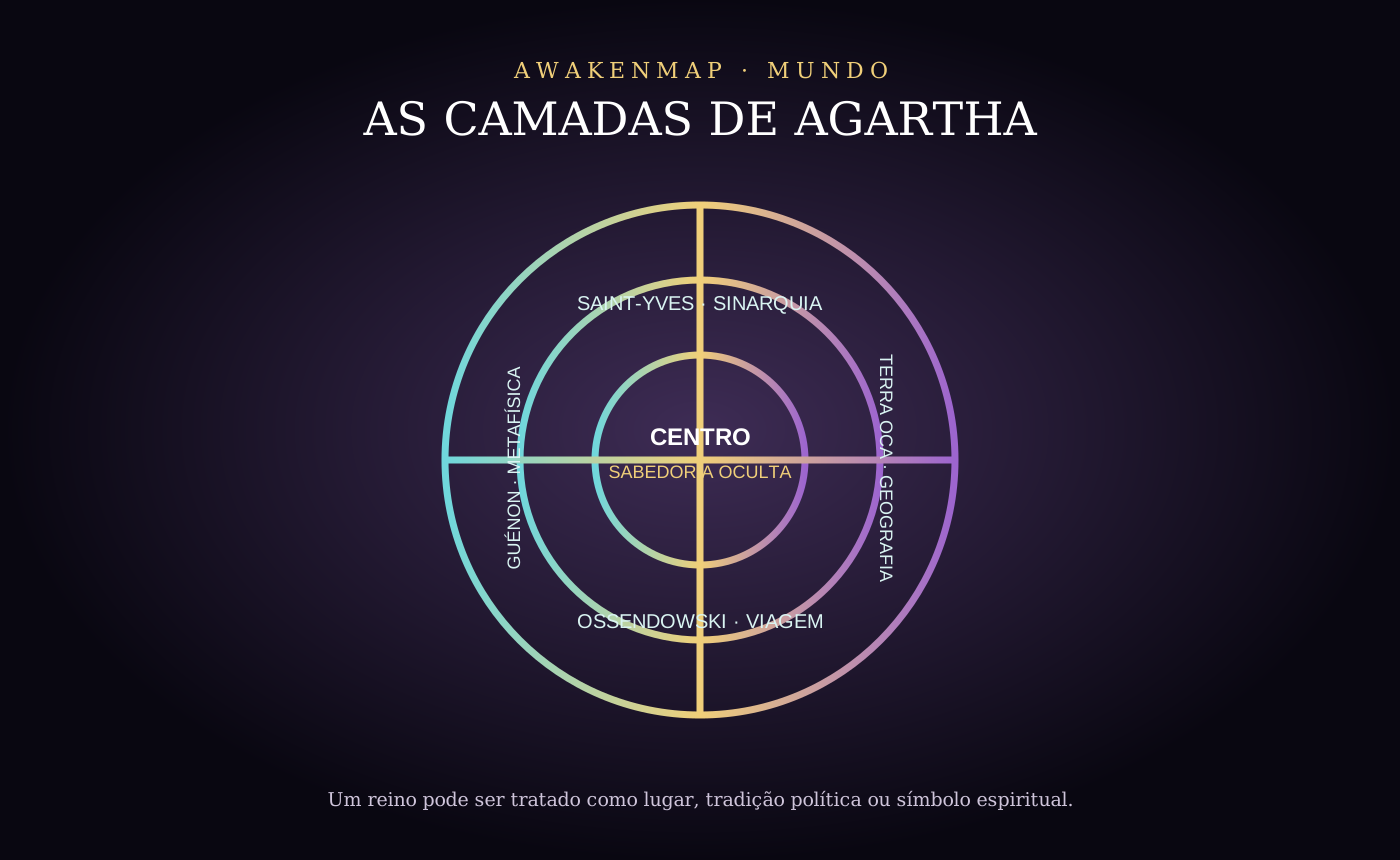
The most influential modern version of Agartha is usually associated with Alexandre Saint-Yves d'Alveydre, a nineteenth-century French occultist. In Mission de l'Inde, he described Agarttha as a subterranean or interior center of wisdom, governed by a spiritual authority called the Brahâtma, linked to a higher order of knowledge and government.
This detail matters: Agartha does not arise as a simple fantastic cave. It emerges inside an esoteric-political project. Saint-Yves imagined a social order guided by spiritual principles, a kind of synarchy in which science, religion and government would be harmonized by initiatic intelligence.
Thus Agartha functions as an indirect criticism of the modern world. In the face of fragmented states, wars, materialism and institutional confusion, the myth offers the image of a hidden civilization that preserved unity, spiritual hierarchy and total knowledge.
The King of the World and invisible authority
In many versions, Agartha is ruled by a King of the World or hierarchy of masters. This figure should not be read only as an underground monarch. It represents the desire for a higher authority that orders history, protects wisdom and corrects the chaos of the surface.
This image appears in many esoteric traditions: hidden masters, invisible fraternities, secret spiritual centers, planetary guardians. The common point is the idea that visible humanity is not alone and not fully in command. A deeper layer is watching, guiding or waiting for the right moment.
Critical reading asks what this invisible authority resolves psychologically. It offers meaning when history seems accidental. It offers order when institutions fail. It offers hope when the surface seems lost. But it can also feed passivity: waiting for hidden masters to solve what requires human responsibility.
Agartha and Shambhala: proximity and confusion
Agartha is frequently confused or related to Shambhala. Shambhala has its own roots in Tibetan Buddhist traditions and the Kalachakra cycle, as well as modern reinterpretations such as Shambhala International, linked to the diffusion of meditative practices in the West. Agartha, by contrast, belongs mainly to modern Western esotericism and Inner Earth literature.
The confusion between the two names reveals how the West often mixed India, Tibet, Mongolia, Buddhism, occultism, Theosophy and geographical fantasy into one Orientalist fog. This does not mean there are no symbolic bridges; it means the traditions need to be differentiated.
On the map, Agartha and Shambhala can dialogue as images of hidden center and preserved wisdom. But treating them as the same thing erases different histories, texts and contexts. Cultural precision improves the mystery instead of reducing it.
Hollow Earth, poles and impossible geography
In the twentieth century, Agartha was absorbed by Hollow Earth theories. In this layer, the underground kingdom stops being only a spiritual center and becomes alternative geography: polar openings, inner oceans, central sun, continents inside the planet and civilizations living on Earth's inner surface.
Modern geology describes Earth with crust, mantle, outer core and inner core, supported by seismology, gravity, volcanism, magnetism and materials physics. There is no robust scientific evidence for a habitable hollow Earth in the terms of these narratives.
This does not make Agartha irrelevant. It changes the reading. As literal geography, it requires extraordinary proof. As myth, it speaks of something deep: the feeling that the surface of life does not exhaust the real. Inner Earth may be less a physical place than an image of the unconscious, initiation and hidden memory.
Agartha, occult Nazism and dangerous use of myth
Agartha has also been linked, in certain literatures, to occult Nazism, Hyperborea, Vril, Black Sun and expeditions to Tibet or Antarctica. This layer must be treated carefully. Not every mention of Agartha is extremist politics, but some twentieth-century authors mixed the myth with racial fantasies, esoteric Aryanism and dangerous revisionisms.
The risk is not only false content; it is aesthetic seduction. Hidden kingdoms, superior lineages, secret centers and chosen civilizations can become language of racial or spiritual hierarchy. What begins as wisdom myth can be used to justify superiority and exclusion.
A responsible reading separates the symbolic value of subterranean imagination from ideological appropriations. Agartha should not be used as a fantasy of purity, spiritual elite or authority above ethics. Every powerful myth needs protection from its darkest uses.
Why the underground fascinates
The underground has always fascinated because it is the place of the hidden: caves, mines, tombs, roots, fossils, underground rivers, magma, treasures, the dead, seeds and initiations. To descend is a universal symbolic gesture. Whoever descends meets fear, memory, shadow and transformation.
Agartha concentrates this gesture into a city. It says: beneath the noise of the surface there is an older order. Beneath official history there is another history. Beneath ordinary identity there is a center. Beneath the visible world there is an inner civilization.
This image explains the myth's force even without geological proof. Agartha is architecture of interiority. It turns the spiritual question into landscape: to find wisdom, descend.
Ferdinand Ossendowski and the mystery of Central Asia
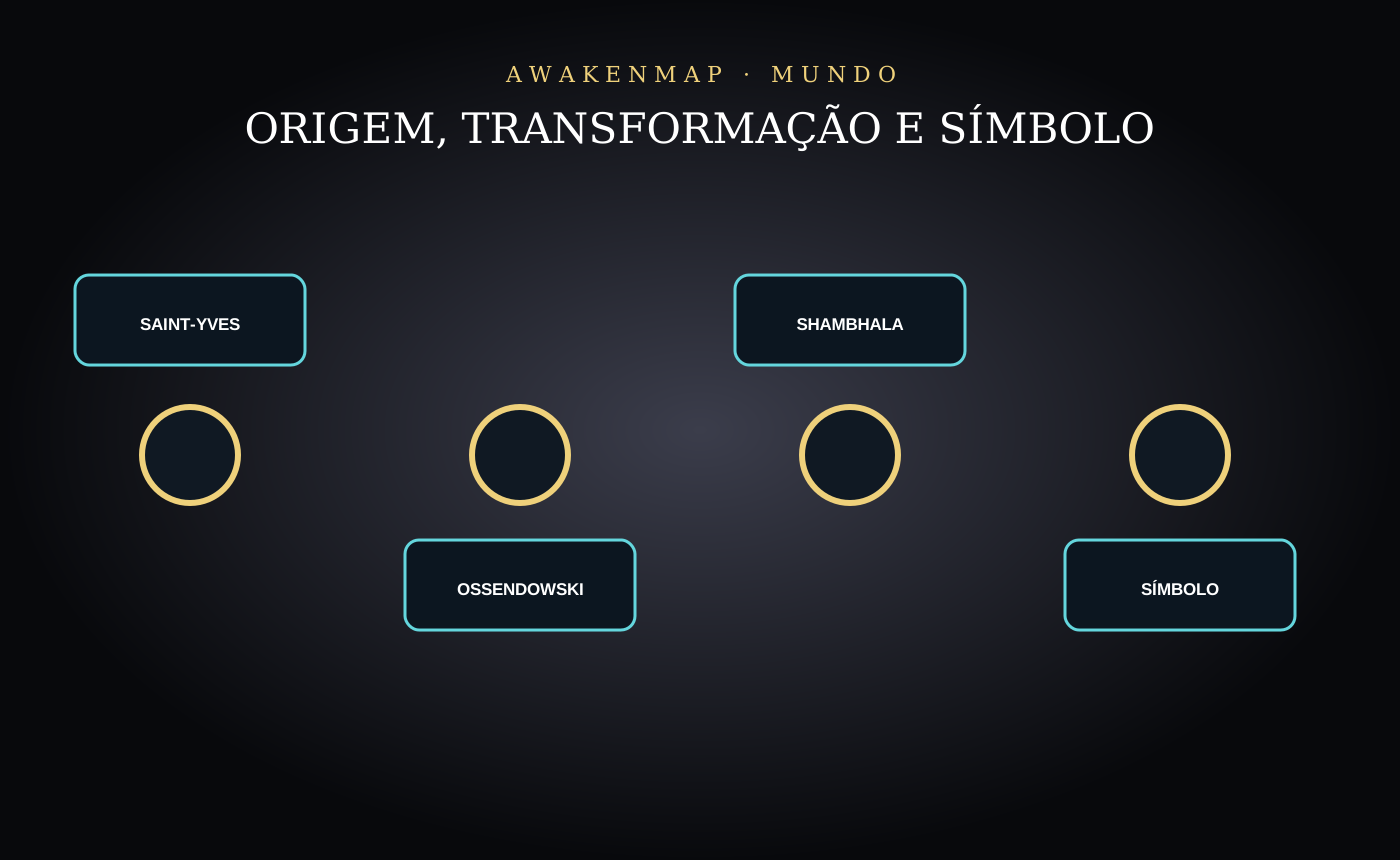
The myth gained wider circulation through Ferdinand Ossendowski, a Polish writer and traveller who published Beasts, Men and Gods in 1922. In accounts set in Mongolia and Central Asia, he described stories of Agharti, underground tunnels and the King of the World. His book moved esoteric cosmology into travel and adventure literature.
The relationship between Ossendowski and Saint-Yves remains debated because their accounts contain important similarities. Critics proposed direct literary influence; supporters imagined a shared oral tradition. Without independent documentation of an underground city, the comparison mainly shows how a narrative gains authority when presented as knowledge heard in distant lands.
René Guénon and the spiritual centre of the world
René Guénon returned to the subject in The King of the World, published in 1927. His interest was more metaphysical than geographical. Agarttha appears as a supreme spiritual centre associated with primordial authority, tradition and an invisible axis organizing religions and symbols.
In Guénon, searching for a physical entrance may miss the point. The centre can be hidden because it represents a principle rather than merely an address. This helps separate two traditions later blended together: Agartha as literal subterranean geography and Agartha as an image of a central spiritual source.
Orientalism and blended traditions
Agartha literature combines India, Tibet, Mongolia, Buddhism, Hinduism and European occultism. These traditions are often fused into a generic landscape of a mysterious East. The fascination created cultural bridges, but also erased differences and turned real peoples into scenery for Western fantasy.
A contemporary reading should ask where each element originates. Shambhala has its own context in Kalachakra Buddhism. Agartha belongs mainly to modern esotericism. The Himalayas are inhabited regions with concrete histories and cultures, not empty spaces where any secret kingdom can be placed.
Mission of India and Saint-Yves's project
Saint-Yves d'Alveydre presented Agarttha within a political and spiritual vision called synarchy. The hidden realm functioned as a model society ordered by knowledge, initiatory authority and harmony among institutions.
This places Agartha within nineteenth-century European debate, not only Asian geography. The underground city expresses criticism of modern conflict and desire for a centre capable of reconciling science, religion and government.
Ossendowski, sources and controversy
In Beasts, Men and Gods, Ferdinand Ossendowski reported stories heard in Central Asia about a subterranean kingdom and the King of the World. Similarities with Saint-Yves produced accusations of dependence or plagiarism.
Even if oral traditions contributed, relationships among the texts require historical examination. Later repetition does not automatically transform a modern narrative into independent testimony for a physical civilization.
Shambhala in its own context
Shambhala belongs to the Buddhist Kalachakra cycle and has specific religious, symbolic and prophetic interpretations. Its identification with Agartha occurred primarily within Western esoteric environments.
Treating both as the same realm erases linguistic, textual and doctrinal differences. Comparison is possible, but it should acknowledge when modern authors constructed the bridge.
Synarchy, authority and political risk
The idea of hidden sages governing above institutions can represent hope for order while weakening democratic responsibility. Invisible authority cannot be questioned, audited or replaced.
The myth becomes dangerous when it legitimizes self-appointed elites, racial hierarchies or authoritarian projects. Spiritual reading must remain accountable to ethics rather than license power without transparency.
Mountains, caves and sacred geography
The Himalaya, Altai, Gobi and other regions became entrances to Agartha in esoteric maps. Mountains stimulate imagination because they conceal valleys, caves and distant communities.
Sacred geography is not the same as physical survey. When a specific entrance is claimed, cartography, geology, access, independent testimony and infrastructure evidence become relevant.
Agartha as depth psychology
Descending into Inner Earth may represent an encounter with memory, shadow and psychic centre. The King of the World becomes an image of inward authority organizing fragmented forces.
This reading explains why Agartha remains fertile without geographical proof. The myth offers a landscape for initiation: leave the surface, cross the unknown and return with deeper order.
Agartha in AwakenMap
In AwakenMap, Agartha connects to Inner Earth, Inner Earth Civilization, Antarctica, D.U.M.B.s, Shambhala, Ley Lines, Lemuria, Atlantis, Ancient Civilizations, Anshar and Return to Source. It is a node where World, Knowledge and Cosmic almost touch.
As a World theme, Agartha speaks of hidden territory, caves, mountains, poles and imagined geography. As Knowledge, it speaks of initiation, esoteric tradition, authors and symbols. As Cosmic, it speaks of invisible hierarchies, masters, inner humanity and planetary destiny.
The page should help the user explore without falling into easy literalism. Agartha's value does not depend on proving an underground capital with streets and temples. Its value lies in mapping how modern culture imagines depth, secrecy and preserved wisdom.
How to read this theme
Read Agartha in layers. The first is historical: Saint-Yves, French occultism, Theosophy, Inner Earth literature. The second is symbolic: descent, hidden center, initiation, subterranean wisdom. The third is conspiratorial: polar entrances, occult Nazism, bases and inner networks. The fourth is critical: geology, sources, cultural appropriation and ideological use.
When someone presents Agartha as physical fact, ask for documentation, location, geological evidence and independent confirmation. When it appears as symbol, ask what transformation it points toward. When it is used to speak of superior races or spiritual elites, raise the ethical alarm.
Agartha is strongest when read as a myth of depth. The surface can be noisy; the myth invites descent. But descending well requires light, discipline and humility.
Critical reading
Agartha should be read as modern esoteric myth, symbol of depth and extraordinary geographical claim when taken literally. The fascination is real; the geography needs evidence.
References and starting points
- Agartha - historical overview
- Alexandre Saint-Yves d'Alveydre
- The Kingdom of Agartha / Mission de l'Inde
- Britannica - Shambhala International
- Shambhala - overview of teachings
- Britannica - Earth: interior structure
- Antarctic Treaty Secretariat
FAQ
Does Agartha physically exist?
There is no robust geological or historical evidence for an underground civilization called Agartha. The theme is strongest as esoteric myth, initiation symbol and Inner Earth narrative.
Are Agartha and Shambhala the same thing?
Not exactly. They were brought together in esoteric literature, but Shambhala has its own Tibetan Buddhist context, while Agartha belongs mainly to modern Western esotericism.
Keep exploring
You can open another path
 Esoteric practices Ka Aree 4/5 intensity Explore →
  Ancient civilizations Lemuria 4/5 intensity Explore →
  Esoteric practices Inner Earth Civilization 4/5 intensity Explore →
  Esoteric practices Hollow Earth 4/5 intensity Explore →
  Esoteric practices Anshar 4/5 intensity Explore →
  Esoteric practices Mount Shasta 4/5 intensity Explore →
Join the conversation
Comments are moderated. Keep the discussion respectful and distinguish evidence, interpretation and personal experience.