Connection level
27 direct connectionsHermeticism is a philosophical and spiritual tradition attributed to Hermes Trismegistus, a figure joining Hermes, Thoth and the idea of ancient wisdom. It belongs to the question of when an ancient tradition becomes a language for reorganizing the inner world.
What Hermeticism means
Hermeticism is not one church or a closed system. It is a family of texts, symbols and practices tied to Hermes Trismegistus, a mythical teacher presented as an Egyptian-Greek sage, revealer of teachings about God, cosmos, soul, mind and return to the divine.
The most important historical core appears in the writings known as the Corpus Hermeticum and in the Asclepius. These texts circulated in Late Antiquity, especially in the mixed cultural environment of Hellenistic and Roman Egypt, where Egyptian religion, Greek philosophy, astrology, magic, Platonism and the search for inner salvation crossed.
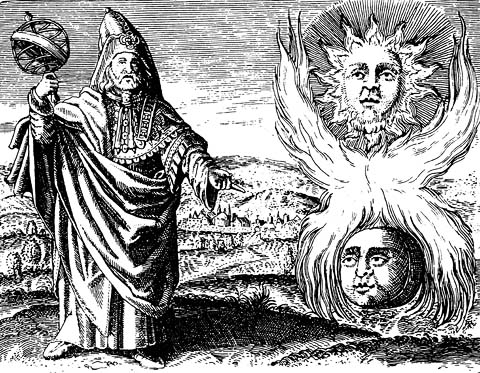
Hermes Trismegistus
Hermes Trismegistus means something like “Hermes thrice-great.” The figure arises from the symbolic fusion between Hermes, the Greek messenger and interpreter, and Thoth, the Egyptian deity tied to writing, measure, wisdom and sacred knowledge.
This explains the force of Hermeticism: it seems to speak of a wisdom prior to modern religious boundaries. In the Renaissance, many thinkers believed these texts preserved an extremely ancient theology. Later, historical research showed that the known writings are much later than they imagined.
Corpus Hermeticum and Renaissance
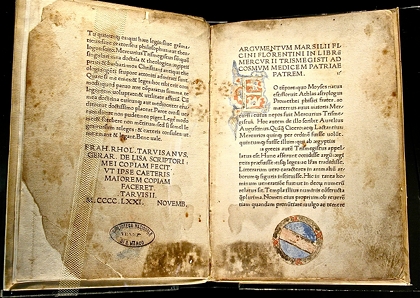
In the fifteenth century, Marsilio Ficino translated Hermetic texts into Latin in Florence, within the Medici circle. The translation helped feed the Renaissance imagination of a primordial wisdom, earlier than and compatible with several traditions.
This reception matters as much as the ancient origin. The Hermeticism that reached the modern West is not only the Hermeticism of the first centuries; it is also Hermeticism reread by humanists, alchemists, natural magicians, philosophers and occultists.
The principle of correspondence
The phrase “as above, so below” is the popular form of a Hermetic idea: the visible and invisible worlds mirror each other. Cosmos, body, mind and soul would be levels of one order. Knowing one level helps read the other.
This idea is powerful because it turns the universe into language. A planet, a metal, an illness, a dream or an emotion can be read as signs of a larger structure. Its beauty is integration; its risk is turning every resemblance into proof.
Alchemy, magic and transformation
Hermeticism connects to Alchemy, Kabbalah, the Emerald Tablets, the Book of Thoth and Mystery Schools. In many readings, the external operation on metals or symbols points to an inner operation: purifying perception, reorganizing desire and being born again in consciousness.
That is why Hermeticism also touches Gnosticism. Both speak of knowledge that transforms the person, not merely accumulated information. The difference is that Hermeticism is often more affirmative toward the cosmos: the world is not only a prison, but a living book.
The Kybalion and the modern layer
In the twentieth century, a book popularized seven principles presented as Hermetic: mentalism, correspondence, vibration, polarity, rhythm, cause and effect, and gender. This material strongly influenced modern esotericism and spiritual self-help.
But separation matters. These seven principles are a modern formulation, not a direct and faithful summary of the ancient Corpus Hermeticum. They may be useful as symbolic language, but they should not replace the real history of the tradition.
What is source and what is evidence
As source, there are ancient texts, manuscripts, Renaissance translations, academic studies and later traditions of alchemy, magic and esoteric philosophy. This documents the historical existence of Hermeticism and its influence in the West.
As metaphysical evidence, the situation changes. The texts show that people imagined the universe as living correspondence; they do not prove every coincidence is a cosmic sign, that every mental vibration shapes matter or that an intact primordial doctrine has existed since ancient Egypt. Responsible reading separates document, symbol, spiritual practice, philosophy and literal claim.
Why it belongs on AwakenMap
The main fracture is between tradition and reinvention. Hermeticism has real historical roots, but each period recreates it according to its desires, fears and questions.
The philosophical connection on AwakenMap is this: awakening is not repeating ancient formulas as if they were secret passwords to the universe. It is noticing when a tradition helps us think better, live better and imagine more responsibly. Ancient wisdom becomes more alive when it does not need to pretend it never changed.
How to continue on the map
After this theme, explore Alchemy, Gnosticism, Kabbalah, Emerald Tablets, Book of Thoth, Mystery Schools, Ancient Egypt, Book of Enoch, Star Merkaba and Law of Attraction.
Simple summary
Hermeticism is a tradition attributed to Hermes Trismegistus, formed by texts and practices about God, cosmos, mind, soul and inner transformation. Its historical base includes the Corpus Hermeticum, the Asclepius and the Renaissance reception by Marsilio Ficino. The theme matters because it offers a language of correspondence between world and consciousness. Critical reading separates ancient tradition, Renaissance reinvention, modern occultism and metaphysical claims.
References and starting points
- Springer academic encyclopedia - Hermes Trismegistus and Hermetism
- Stanford Encyclopedia of Philosophy - Marsilio Ficino and the Corpus Hermeticum
- Harvard - reading the first treatise of the Corpus Hermeticum
- Gnosis Archive - library of Hermetic texts
- Wikimedia Commons - image of Hermes Trismegistus
- Wikimedia Commons - early edition of the Corpus Hermeticum
Keep exploring
You can open another path
 Esoteric practices Gnosticism 5/5 intensity Explore →
  Esoteric practices Alchemy 5/5 intensity Explore →
  Esoteric practices Emerald Tablets 5/5 intensity Explore → Esoteric practices Gnosticism 5/5 intensity Explore →
  Map center Great Awakening 5/5 intensity Explore →
  Esoteric practices Kabbalah 5/5 intensity Explore →
Join the conversation
Comments are moderated. Keep the discussion respectful and distinguish evidence, interpretation and personal experience.