Connection level
8 direct connectionsAlchemy is one of the strongest languages of transformation. On the outside, it speaks of metals, furnaces, flasks, sulfur, mercury, the philosopher’s stone and gold. Inside, it speaks of something else: turning raw matter into something more refined — and transforming the human being in the process.
What alchemy is
Alchemy was practiced in several cultures, with important forms in China, India, the Islamic world and Europe. It mixes natural philosophy, religion, ancient medicine, metallurgy, astrology, symbolism and laboratory practice. That is why it does not fit neatly into one box.
On AwakenMap, alchemy connects to the Great Awakening, Sacred Geometry, meditation, the Law of One, 5D Earth and advanced technology and high frequency. The central question is simple: how can something heavy, confused or impure be refined into consciousness, healing or wisdom?
Where the word comes from
The word “alchemy” reached modern languages through Latin and Arabic paths. The Arabic term al-kīmiyā carries the article “al”, and its root is commonly connected to Greek terms used for fusion, mixture or work with substances. This origin already shows the story of the theme: a tradition traveling through languages, empires, workshops, libraries and spiritual schools.
The important point is this: alchemy was never only “making gold”. That was the most famous image, but behind it stood an entire worldview.
The real image of the laboratory
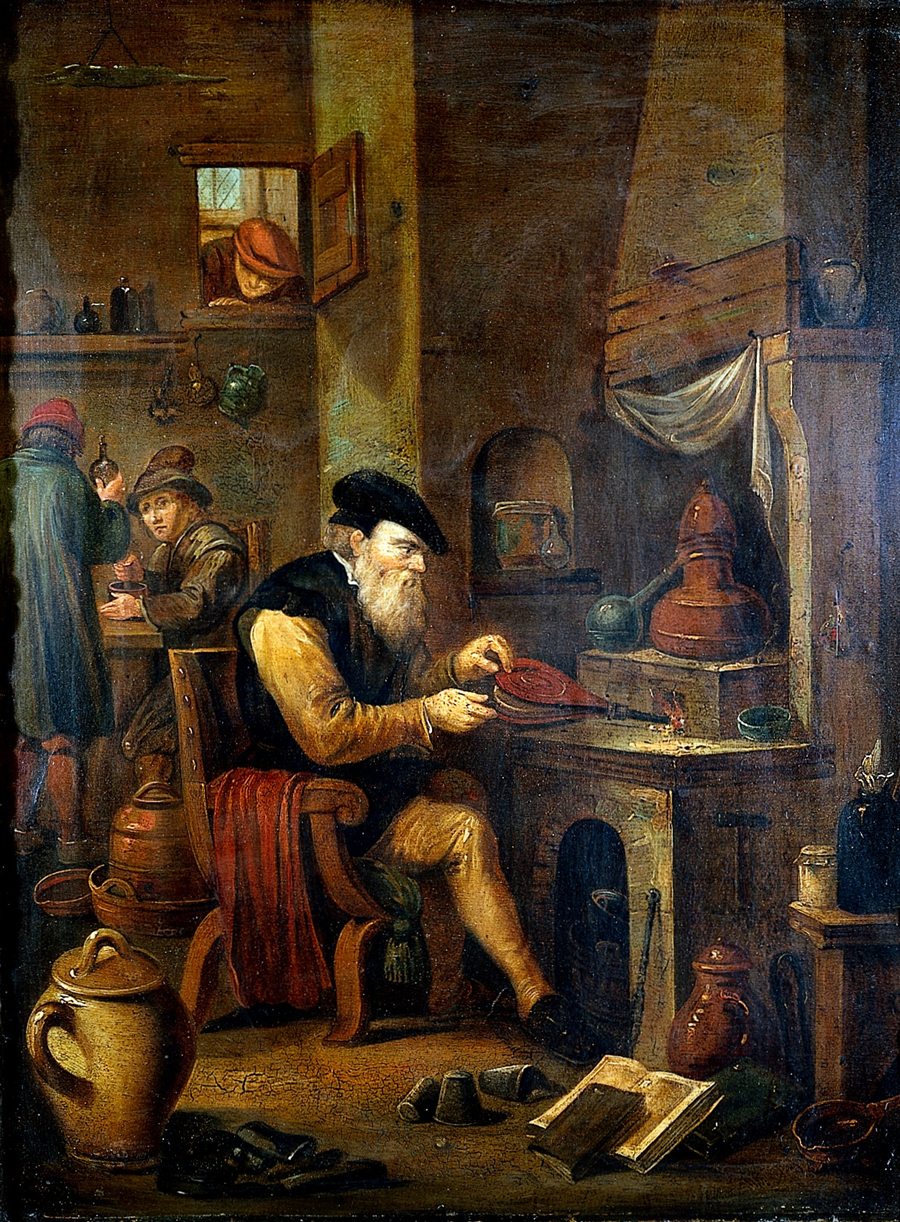
This historical painting shows the concrete side of alchemy: instruments, furnace, flasks, study, trial and error. The scene helps correct a common impression. The alchemist was not only a fantasy magician; often he was also someone working with substances, heat, distillation, metallurgy and remedies.
But the image also shows the other side: the laboratory almost looks like a temple. Ancient science, imagination, faith, secrecy and symbol occupy the same room.
Philosopher’s stone and elixir of life
The philosopher’s stone is alchemy’s most famous symbol. In the stories, it could turn common metals into gold and was also connected to the elixir of life, a substance able to heal, renew or extend existence.
Even when read symbolically, the idea is powerful. Lead represents the raw state: weight, ignorance, fear, matter not yet refined. Gold represents maturity: clarity, integration, presence and inner value. The philosopher’s stone is the secret of the passage between those states.
The elixir of life: alchemy as a search for healing and permanence
The elixir of life is one of alchemy’s most human layers. The search was not only about becoming rich by turning metal into gold. It was about overcoming decay, disease, aging and death. That is why the philosopher’s stone appears, in many narratives, as something that produces a perfect medicine: a substance able to renew the body and restore vitality.
This brings alchemy close to medical traditions, longevity recipes, panaceas and spiritual practices. The promise was enormous: finding a matter so purified that it could purify the human body too. Today, that image survives in another vocabulary — rejuvenation, biohacking, longevity, regenerative medicine and energetic healing. The question changed clothes, but did not disappear: can the body be renewed?
Magnum Opus: the Great Work
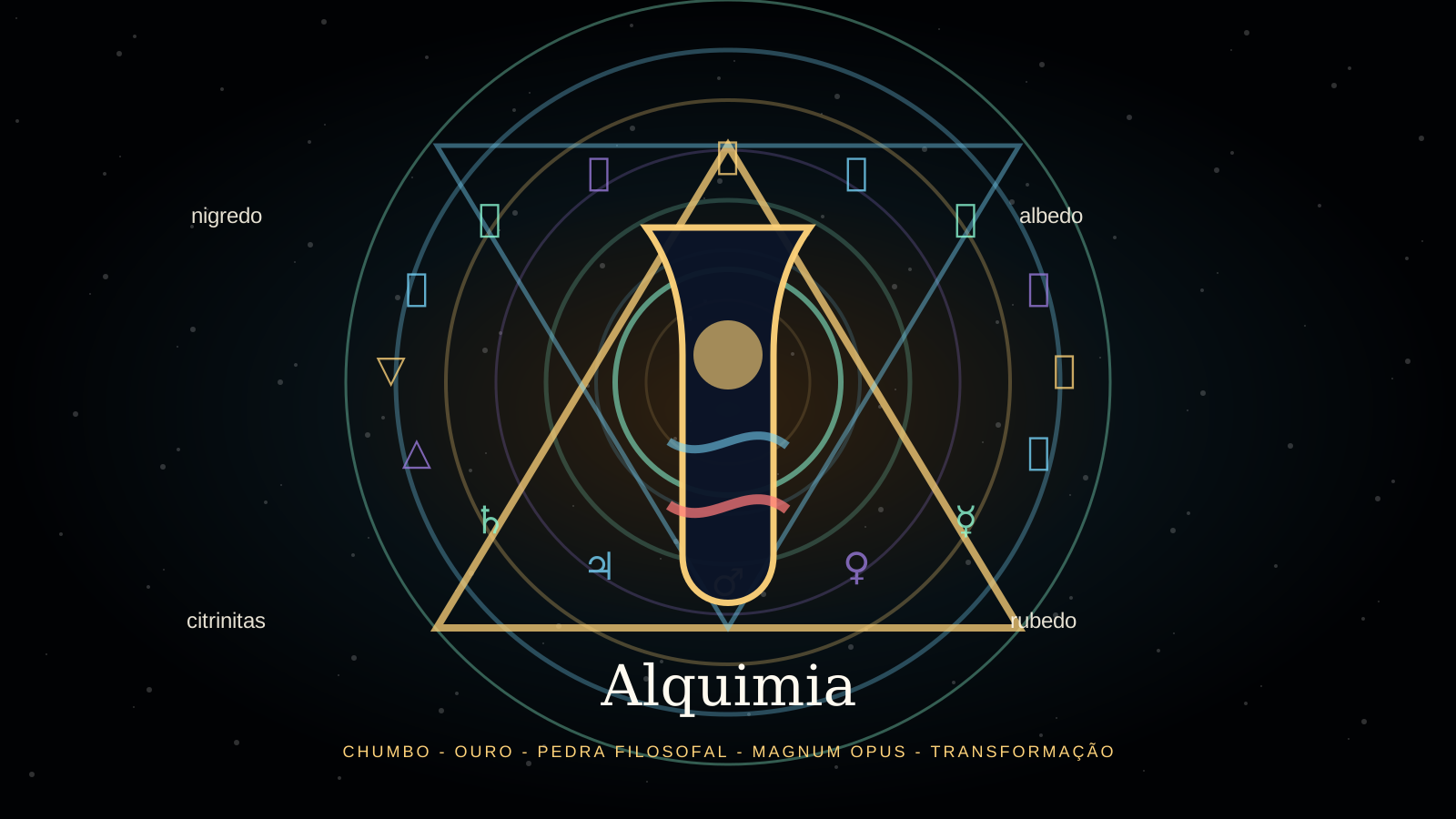
The symbolic heart of alchemy is the Magnum Opus, the Great Work. In many readings, it appears as a sequence of phases represented by colors: nigredo, the black of decomposition; albedo, the white of purification; citrinitas, the yellow of awakening; and rubedo, the red of final integration.
This process grips people because it feels psychological. First something darkens and breaks down. Then come cleansing, reorganization, illumination and union. Anyone who has passed through crisis, emotional healing or spiritual change can understand this structure without knowing Latin.
Hermetism, planets and symbols
Western alchemy speaks with Hermetism, a tradition connected to the name Hermes Trismegistus. It also uses correspondences between metals and planets: gold and Sun, silver and Moon, mercury and Mercury, iron and Mars, copper and Venus, tin and Jupiter, lead and Saturn.
This language makes alchemy feel like a map of connections. Metal, planet, body, soul and cosmos become parts of one reading. That is why it approaches themes such as Sacred Geometry, the Age of Aquarius and the Law of One: all of them speak of the relation between microcosm and macrocosm, the small and the great reflecting each other.
The bridge with chemistry
Some alchemical practices helped develop instruments, processes and habits that later mattered to chemistry: distillation, calcination, sublimation, dissolution, metallurgy, pharmacy and careful work with substances. At the same time, alchemy was not modern chemistry. It mixed experiment, cosmology, religion and symbol.
That mixture is exactly what makes the theme interesting. Alchemy stands at the border: part workshop, part temple, part laboratory, part inner path.
Inner alchemy
In modern spiritual reading, alchemy becomes a metaphor for personal transformation. The “gold” is not metal; it is matured consciousness. The “fire” is not only heat; it is the pressure of life. The “vessel” is not only a container; it is body, mind and heart holding a process of change.
This is the link with the Great Awakening, 5D Earth, 12-Strand DNA and advanced technology and high frequency. All these themes use different languages to speak of the same image: something in the human being can be refined.
Books that deepen the theme
To go beyond encyclopedia summaries, some books are especially useful. Lawrence M. Principe’s The Secrets of Alchemy is one of the strongest modern entrances because it treats alchemy as real history of science and culture, not only fantasy. Mircea Eliade’s The Forge and the Crucible reads metallurgy, fire and transformation as ancient religious experiences. Stanton J. Linden’s The Alchemy Reader gathers primary texts from Hermes Trismegistus to Isaac Newton.
For the psychological layer, C. G. Jung’s Psychology and Alchemy matters because it reads alchemical symbols as images of inner transformation. E. J. Holmyard’s Alchemy is a historical classic for understanding the bridge between alchemical tradition, the Islamic world, medieval Europe and the birth of chemistry.
Why this theme grips people
Alchemy grips people because it promises that nothing is wasted. Even lead has a path. Even confusion can become material for the work. Even the fall can be a stage of the process. That is the charm: error, shadow and heaviness are not the end of the story; they are raw material.
That is why alchemy continues to appear in books, films, games, psychology, spirituality and pop culture. It gives visual form to an old hope: the possibility of becoming something else without denying what one was before.
Connections to continue
After this theme, open Sacred Geometry, meditation, the Law of One, the Great Awakening, 5D Earth and advanced technology and high frequency. This path leads from symbolism to practice: form, attention, unity, awakening and frequency change.
Simple summary
Alchemy is the symbolic art of transformation. Historically, it involved metals, remedies, furnaces, flasks and the search for the philosopher’s stone. Spiritually, it became a language for inner change: turning lead into gold, shadow into consciousness and raw matter into wisdom.
References and starting points
- Britannica - Alchemy
- Science History Institute - The Secrets of Alchemy
- University of Chicago Press - Lawrence M. Principe, The Secrets of Alchemy
- University of Chicago Press - Mircea Eliade, The Forge and the Crucible
- Cambridge University Press - Stanton J. Linden, The Alchemy Reader
- Internet Archive - E. J. Holmyard, Alchemy
- International Association for Analytical Psychology - C. G. Jung, Psychology and Alchemy
- Science Museum / Google Arts & Culture - Nicolas Flamel and the philosopher’s stone
- British Library / Google Arts & Culture - Alchemy and the philosopher’s stone
- Wikimedia Commons - Alchemist in his laboratory / Wellcome
- The Alchemy Website - Adam McLean archive
FAQ
Was alchemy only about making gold?
No. Metal transmutation was a famous part, but alchemy also involved ancient medicine, philosophy, religion, symbols and inner transformation.
What is the philosopher’s stone?
It is the great alchemical symbol of perfection and transformation. In literal readings it would turn metals into gold; in spiritual readings it represents illumination and integration.
Is alchemy the same as chemistry?
No. Alchemy helped form practices that influenced chemistry, but it mixed laboratory work, spirituality, cosmology and symbol in a way modern science does not.
Keep exploring
You can open another path
 Esoteric practices Emerald Tablets 5/5 intensity Explore →
  Esoteric practices Hermeticism 5/5 intensity Explore →
  Esoteric practices Gnosticism 4/5 intensity Explore →
  Esoteric practices Kabbalah 4/5 intensity Explore →
  Esoteric practices Mystery Schools 4/5 intensity Explore → Esoteric practices Hermeticism 4/5 intensity Explore →
Join the conversation
Comments are moderated. Keep the discussion respectful and distinguish evidence, interpretation and personal experience.