Connection level
12 direct connectionsPsychic Healing brings together intention, prayer, distant healing, mediumship and mental influence as frontier practices between spirituality, parapsychology and critical care.
Healing that does not touch the body
Psychic Healing is the name given to practices that try to influence health, emotion or well-being through nonphysical direct means: intention, prayer, visualization, mediumship, distant passes, mental focus, spiritual transmission or the action of consciousness on the body. It appears in religious traditions, spiritualism, parapsychology, New Age and energy healing movements.
The theme fascinates because it touches an enormous question: can mind affect another person beyond the ordinary paths of speech, touch and presence? Is there a dimension of intention that crosses distance? Or are we dealing with placebo, comfort, symbolic bond, coincidence, interpretation and hope?
In AwakenMap, Psychic Healing needs to be read with openness and rigor. There are powerful human reports. Entire traditions are built around spiritual healing. And there is also risk of charlatanism, false promises and abandonment of medical treatment.
Spiritual healing and sacred gift
Britannica describes healing cult and faith healing as recourse to divine power to cure physical or mental disabilities, together with medical care or in place of it. In many cultures, the capacity to heal is attributed to priests, saints, shamans, mediums, kings, prophets or people with a special gift.
This history shows that psychic healing is not a recent invention. Humans have always sought healing beyond medicine: blessing, laying on of hands, collective prayer, pilgrimage, relic, trance, intercession, chant, holy water, vow, ritual. Suffering opens a spiritual question because illness does not strike only tissue; it strikes meaning.
The strength of these practices often lies in the field of faith, belonging and hope they create. Even when there is no proof of paranormal action, the experience can reorganize courage, emotion and relation to pain.
Parapsychology and distant healing
Britannica defines parapsychology as a discipline investigating phenomena that cannot be explained by known natural laws, including extrasensory perception. Psychic healing enters this territory when it claims that intention or consciousness could produce effects in another person without ordinary sensory contact.
The literature on distant healing or distant healing intention includes intercessory prayer, mental healing, Therapeutic Touch, distant Reiki and similar practices. Systematic reviews in PubMed investigated clinical trials of these modalities, but results are hard to interpret because of methodological differences, variable quality and replication problems.
The honest point is: there are studies, but no strong consensus. The area remains controversial. For AwakenMap, this matters: the theme should not be sold as proven, but also should not be dismissed without understanding why so many cultures return to this question.
What may work without being paranormal
Even if the paranormal hypothesis is uncertain, there are pathways through which psychic healing may produce real effects. A person who knows they are being prayed for or remembered may feel support, hope and reduced loneliness. A ritual may reduce anxiety. A community may mobilize concrete care. Expectation may alter perception of pain.
The healer's intention may also transform the healer: they become more attentive, compassionate and available. This changes relationships. Sometimes what seems like distant healing later generates calls, visits, financial help, food, transport, practical care. Intention becomes action.
These effects do not prove curative telepathy, but they show the practice may have human value. The mistake is confusing human value with proof of invisible mechanism.
The temptation to promise miracle
The greatest risk of Psychic Healing is the promise of miracle. People who are ill, afraid, in pain or grieving are vulnerable. When someone promises to remove cancer, cure depression, clear entities, deprogram trauma or replace medical treatment with mental force, they enter dangerous territory.
Spiritual promise can delay diagnosis, interrupt medication, isolate the person from family and create dependence on the healer. It can also turn therapeutic failure into blame: if it did not heal, it was lack of faith, blockage, resistance, karma or negative energy.
An ethical practice should never use mystery to exploit desperation. Responsible psychic healing is complementary, humble and transparent about limits.
Distant healing and consent
Many people send prayer or energy to someone without asking permission. In religious context, this may be understood as blessing. In therapeutic context, however, consent matters. If the practice involves directed intention, energy reading, visualization or symbolic intervention, it is better to respect the person's autonomy.
There are simple distinctions: silently wishing well is different from claiming to work spiritually in someone's field. The first is compassion; the second may invade boundaries, especially if accompanied by spiritual diagnosis or payment.
The criterion is respect. Does the practice increase freedom or cross the person without listening? Healing without consent can become control with luminous language.
Mediumship and healing
In spiritualism, communication with the spirit world and spiritual healing often walked together. Britannica observes that for spiritualists, communion with the spiritual world is possible and desirable, and spiritual healing is seen as a natural result of that communication.
This view appears in passes, spiritual surgeries, incorporation of healing entities, prayers, energized water and mediumistic care. For practitioners, the human healer may be an intermediary of forces, guides or spiritual intelligences.
Critical reading does not need to mock this. But it must ask about safety, transparency, consent, not replacing medicine, traceability of results and care for vulnerable people.
When intention helps the patient themselves
Visualization, prayer and intention practices may help the ill person regulate themselves. Visualizing light, imagining healing, repeating prayers or feeling supported may reduce fear and organize hope. This can improve treatment adherence, sleep, mood and the capacity to cross difficult procedures.
This layer is more plausible than healing another person at a distance. Mind influences body through known pathways: stress, attention, behavior, sleep, pain, breathing, nervous system and choices. Psychic practice may act as symbolic language to mobilize these pathways.
The value does not diminish by being internal. Sometimes the greatest healing is the person no longer facing illness alone inside.
How to read psychic healing studies
Distant healing studies face difficult problems: how to blind participants and healers? How to measure intention? How to avoid publication bias? How to separate prayer received outside the study? How to define dose? How to replicate spiritual states? How to interpret multiple outcomes?
For this reason, systematic reviews often find mixed results and variable quality. Some suggest possible effects; others point to insufficient evidence. The reader needs to resist headlines. One positive study does not solve the issue; one negative study does not end all human experience.
The mature posture is to follow evidence without turning desire into conclusion.
Psychic Healing in AwakenMap
In AwakenMap, Psychic Healing connects with Reiki, Holistic Healing, Auras, Mass Meditation, Maharishi Effect, Collective Consciousness, Remote Viewing, Mediumship and Love and Light. It is a boundary node: it asks how far intention, consciousness and care can reach.
It also serves as an ethical warning. Many themes in the map deal with subtle capacities and expansion of mind. Without criticism, this can become fantasy of power. With too much cynicism, the human dimension of faith, hope and compassion is lost.
The balance is to treat Psychic Healing as spiritual hypothesis and cultural practice, not as substitute for clinical care.
The best way to read this theme
Read Psychic Healing as a frontier field. There are ancient religious practices, personal reports, controversial studies, plausible psychological effects and extraordinary claims. Mixing everything flattens the theme.
The poor reading asks only: does it work or not? The mature reading asks: works in what sense? As comfort? As ritual? As community? As placebo? As possible anomalous phenomenon? With which risks?
Read this way, Psychic Healing stops being an easy promise and becomes a serious investigation into intention, suffering, care and mystery.
Critical reading
Psychic Healing should be read as a frontier field between faith, intention, parapsychology and care. Its human value does not authorize medical promises; its extraordinary claims require proportional evidence.
What falls under psychic healing
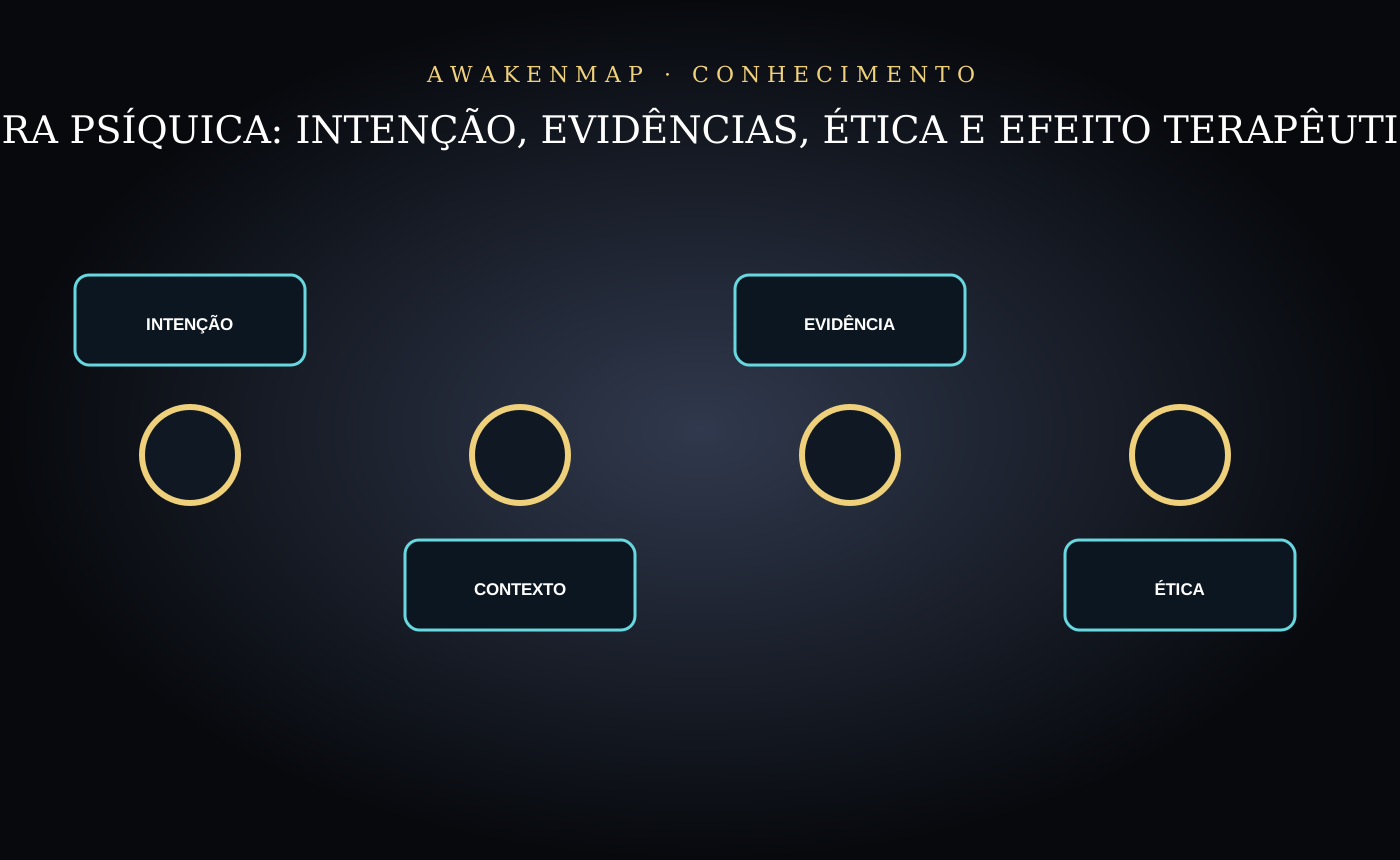
The label combines different practices: intercessory prayer, laying on of hands, visualization, Reiki, mediumistic healing and distant intention. Some involve contact and ritual; others claim to act without presence or patient knowledge.
Defining the practice is the first step. Results from one modality cannot automatically be transferred to every other form.
Perceived improvement and mechanism
A person may relax, feel hope or experience less pain during a session. That improvement deserves respect but does not identify its cause. Attention, expectation, rest and natural symptom change may contribute.
A paranormal mechanism is an additional hypothesis. Supporting it requires reliable effects beyond therapeutic context and alternative explanations.
Reiki and the energy field
Reiki uses light touch or hands held near the body and proposes a vital energy. NCCIH reports inconsistent studies and no scientific evidence for the described energy field.
Lack of evidence for the mechanism does not make every experience false. It limits what may responsibly be claimed, especially about treating disease.
Distant-healing studies
Distant trials face challenges involving blinding, multiple outcomes, small groups and selective publication. Isolated positive findings require independent replication and a protocol defined before data collection.
If a healer later chooses which symptoms or time periods count, coincidence can resemble an effect. Statistical transparency is essential.
Regression to the mean and natural history
People seek help when symptoms are intense. Many conditions fluctuate and may improve afterward without intervention. This return toward usual values is called regression to the mean.
Controlled comparison helps separate the practice from the moment it was sought. A before-and-after report cannot make that distinction.
Consent and vulnerability
Touch, prayer and spiritual interpretation require clear consent. Vulnerable patients should not be pressured to disclose trauma, accept energetic diagnoses or believe that doubt blocks healing.
Consent can be withdrawn at any time. Children and people with reduced capacity require additional protection.
Signs of exploitation
Warnings include guaranteed cures, escalating charges, secrecy, family isolation and instructions to abandon treatment. Calling deterioration a “healing crisis” may conceal real harm.
A responsible practitioner recognizes limits, avoids diagnosis beyond competence and refers emergencies.
Integration without abandoning care
A spiritual practice may offer emotional or ritual support when it does not replace necessary assessment. Inform the health team and maintain clear goals.
The useful question is whether it increases safety, autonomy and engagement with care or creates dependency and delay. Its effect on life matters as much as the session experience.
Additional references
References and starting points
- Britannica - Parapsychology
- Britannica - Healing cult / faith healing
- Britannica - Spiritualism, belief and practice
- PubMed - The efficacy of distant healing: systematic review
- PubMed - Distant healing, update of a systematic review
- PubMed - Quality of research on hands-on and distance healing
- PMC - Distant healing intention therapies overview
FAQ
Does Psychic Healing replace medical care?
No. It should be treated, at most, as a complementary practice of spiritual or emotional support. Diagnosis, medication, surgery, therapy and emergencies require qualified professionals.
Is there proof of distant healing?
There are studies and reviews, but the area remains controversial and without strong consensus. Results vary, methods are difficult and strong claims require very robust evidence.
Keep exploring
You can open another path
 Esoteric practices Chakras 4/5 intensity Explore →
  Healing and energy QHHT 4/5 intensity Explore →
  Healing and energy Auras 4/5 intensity Explore →
  Esoteric practices Ayahuasca 3/5 intensity Explore →
  Consciousness and symbols Mental and Spiritual States 3/5 intensity Explore →
  Esoteric practices Organic Energy 3/5 intensity Explore →
Join the conversation
Comments are moderated. Keep the discussion respectful and distinguish evidence, interpretation and personal experience.