Connection level
9 direct connectionsTelepathy is the hypothesis of mind-to-mind communication without known sensory channels. It crosses parapsychology, intimate experiences, Ganzfeld, collective consciousness and the boundary between intuition, coincidence and evidence.
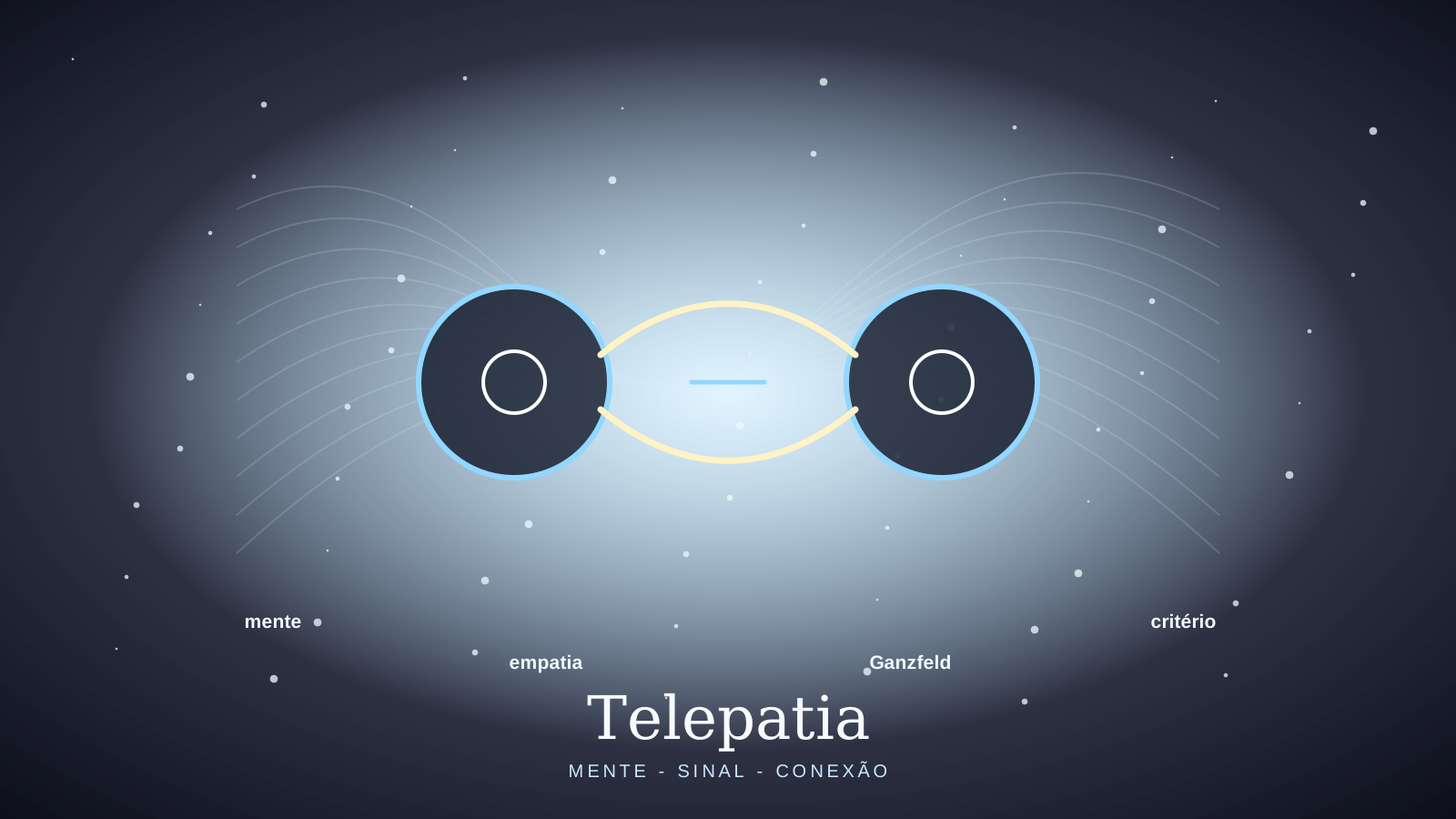
The idea of one mind reaching another
Telepathy is one of the oldest and most persistent ideas in the human imagination: the possibility that thoughts, emotions or images pass from one mind to another without speech, gesture, touch, writing or any known sensory signal. The word seems simple, but touches a huge question: is consciousness entirely private, or is there some level of connection between minds?
Britannica includes telepathy among cognitive parapsychological phenomena, alongside clairvoyance and precognition, as forms of perception supposedly independent of ordinary sensory channels. This formulation matters because it clarifies the test point: if telepathy exists as an objective phenomenon, it must transmit information without conventional cues.
In AwakenMap, Telepathy should be read as a frontier theme. There are real subjective experiences: thinking of someone and receiving a message, feeling that someone is unwell, dreaming of an event, completing sentences, sensing emotional states at distance. The critical question is whether these experiences demonstrate mental transmission, subtle cue reading, coincidence, selective memory, empathy or narrative construction.
Spontaneous telepathy and everyday life
Most people who believe in telepathy do not begin in a laboratory; they begin with an intimate experience. A mother senses something about a child. A couple looks at each other and understands. Friends say the same thing at the same time. Someone thinks of a person and the phone rings. These episodes are powerful because they seem to cross the ordinary solitude of mind.
Critical reading does not need to ridicule this. Human relationships are full of real synchronies. Close people learn one another's patterns, microexpressions, schedules, vocabulary, fears and habits. The body notices much before language does. In many cases, what seems like telepathy may be refined empathy, relational memory or unconscious inference.
But not everything is easily explained by obvious cues. Some reports remain strange for those who live them. The care is not turning strangeness into automatic proof. Personal experiences are starting points for questions, not the end of investigation.
Psychical research and parapsychology
Modern investigation of telepathy gained strength in the late nineteenth century, in a context of spiritualism, hypnosis, mediumship and scientific interest in anomalous phenomena. The Society for Psychical Research, founded in 1882, sought to study reports of mental communication, apparitions, mediumship and crisis experiences with methods more systematic than testimony alone.
Parapsychology tried to bring these questions into controlled testing. Zener cards, guessing experiments, dream studies, pair telepathy and later the Ganzfeld protocol emerged as attempts to reduce noise and measure hits above chance. This history shows that telepathy is not only a fantasy theme; there has been, and still is, organized research.
At the same time, parapsychology faces persistent criticism: fragile replication, small effects, selective publication, experimental design, statistical analysis and difficulty producing strong repeatable demonstrations for mainstream science. The field lives in this tension between suggestive results and lack of consensus.
Ganzfeld: the laboratory of the receptive mind
The Ganzfeld experiment is one of the best-known methods for testing telepathy or anomalous perception. In typical versions, one person remains in a condition of reduced sensory stimulation, with relaxation, diffuse light and uniform noise, while another tries to mentally send an image or video. The receiver then chooses among possible targets.
The idea is that, by reducing external sensory noise, subtle signals or psi might emerge. Recent meta-analyses continue to debate whether Ganzfeld results remain above chance. Some researchers point to positive statistical effects; critics point to methodological problems, publication biases and fragile replication.
This is an excellent example of how the theme should be read. A small statistical result is not cinematic proof of mind-to-mind communication. It also should not be dismissed without analysis. The mature question is: does the effect survive preregistration, independent replication, rigorous control, complete databases and absence of sensory leakage?
Cold reading, subtle cues and unconscious inference
Before invoking telepathy, ordinary information pathways must be considered. Humans are excellent readers of signs: posture, breathing, gaze, speech rhythm, hesitation, word choice, shared history, social context and probabilities. Much of what we call intuition is rapid processing of real cues.
Cold reading, the Forer effect, open questions and vague statements can also create the impression of mental access. A skilled reader says something broad enough to seem precise, observes reactions and adjusts direction. The person being read fills gaps with their own memory. This can feel paranormal without being paranormal.
The goal of this criticism is not to kill intuition. It is to protect it. Intuition becomes more valuable when we can separate subtle perception from fantasy, empathy from projection, coincidence from pattern, cue reading from mental transmission. Without that separation, every feeling becomes evidence.
Telepathy, trauma and mental health
There is a sensitive dimension: believing one can read thoughts or that others invade the mind can appear in psychological suffering. In certain contexts, ideas of thought transmission, mental influence or hidden messages may be associated with paranoia, psychosis, mania, trauma or dissociation. This does not mean every reported telepathic experience is illness; it means clinical discernment matters.
Responsible spirituality should never encourage fear of mental invasion, psychic persecution or absolute certainty that others' thoughts are being captured. If the experience causes distress, isolation, insomnia, loss of functioning or a sense of threat, the most careful path is seeking psychological or psychiatric support.
In AwakenMap, Telepathy should be presented with grounding. The search for connection cannot become panic about permeability. A healthy mind needs bond and boundary. Not every sensation belongs to another person; not every synchronicity is a message.
Empathy, co-regulation and symbolic telepathy
Even if literal telepathy remains without scientific consensus, there is a very important symbolic version: humans deeply affect one another. Emotions circulate in groups. One person's anxiety changes the room. Calm regulates. Gazes coordinate. Babies and caregivers synchronize. Groups singing, praying or meditating can share rhythm.
This symbolic telepathy does not require paranormal transmission. It speaks of the relational porosity of life. We are intersubjective creatures. One person's body reads another body. Consciousness forms in relation. Sometimes we feel the other not because we receive a mental ray, but because we are made to respond to the other.
This layer connects with Collective Consciousness, Mass Meditation and the Maharishi Effect. Even without proving ESP, it shows that mind is not an isolated island. The task is to differentiate demonstrable psychosocial connection from extraordinary claims about information transmission without a known channel.
Telepathy and contemporary spirituality
In current spirituality, telepathy appears linked to soulmates, twin flames, starseeds, guides, animals, plants, extraterrestrial beings, channeling and communication with the Higher Self. In some reports, it emerges as a language of love and attunement; in others, as proof of psychic awakening.
This language can be meaningful when used with humility. Feeling deep connection with someone can open compassion, listening and presence. The risk is using telepathy to avoid real conversation: believing the other knows, that the other sent signs, that a bond exists without consent, that an internal fantasy replaces adult communication.
The ethical rule is simple: telepathy should never replace consent, dialogue and respect. If something matters, speak. If there is a relationship, verify. If there is doubt, ask. Mature spirituality does not use the invisible to escape visible responsibility.
Telepathy in AwakenMap
In AwakenMap, Telepathy connects to Third Eye, Auras, Collective Consciousness, Mass Meditation, QHHT, Starseeds, Law of One, Channeling, Mental and Spiritual States, the Great Awakening and Simulation Reality. It is a node about communication beyond speech.
This theme matters because many spiritual paths promise expanded perception. The user may seek telepathy as power, but the page should lead toward a deeper question: what kind of connection am I trying to access? Do I want control, proof, intimacy, healing, belonging or escape from loneliness?
The best reading keeps three possibilities open without confusing them: subjective experiences can be real for those who live them; conventional explanations may be sufficient in many cases; objective claims of telepathy require rigorous tests.
How to read this theme
Read Telepathy with curiosity and discipline. When there is personal report, respect the experience, but ask what information was available. When there is a study, look at design, replication, effect size and methodological criticism. When there is a spiritual promise, observe whether it increases autonomy or dependence.
If the experience brings beauty, connection and compassion, it can be integrated as symbol or intuition. If it brings fear, persecutory certainty or confusion of boundaries, it needs care. The boundary between openness and disorganization matters.
Telepathy remains fascinating because it touches the desire not to be alone inside one's own mind. Perhaps that desire is as important as the hypothesis. The final question is not only whether thoughts travel; it is how we learn to listen without inventing, feel without invading and connect without losing discernment.
Critical reading
Telepathy should be read between subjective experience, empathy, coincidence, parapsychology and mental health. Respecting reports does not mean accepting every conclusion without method.
References and starting points
- Britannica - Parapsychological phenomenon
- Britannica - Parapsychology
- Britannica - Extrasensory perception
- PubMed - Anomalous perception in a Ganzfeld condition, meta-analysis
- PMC - Stage 2 Registered Report: Ganzfeld meta-analysis
- PMC - Questionable research practices in Ganzfeld telepathy meta-analysis
- PMC - Functional brain imaging of alleged paranormal phenomena
FAQ
Has telepathy been proven?
There are parapsychological studies and statistical debates, especially in protocols such as Ganzfeld, but there is no broad scientific consensus that telepathy is proven as a robust and repeatable phenomenon.
Can feeling other people's thoughts be a problem?
If the experience causes fear, insomnia, isolation, paranoia or loss of functioning, it is important to seek psychological or psychiatric support. Healthy spirituality needs boundaries.
Keep exploring
You can open another path
 Esoteric practices Dolphins and Whales 4/5 intensity Explore →
  Consciousness and symbols Collective Consciousness 4/5 intensity Explore →
  Esoteric practices Pleiadian Guidance 4/5 intensity Explore →
  AI and Matrix The Borg 3/5 intensity Explore →
  Control systems CIA Project Stargate 3/5 intensity Explore →
  Healing and energy Higher Mind 3/5 intensity Explore →
Join the conversation
Comments are moderated. Keep the discussion respectful and distinguish evidence, interpretation and personal experience.