Connection level
26 direct connectionsHigher Mind is the name given to the sense that there is a wider layer of consciousness able to observe desires, fears and thoughts without fully identifying with them. The theme belongs to the question of when elevated perception becomes real guidance.
What the term means
In modern spiritual traditions, Higher Mind usually indicates an inner intelligence more lucid than the reactive mind. It appears as witness consciousness, the voice of discernment, deep intuition, contact with the soul or the ability to see a problem from a viewpoint less trapped in ego.
The term is broad because it gathers different lineages. In the psychology of religion, William James studied mystical experiences as states that can reorganize a person's life. In esoteric currents, Higher Mind can appear as a bridge to the Oversoul or the Akashic Records. In psychological reading, it can be understood as an integrating function: the person can see inner patterns without automatically obeying them.
How the idea formed
The notion did not begin with one single author. It formed through the convergence of mysticism, philosophy, Theosophy, depth psychology, contemplative practices and contemporary self-knowledge language. The vocabulary changes, but the structure repeats: there is a fragmented everyday consciousness and there is the possibility of a wider seeing.
That is why Higher Mind does not need to be treated as an invisible organ or separate entity. It can be read as symbol, inner experience, ethical ideal or metaphysical hypothesis. The care is not to turn every pleasant thought into a higher message.

Higher Mind and ego
The most common contrast is with ego. Here, ego does not only mean vanity; it means the habitual center of defense, desire, fear, identity and personal narrative. Higher Mind would be the ability to perceive that center in operation.
This difference matters. A person may think they are listening to elevated wisdom when, in practice, they are only giving spiritual language to a preference, resentment or escape. That is why the main fracture of this theme is discernment and self-deception.
What neuroscience helps separate
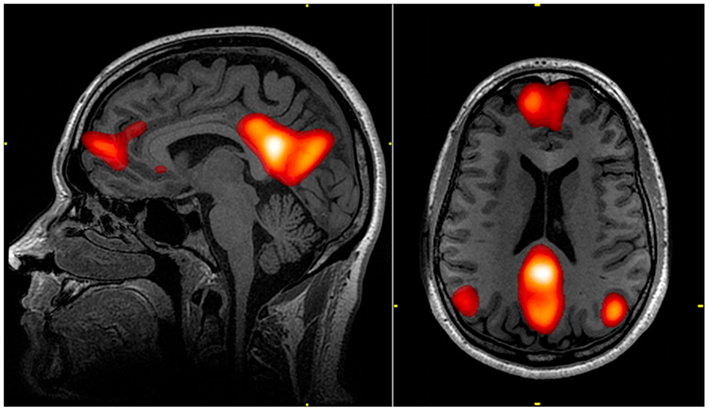
Studies on meditation and brain networks do not prove a metaphysical Higher Mind. They help with another point: they show that attention, mind-wandering, self-reference and inner observation have measurable correlations in the brain. Research on the default mode network associates this network with autobiographical memory, self-related thought and projection into the future.
When contemplative practices reduce rumination or increase meta-awareness, that can feel, from inside, like a clearer mind. The scientific data does not exhaust spiritual experience, but it prevents lazy reading: not everything is channeling, and not everything is valueless illusion.
Intuition, message and verification
The theme approaches Intuition, the Third Eye and Telepathy because all deal with information perceived before a complete rational explanation. Higher Mind, however, should not be only intuitive speed. It should include calm, responsibility and capacity for revision.
Inner guidance becomes more reliable when it does not demand haste, inflate superiority, isolate the person from criticism or ask them to abandon basic care. If the supposed message makes someone less honest, less compassionate or less able to verify facts, perhaps it is not Higher Mind; perhaps it is fantasy wearing sacred clothing.
What is source and what is evidence
As source, there are mystical reports, psychology of religion, contemplative traditions, analytical psychology, meditation studies and testimonies of personal transformation. As evidence, the situation changes according to the claim. An ethical change in someone's life can be biographical evidence; a claim about cosmic records, collective destiny or telepathic communication requires another standard.
AwakenMap does not need to reduce Higher Mind to neurons, nor accept every inner voice as truth. The mature point is asking what the experience produces: more lucidity or more certainty without foundation?
Relation to other nodes
On the map, Higher Mind connects to Meditation, Collective Consciousness, Intuition, the Third Eye, Telepathy, the Oversoul, the Akashic Records, Enlightenment, Empty Awareness, Gnosticism and Free Will.
These connections draw a corridor between inner practice, subtle perception and philosophical responsibility. The node does not claim every intuition comes from a higher source; it asks how to recognize the difference.
Why it belongs on AwakenMap
The main fracture is between discernment and self-deception. Higher Mind is valuable when it expands perception, humility and responsibility. It becomes dangerous when it becomes a license to never doubt oneself.
The philosophical connection on AwakenMap is here: awakening is not obeying any inner voice just because it seems luminous. It is learning to listen better without abandoning verification, ethics and consequence.
How to continue on the map
After this theme, explore Meditation, Intuition, the Third Eye, the Oversoul, the Akashic Records, Enlightenment, Empty Awareness and Collective Consciousness.
Simple summary
Higher Mind is the idea of a more lucid layer of consciousness, able to observe ego and guide choices with greater clarity. It can be read as spiritual symbol, contemplative experience, psychological function or metaphysical hypothesis. The theme matters because it teaches that elevated perception only matters when it produces discernment, humility and verification.
References and starting points
- Internet Archive - William James and religious experience
- U.S. National Library of Medicine - meditation and the default mode network
- U.S. National Library of Medicine - review on meditation and the default mode network
- International Association for Analytical Psychology - Jung's works on archetypes and collective unconscious
- Internet Encyclopedia of Philosophy - mysticism
- Wikimedia Commons - default mode network image
- Wikimedia Commons - Buddha meditating image
Keep exploring
You can open another path
 Map center Great Awakening 5/5 intensity Explore →
  Healing and energy Intuition 5/5 intensity Explore →
  Esoteric practices Meditation 5/5 intensity Explore →
  Esoteric practices Bashar 4/5 intensity Explore →
  Esoteric practices Channeling 4/5 intensity Explore →
  Esoteric practices The Guardians 4/5 intensity Explore →
Join the conversation
Comments are moderated. Keep the discussion respectful and distinguish evidence, interpretation and personal experience.