Connection level
3 direct connectionsAuras are described as an energy field or subtle field around people, places and objects. Aura study sits between spirituality, subtle perception, colors, bodily sensitivity, chakras and consciousness, but it also requires care: are we speaking of symbolic experience, intuitive reading or observable evidence?
The field people say they feel
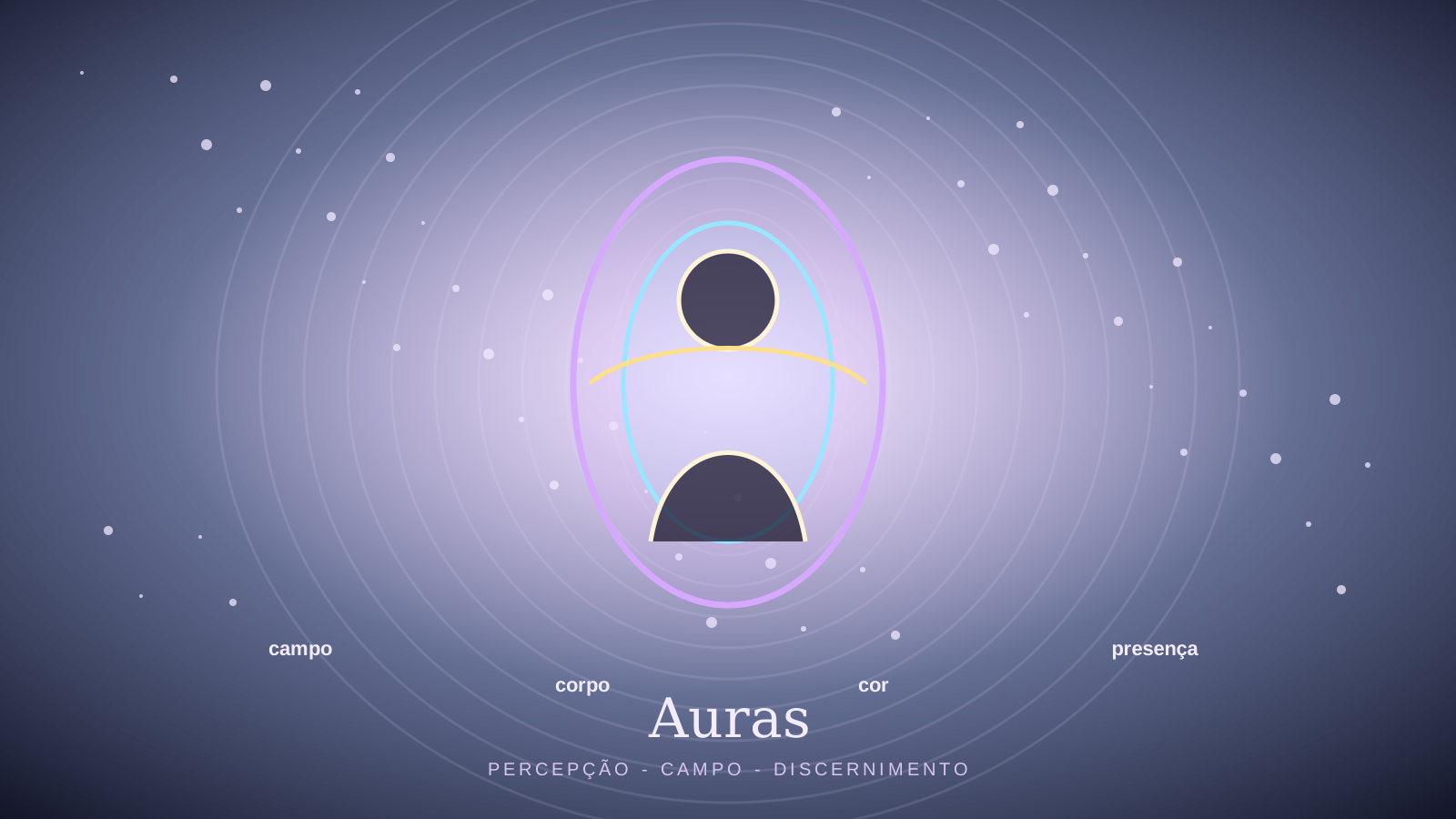
Aura is one of the most persistent images in popular spirituality: a luminous, colored or vibrational field around the body. Some people say they see it as halos, layers or colors; others say they feel it as pressure, temperature, openness, heaviness, repulsion or magnetism. In energy therapies, it is treated as an extension of the subtle body; in symbolic reading, as an expression of emotional and spiritual state.
The theme is fascinating because it stands between real sensation and interpretation. A person may enter a place and perceive tension. They may meet someone and feel expansion or closure. They may notice brightness in the face, posture, microexpressions, smell, rhythm of voice, bodily presence and mood. The question is: are we perceiving an objective aura or translating many subtle signals into energetic language?
In AwakenMap, Auras should be a page of discernment. It does not need to ridicule those who perceive subtle fields, nor sell every colored reading as proven fact. The better path is to study the layers: spiritual tradition, parapsychology, Kirlian, synesthesia, interoception, psychology of presence and ethics of energetic reading.
Aura in modern spirituality
The notion of a subtle field around the body appears in many religious and esoteric languages, but its modern form gained strength through spiritualism, Theosophy, New Age, energy healing and psychic development movements. Britannica describes modern spiritualism as a movement in which communication with the spirit world, survival after death and spiritual healing had a central role.
In this environment, aura came to be seen as a kind of vibrational signature of the person. Colors and layers would indicate health, emotion, spirituality, protection, attachments, gifts or blockages. Aura also became linked to ideas of human magnetism, mediumship, clairvoyance and vital fields.
It is important to situate the theme historically because this avoids two simplifications. The first is thinking aura was born in internet posts. The second is thinking every spiritual tradition always meant exactly the same thing. Modern aura language is a living mixture of many currents.
Parapsychology and the edge of evidence
Britannica defines parapsychology as the study of cognitive phenomena such as extrasensory perception, partly emerging in the context of nineteenth-century spiritualism. Aura enters this field as a claim of perception beyond ordinary senses: seeing, feeling or interpreting an invisible field.
The problem is that extraordinary claims require strong evidence. Personal reports may be sincere, but sincerity is not proof. Aura readers may identify emotional traits through social sensitivity, body reading, inference, suggestion or confirmation bias. This does not make every experience false; it makes interpretation more complex.
The mature posture is to distinguish experience from conclusion. I felt something around that person is an experience. That person has a green aura because they are healed is an interpretation. Therefore I can diagnose their spiritual health is already a high-risk claim.
Kirlian: aura photography or electrical discharge?
Kirlian photography is frequently used as supposed visual proof of aura. The technique produces luminous images by exposing objects, leaves or body parts to electromagnetic fields. Encyclopedia.com describes Kirlian photography as creating an image on film or photographic paper through exposure to an electromagnetic field.
The fascination is understandable: fingers, leaves and objects appear surrounded by glows, as if the invisible had been photographed. But the more cautious scientific reading points to corona discharges, moisture, pressure, grounding, voltage and environmental conditions. The glow does not need to be interpreted as a spiritual field.
This does not destroy the symbolic value of the images. Kirlian can be art, metaphor and invitation to reflect on electricity, life and perception. But using the technique as spiritual or medical diagnosis requires extreme care. A beautiful image is not automatically evidence for what we want it to prove.
Colors: symbolic language, not absolute dictionary
Much aura reading works with colors. Red would indicate vitality, anger or grounding; orange, creativity and desire; yellow, mind and power; green, healing and heart; blue, communication and peace; violet, spirituality. These codes can be useful as symbolic language.
The mistake is treating colors as a universal dictionary. Color changes according to culture, context, person and tradition. Green can mean healing in one reading and envy in another. Red can be life, danger, passion, war or body. A golden aura may be holiness to someone and projection of admiration to another.
The better reading uses colors as questions. What does this color awaken? Which emotion accompanies it? Which pattern of presence seems to appear? What does the person confirm in their own experience? Without dialogue and humility, aura reading becomes theater of certainty.
Synesthesia and colored halos
Some people really do report seeing colors associated with people, voices, emotions, letters, numbers or sounds. Synesthesia is a neurological phenomenon in which stimuli in one sensory modality evoke experiences in another. A PubMed Central study on colored halos around faces and emotion-evoked colors discusses cases that partly resemble popular descriptions of aura.
This does not explain all spiritual experiences, but it opens an interesting bridge. Someone may see colors around people without inventing and without necessarily perceiving an external energy field. It may be a perceptual way the brain associates emotion, identity and color.
This hypothesis is valuable because it reduces the conflict between spirituality and science. Some experiences may be subjectively real, perceptually consistent and still not prove an objective aura. The challenge is respecting the experience without exaggerating the conclusion.
Interoception: feeling the field begins in the body
Many aura perceptions may involve interoception, the capacity to perceive internal bodily states. Research on mindfulness and interoception discusses how contemplative practices increase attention to bodily signals, breathing, heartbeat, tension and visceral sensation.
When someone says I felt that person's energy, perhaps part of the phenomenon is the body responding. The chest closes, the belly contracts, the skin tingles, breathing changes, posture withdraws. The body perceives social and environmental signals before the mind formulates an explanation.
This does not reduce the experience. On the contrary, it grounds it. Perhaps aura is, in many cases, a symbolic language for the relational intelligence of the body: a way of saying we perceive more than we can explain in words.
Aura, presence and relational field
Even without assuming a measurable energetic field, there is something real in the way people affect environments. Some enter a room and calm it. Others tense it. Some seem to occupy too much space; others almost disappear. This involves voice, gaze, rhythm, availability, history, nervous system and intention.
Calling this aura can be poetically precise. The person does not end at the skin in a relational sense. Their inner state crosses gestures, speech, silence, choices and atmosphere. An anxious leader creates field. A calm mother creates field. A group in fear creates field. A meditative community creates field.
The difference lies in not turning metaphor into rigid diagnosis. We can speak of a field of presence without claiming that every color seen around someone is an objective fact about their soul.
The risk of invasive readings
Reading aura involves ethical responsibility. Telling someone their aura is dark, contaminated, broken or trapped can cause fear, dependency and guilt. In vulnerable contexts, this kind of speech can become spiritual manipulation.
Responsible reading avoids absolute sentences. It does not diagnose disease. It does not create panic. It does not use supposed energetic vision to control decisions. It does not turn the reader into an authority over another person's soul.
The ethical question is direct: does this reading increase autonomy, clarity and care? Or does it increase fear, submission and the need to return to the reader in order to feel safe? In the second case, the practice has failed.
Energetic cleansing and protection
Aura cleansing practices appear in baths, smoke cleansing, prayers, visualizations, crystals, Reiki, passes, meditation and protection rituals. Even when not proven as literal removal of external energy, they may function as psychological and symbolic rituals of transition.
Taking a conscious bath, lighting a candle, breathing, imagining light, cleaning the house or praying can mark a passage: I leave this weight, return to my center, establish a boundary. The value may lie in its effect on attention, body, emotion and intention.
The care is not to turn protection into paranoia. If everything becomes negative energy, envy, attack or contamination, the person begins to live closed. Good protection is not chronic fear; it is presence with boundary.
Auras in AwakenMap
In AwakenMap, Auras connects with Chakras, Kundalini, Reiki, Light Body, Love and Light, Lightworkers, Meditation, Mental and Spiritual States and Energy Healing. It is a node between subtle perception, body and relationship.
It helps the network speak about what many people feel but do not always know how to name: atmospheres, presences, fields, openness, closure, brightness, heaviness. At the same time, it forces the map to maintain criteria, because this area is full of easy promises and improvised diagnoses.
The page should teach a rare skill: taking sensitivity seriously without abandoning discernment.
The best way to read this theme
Read Auras as a language of perception. Genuine spiritual experiences, bodily metaphors, synesthesia, social reading, interoception, art and symbolic imagination may be mixed in the same theme. Separating these layers makes the page more honest and stronger.
The poor reading asks only: what color is my aura? The mature reading asks: what presence do I cultivate? How does my body perceive environments? Which signals do I interpret too quickly? How can I use sensitivity to care better, not to judge more?
Read this way, Auras stops being colored spectacle and becomes a practice of relational attention: perceiving the field without losing the ground.
Critical reading
Auras should be read as a language of sensitivity, presence and interpretation, not as absolute diagnosis. The theme gains value when it separates experience, symbol, bodily perception and extraordinary claim.
References and starting points
- Britannica - Parapsychology
- Britannica - Spiritualism
- Encyclopedia.com - Kirlian Photography
- PMC - Mindfulness, Interoception, and the Body
- PMC - Colored halos around faces and emotion-evoked colors
- PMC - Body awareness and mindfulness
FAQ
Are auras scientifically proven?
There is no scientific consensus that an objective colored field surrounds people as described in spiritual readings. There are, however, subjective experiences, synesthesia, body reading and interoceptive perception that help explain part of the phenomenon.
Does Kirlian photography prove aura?
Not conclusively. The images can be explained by electrical discharge, moisture, pressure, voltage and environmental conditions. They may have symbolic value, but should not be used as simple proof of a spiritual field.
Keep exploring
Join the conversation
Comments are moderated. Keep the discussion respectful and distinguish evidence, interpretation and personal experience.