
Connection level
9 direct connectionsOperation Highjump was the major U.S. military expedition to Antarctica in 1946-1947, associated with Admiral Richard Byrd, Task Force 68, aerial reconnaissance, polar training, accidents and mapping the ice. On AwakenMap, the theme matters because a documented operation became a meeting point for military history, Neuschwabenland, secret bases, UFOs and myths about forbidden zones of the planet.
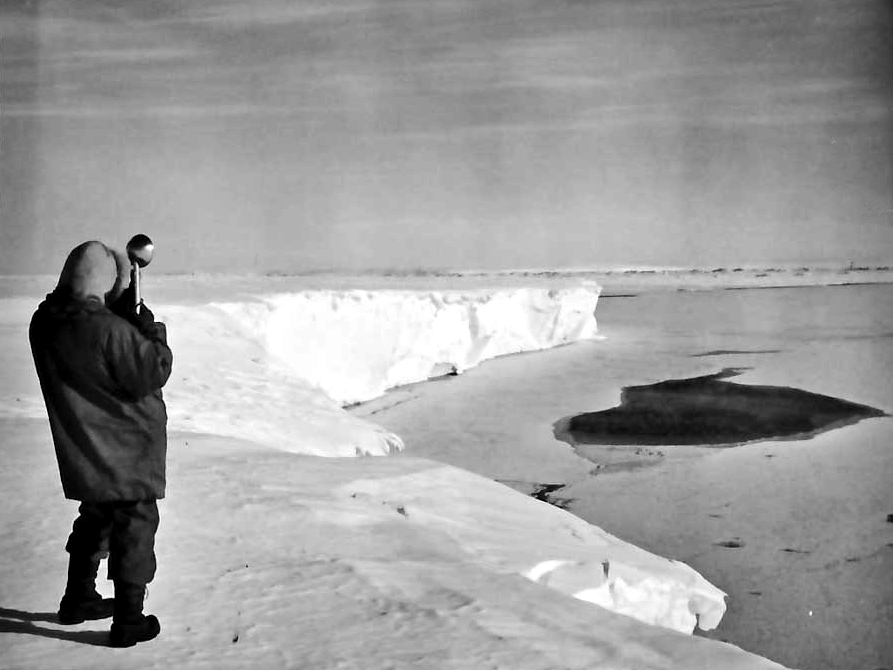
The expedition that became a polar enigma
Operation Highjump was the popular name for the United States Navy Antarctic Developments Program of 1946-1947, a huge American naval and air-naval operation in Antarctica shortly after World War II. Officially, it involved training under polar conditions, reconnaissance, aerial photography, logistical tests and establishing presence in a still little-known region.
Britannica describes Highjump as the largest sea and air operation attempted up to that time in Antarctica, with 13 ships, aircraft and thousands of men. Richard E. Byrd, the celebrated polar explorer, became associated with command and the public image of the expedition. The operation's size, timing and Antarctica's natural mystery made the theme grow far beyond naval history.
In AwakenMap, Highjump is a World node because it involves territory, ice, ships, aircraft, bases, maps and logistics. But it is also a frontier node because it connects to Hollow Earth, separatist Nazis, Neuschwabenland, hidden bases, UFOs, unknown technology and narratives of polar secrecy.
Context: postwar and strategic Antarctica
Highjump happened at a specific moment: the world had just left World War II and was rapidly entering Cold War logic. The United States had greatly expanded its military, naval and technological capacity. Antarctica, although without permanent population and covered in ice, had strategic value as extreme laboratory, sovereignty frontier and geopolitical projection space.
Interest in polar regions was not new. Byrd had already led previous expeditions, built bases such as Little America and helped transform Antarctica into a place of heroic imagination and national science. Highjump amplified that scale: it was not only romantic exploration, but fleet, training, photography and operational capability.
This context reduces the need for a fantastic explanation for the mission's size. A victorious naval power had real reasons to test men, ships, aircraft, communications and procedures in one of the most hostile environments on Earth.
Task Force 68 and the logistical machine
The operation was associated with Task Force 68. Historical sources commonly mention thousands of men, support ships, aircraft, seaplanes, an aircraft carrier and specialized units. The practical aim was to learn how to operate in extreme cold, build support on ice, produce reconnaissance and gather data for future actions.
This logistical dimension is decisive. Antarctica does not forgive improvisation. Fuel freezes, metal breaks, engines fail, communication is lost, ice traps ships, wind changes routes and runways can disappear. Highjump was also a school of limits.
In conspiracy imagination, quantity becomes suspicion: why so many ships? Why so much haste? Why the military? The historical answer is simpler and still impressive: because Antarctica required scale, and the Navy wanted to know whether it could project force and survive there.
Byrd, Cruzen and the image of the polar explorer
Richard E. Byrd was a perfect figure for turning a military mission into myth. Aviator, explorer, celebrity, symbol of polar courage, he carried the aura of a man crossing frontiers. Admiral Richard H. Cruzen also had an important role in executing the operation, especially in operational leadership.
The Naval Historical Foundation emphasizes the mission's exploration and mapping dimension. Byrd, in turn, became the name the public associated with Antarctic secrets. In alternative narratives, any ambiguous phrase attributed to Byrd becomes a door to inner worlds, polar threats or nonhuman technology.
A mature reading recognizes that charismatic figures generate legends. The larger the figure, the easier it is to turn logistics into epic and interview into prophecy.
Aerial photography and cartography of ice
One of the central results was aerial photography. Britannica mentions tens of thousands of photographs obtained by aircraft, important for geographic and cartographic knowledge. Before modern satellites, flying and photographing was a powerful way to turn blankness on the map into operational information.
This part is less cinematic than secret battles, but historically enormous. Mapping Antarctica meant recording coasts, ice shelves, mountains, routes and base possibilities. The unknown was literally photographed.
In AwakenMap, this connects Highjump to the theme of secret maps. The difference is that real maps do not automatically prove hidden civilizations. They show the passage from an imagined Antarctica to a measured Antarctica.
Accidents, cold and early end
Highjump also involved tragedies and real risks. Air crashes, human losses, equipment damage and severe weather conditions are part of the history. The operation ended earlier than some expectations might suggest, partly because of the approach of Antarctic winter and the natural difficulties of the environment.
This interruption fed speculation: had the fleet been expelled by UFOs? Had it found a Nazi base? Had it faced unknown technology? The basic historical explanation, however, is already strong: operating in Antarctica in 1947 was dangerous, expensive and limited by weather, ice and logistics.
The mistake is imagining that every early ending requires a hidden enemy. Sometimes, the adversary is simply the most hostile continent on Earth.
Byrd's phrase and aircraft over the poles
One of the most cited pieces in alternative theories is the interview in which Byrd reportedly warned about possible attacks coming from polar regions. This phrase is often removed from its postwar context, when long-range aviation, missiles, polar routes and continental defense were real concerns.
Read historically, the phrase speaks of military strategy: in a world of faster aircraft and global routes, the poles ceased to be margins and could become corridors. Read conspiratorially, it becomes a sign of enemies hidden in the ice or inside Earth.
The page must show this difference. The same text can be interpreted prudently or mythologically. The question is: which reading requires fewer leaps and fits the historical moment better?
Neuschwabenland and the Antarctic Nazi base
The association between Highjump and Nazi bases in Antarctica comes from a collage of facts and fantasies: the German expedition to Neuschwabenland before the war, the disappearance of Nazi leaders, submarines, secret technology, flying saucers and the fascination with ice as a perfect hiding place.
Historically, there is no consensus or robust evidence of an operational Nazi superbase in Antarctica capable of confronting the U.S. Navy in 1947. The narrative persists because it combines strong ingredients: incomplete defeat, miraculous technology, inaccessible continent and military secrecy.
In AwakenMap, this layer should be presented as modern conspiracy myth, not established fact. It can be studied because it shapes imaginaries around Highjump, but it needs clear critical marking.
Hollow Earth, UFOs and the polar door
Highjump was also absorbed by Hollow Earth narratives. In this reading, Byrd would have found polar entrances to an inner world, advanced civilizations or intraterrestrial bases. Some versions mix apocryphal diaries, Agartha, UFOs and messages from superior beings.
These stories are powerful because Antarctica feels like a threshold. Ice hides, the map has restrictions, access is difficult, and imagination already expected polar openings since Symmes. Highjump, with its real fleet, entered as dramatic proof for an older mythology.
But a real operation does not automatically validate every narrative attached to it. Critical work means separating naval documents, interviews, accidents and photographs from dubious diaries, sensational videos and reports without verifiable origin.
Why Highjump holds attention
Highjump holds attention because it is a perfect case of modern mystery: it really happened, involved the military, occurred in a remote place, left images, had accidents, ended under environmental pressure and became tied to a legendary figure. That is enough to generate legitimate questions.
The problem begins when question becomes certainty. 'It was large' becomes 'it was a secret war'. 'It was military' becomes 'it hid aliens'. 'It ended early' becomes 'they were defeated'. 'Byrd spoke of the poles' becomes 'he confirmed hidden bases'. Each leap may seem small, but together they build a story without proportional foundation.
The best reading keeps the tension: Highjump is historically impressive without needing a battle against flying saucers. The real Antarctica is already extreme enough.
A large operation on an extreme continent
The task force looks extraordinary when stripped of context. Ships, aircraft, tractors, fuel, workshops, medical teams and communications were necessary because Antarctica provided no ports, roads or local support. Logistical redundancy was a condition of survival, not automatic evidence of combat.
The postwar world also gave polar experience strategic value. Training personnel and equipment in extreme cold, expanding maps and testing naval aviation had clear military usefulness. Recognizing strategic interest is more accurate than describing Highjump as pure science or converting it into a secret war.
The George 1 accident
On 30 December 1946, the PBM Mariner flying boat George 1 crashed during a reconnaissance mission. Three crew members died, and survivors remained isolated until rescue. The event documents the hazards of navigation, visibility and terrain in polar operations.
Later narratives sometimes reorganize losses and damage as signs of attack. Methodologically, the difference is to seek contemporary reports, names, dates and recorded causes. A real tragedy needs no hidden enemy to be serious.
Why the mission ended
Highjump concluded its Antarctic activity as winter approached, amid operational difficulty and partially completed objectives. The polar calendar imposes a narrow window: ice, darkness, storms and falling temperatures make withdrawal and supply increasingly dangerous.
It is fair to say the operation ended before every ambition was fulfilled. Claiming it was driven away by flying discs requires additional evidence unavailable in the surviving record. An altered schedule may be a clue, but it must be compared with logistics and weather.
Operation Highjump in AwakenMap
In AwakenMap, Operation Highjump connects to Antarctica, Neuschwabenland, Hollow Earth, Agartha, underground bases, UFOs, separatist Nazis, secret space program, Byrd, secret maps and hidden technology. It is a node linking extreme geography to geopolitical paranoia and esoteric myth.
As World, it speaks of ice, fleet, aviation, bases, climate, logistics and cartography. As Knowledge, it speaks of military history, postwar context, polar exploration and documents. As Cosmic, it speaks of polar entrances, hidden civilizations, UFOs and the idea that the planet keeps forbidden zones.
A premium page should let the reader feel the fascination without losing ground. Highjump should not be reduced to mockery or inflated into total proof. It is best understood as a real operation that became a screen for all fears and desires about Antarctica.
How to read this theme
Start with what is documented: dates, Task Force 68, Byrd, Cruzen, ships, aircraft, aerial photography, Little America IV, accidents and climate difficulties. Then observe the interpretive layer: why did a real mission become myth?
When an extraordinary claim appears, ask for the primary source. Is there a naval document? Verifiable interview? Authentic diary? Contextualized photograph? Or does the story depend on repetition in sites, videos and books without traceable origin?
Operation Highjump teaches that ice is a mirror. In it, we project military strategy, fear of the enemy, desire for discovery and the hope that there is still a hidden door at the end of the world.
Critical reading
Operation Highjump should be read as real military expedition, polar exploration milestone and later conspiracy myth. The fascination grows when documents, logistics and hidden-Antarctica narratives remain in separate layers.
References and starting points
- Wikimedia Commons - Operation Highjump photographer
- Naval History and Heritage Command - Operation High Jump photo
- Britannica - Operation High Jump
- Britannica - Richard E. Byrd
- Naval Historical Foundation - Admiral Richard H. Cruzen and Operation Highjump
- Office of the Historian - High Jump II correspondence
- South-Pole.com - Operation Highjump: The Great Antarctic Expedition
FAQ
Was Highjump a secret war against Nazi bases?
There is no robust evidence for that reading. What is documented is a large naval operation for training, reconnaissance, aerial photography and polar logistics.
Why did the operation become myth?
Because it combined the military, Antarctica, Byrd, enormous scale, accidents, early ending and a continent already charged with secrecy.
Keep exploring
You can open another path
 Esoteric practices Operation Highjump 5/5 intensity Explore →
  Earth and Antarctica Antarctica 4/5 intensity Explore →
  Secret Space Program Dark Fleet 4/5 intensity Explore →
  Esoteric practices Admiral Byrd 4/5 intensity Explore →
  Earth and Antarctica Nazi Breakaway Groups 4/5 intensity Explore →
  Secret Space Program Secret Programs, Hidden Technology and Disclosure 4/5 intensity Explore →
Join the conversation
Comments are moderated. Keep the discussion respectful and distinguish evidence, interpretation and personal experience.