Connection level
3 direct connectionsNeuschwabenland is the Antarctic region linked to the German expedition of 1938-1939, just before World War II. The topic combines Queen Maud Land, the Schwabenland ship, aerial mapping, whaling, propaganda and the later mystery layer that turned a historical expedition into theories about Nazi secret bases, submarines, flying discs and hidden survival in the ice.
The Antarctica that became a conspiracy screen
Neuschwabenland, or New Swabia, is the name associated with an area of Queen Maud Land in Antarctica explored by a German expedition in 1938-1939. The name came from the ship Schwabenland, used in the voyage. Historically, the episode involves aerial reconnaissance, economic interest in whaling, polar geopolitics and an attempt to mark presence in a region disputed by powers.
In alternative imagination, however, Neuschwabenland became something else: supposed secret Nazi base, hiding place for advanced technology, submarine route, portal to Hollow Earth, origin of flying saucers and contact point with underground civilizations. The distance between historical fact and later mythology is exactly what makes the theme important.
In AwakenMap, Neuschwabenland needs to be treated as a frontier node. It belongs to World because it speaks of place, ice, maps, ship and real expedition. But it also belongs to the field of secrecy because it became one of the great modern screens for fear, technological fascination and Nazi imagination.
The German expedition of 1938-1939
The expedition departed in late 1938 and reached Antarctica in early 1939, under the command of Alfred Ritscher. Practical aims included reconnaissance and interests linked to whaling, since Germany sought sources of whale oil for its economy. Aircraft launched from Schwabenland photographed large areas, contributing to maps and reconnaissance of the region.
The fact that there were aircraft, photographs and a Nazi flag over a remote part of the world would already be enough to generate imagination. But the operation was brief. There was no time, logistics or convincing material evidence for the construction of an Antarctic underground superbase.
Historical reading must begin here: Neuschwabenland was a real prewar expedition with strategic and economic aims. The later myth begins when this short visit is transformed into lasting secret infrastructure.
Queen Maud Land and the problem of the map
The region lay within the space associated with Norwegian claims, now known as Queen Maud Land. Antarctica of the period was a board of names, explorations, claims and national science. Marking the map was a way of existing geopolitically.
This cartographic dimension matters because many myths are born from incomplete maps. Antarctica still had areas little known to the public, and ice works like a visual eraser: it covers mountains, valleys, rock, coast and anything imagination wants to hide.
In AwakenMap, Neuschwabenland connects to the theme of secret maps precisely for this reason. What was actually mapped is interesting. What was projected onto the blanks of the map is another layer, more mythological.
The Nazi-base thesis
The conspiracy version claims that the Nazis built a base in Neuschwabenland before or during World War II, perhaps called Base 211, to develop exotic technology, hide leaders, operate flying saucers or prepare continuity of the Reich after 1945.
The article by Summerhayes and Beeching in Polar Record, also discussed by Nature, analyzed this narrative and treated it as myth without documentary support. The authors highlight logistical problems, absence of construction evidence, inconsistencies about location, extreme climate and confusions between real facts and extrapolations.
The criticism does not deny that Nazis had interests in exploration, resources and propaganda. It denies that the evidence supports a secret Antarctic superbase. That difference is essential.
Submarines, escape and the seduction of the incomplete ending
Part of the myth feeds on the idea that, after the German defeat, submarines carried technology, gold, archives or leaders to Antarctica. The arrival of U-boats in Argentina after the war helped imagination build hidden routes through the South Atlantic.
The problem is that the existence of real submarines does not prove an Antarctic destination or secret base. Conspiracy narratives often work this way: they take a documented fact, expand its shadow and connect it to a geographic void. The leap feels plausible because the first part is true.
The critical question is simple: what document robustly connects these submarines to Neuschwabenland, an operational base and exotic technology? Without that link, the story remains an escape myth.
Operation Highjump and the later collage
Neuschwabenland is often connected to Operation Highjump, the large U.S. naval expedition of 1946-1947. In conspiracy narrative, Highjump was an attempt to attack or investigate Nazi bases in Antarctica and was interrupted by unknown technological resistance.
Historically, Highjump has documented explanations: polar training, aerial photography, logistics, reconnaissance, science and strategic presence. Britannica describes its enormous scale, but that does not automatically turn it into a secret war.
The key point is that Highjump occurred after the war, on a remote continent, with a large fleet and under a climate of military secrecy. These ingredients were attached to Neuschwabenland to create a larger narrative. The collage is culturally potent, but documentarily weak.
Nazi flying saucers and impossible technology
Another layer involves Nazi flying saucers, antigravity, projects such as Haunebu, Vril and reverse-engineered technology. These narratives connect Neuschwabenland to the postwar UFO imagination, where German secret weapons and unidentified aerial phenomena mixed.
The seduction is understandable: Nazi Germany did develop military technology advanced for its time, such as V-2 rockets and jets. That real fact opens space for extrapolations. But rockets and jets do not prove antigravity discs operating from a polar base.
Premium reading should separate real technological capacity, propaganda, war rumors, pulp fiction and later ufology. Mixing everything into a single story turns investigation into collage.
Why Antarctica sustains this myth
Antarctica is perfect for conspiracies because it is distant, extreme, regulated by treaties, difficult to visit and visually mysterious. The continent seems to hide by nature. Ice, silence, scientific bases, environmental restrictions and the absence of ordinary cities create an atmosphere of the forbidden.
Nature and Wired, when discussing the study on the Nazi base, highlighted precisely this persistence of the myth. Remote places accept extraordinary narratives more easily because most people cannot verify them directly.
In AwakenMap, this layer is essential: Neuschwabenland says less about hidden proof and more about the way Antarctica functions as a screen for modern anxieties.
The moral risk of Nazi mythology
A necessary caution: myths about secret Nazi technology can unintentionally turn a genocidal regime into an object of aesthetic fascination or occult power. This is dangerous. The historical reality of Nazism is already terrible enough; it does not need to be romanticized with superscience and heroic mystery.
A responsible reading should study the narrative without glamorizing the regime. The question should not be 'what incredible technology did they hide?', but 'why do we still project almost supernatural power onto a murderous ideology?'.
This criterion protects the page from becoming involuntary propaganda. Neuschwabenland can be analyzed as conspiracy myth, but always with ethical clarity.
The Schwabenland and documented logistics
The expedition used the ship Schwabenland, equipped to launch Dornier Wal seaplanes. Flights photographed large areas and dropped German markers. The short operation depended entirely on the vessel, fuel, crew and weather.
This logistical profile is incompatible with secretly building a large self-sufficient underground base. Tunnels, generators, food, personnel and continuous transport would leave material and administrative traces far beyond an aerial survey campaign.
Whaling economics and territorial ambition
Germany depended on imported whale oil for food and industry. Exploring Antarctic waters had economic aims alongside cartographic and territorial value. The Nazi state also sought prestige and resource autonomy.
Recognizing real interests makes the episode more understandable than a purely occult explanation. States send expeditions to map, claim and calculate resources. A Nazi government does not make every mission automatically supernatural.
How the myth was assembled after the war
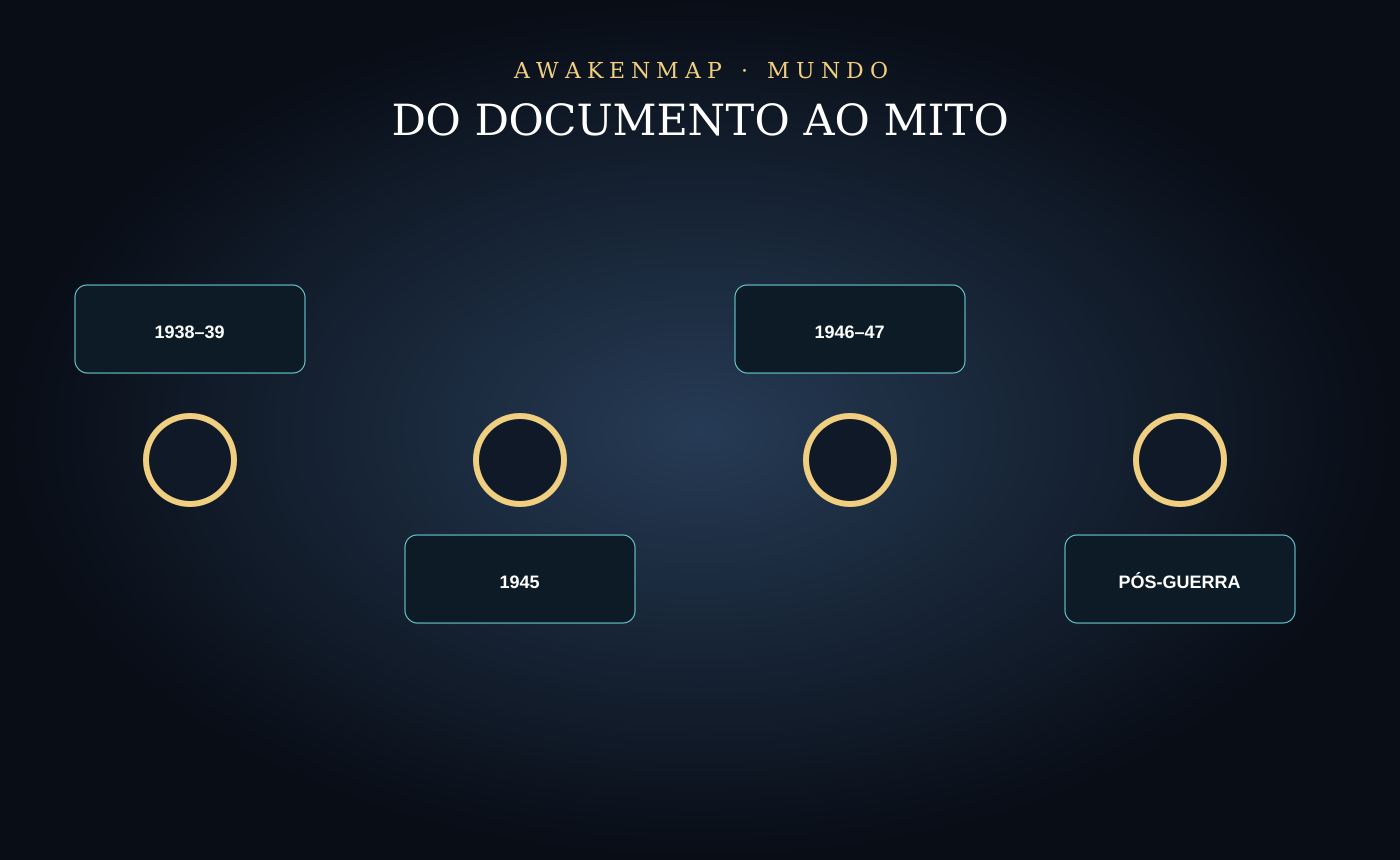
The modern narrative combines the 1938–1939 expedition, late submarine surrenders in Argentina, rumours of fugitives, Operation Highjump in 1946–1947 and later flying-saucer stories. These episodes are real to different degrees, but they did not originate as one documentary sequence.
Critical method builds a timeline. When every silence becomes proof, every coincidence becomes connection and contradictory documents become part of the cover-up, a story becomes resistant to testing.
Military secrecy should also be distinguished from unlimited fantasy. States do classify operations and technology, but real secrecy leaves indirect traces: budgets, personnel, facilities, declassified records and comparable testimony. The complete absence of such traces weighs against a continent-scale base.
The subject remains useful because it shows how authentic facts can be reorganized into a false story without every fragment being invented. Durable misinformation often uses real documents outside their proper scale, context or sequence. Learning to reconstruct chronology is therefore more valuable than memorizing a list of claims.
Neuschwabenland in AwakenMap
In AwakenMap, Neuschwabenland connects to Antarctica, Operation Highjump, Hollow Earth, Agartha, Separatist Nazis, underground bases, UFOs, hidden technology and secret maps. It is a node showing how a small historical fact can become expansive mythology.
As World, it speaks of ice, Queen Maud Land, the ship Schwabenland, aerial reconnaissance and polar geography. As Knowledge, it speaks of exploration history, propaganda, war, cartography and documentary criticism. As Cosmic, it speaks of portals, hidden civilizations, forbidden technology and the fantasy of a secret preserved in ice.
A premium page should make the reader sharper: recognize the real episode, understand why it fascinates and perceive where the narrative leaps beyond evidence.
How to read this theme
Start with what is documented: the German expedition of 1938-1939, the ship Schwabenland, Alfred Ritscher, aerial photographs and the context of whaling and polar geopolitics. Then separate the conspiracy layer: Base 211, flying saucers, Nazi escape, Highjump as secret war and Hollow Earth.
When a claim appears, ask for the primary source, logistics, date, climate, location and consistency between versions. A story that changes place, scale and purpose depending on the author needs careful treatment.
Neuschwabenland teaches that ice does not only preserve cold. It also preserves human projections: fear, guilt, desire for secrecy and the temptation to turn history into legend.
Critical reading
Neuschwabenland should be read as real Antarctic expedition, later conspiracy myth and case of historical projection. The theme requires documentary discernment and ethical care not to glamorize imaginary Nazi technology.
References and starting points
- Polar Record - Hitler's Antarctic base: the myth and the reality
- Nature - Did Hitler have a base in the Antarctic?
- Wired - Nazi Antarctic Base, Sunk
- Polar Stories - That Time the Nazis Claimed a Chunk of Antarctica
- Britannica - Operation High Jump
- Norwegian Polar Institute - Queen Maud Land
FAQ
Was there a Nazi base in Neuschwabenland?
There is no robust evidence of an Antarctic Nazi superbase. What existed was a real German expedition in 1938-1939, brief and linked to reconnaissance and economic interests.
Why does the myth remain popular?
Because it combines Antarctica, Nazism, submarines, secret technology, UFOs and Operation Highjump into a narrative of extreme secrecy.
Keep exploring


Join the conversation
Comments are moderated. Keep the discussion respectful and distinguish evidence, interpretation and personal experience.