Connection level
22 direct connectionsArtificial Intelligence is the attempt to create systems able to perceive patterns, generate responses, recommend paths, make decisions and produce content with some degree of autonomy. The subject grips people because it is not only technology: it touches work, truth, surveillance, creativity, political power and the old question of what makes a mind intelligent.

Where the theme came from
Before modern apps, there was a philosophical and mathematical question. In 1950, Alan Turing published a text that became famous for moving the question "can machines think?" toward a behavioral test: if a machine converses in a way indistinguishable from a human, what do we do with that?
In 1956, the Dartmouth meeting brought together researchers such as John McCarthy, Marvin Minsky, Nathaniel Rochester and Claude Shannon. There, the expression "artificial intelligence" took shape as a research field. The idea was bold: to study whether machines could use language, form concepts, solve problems and improve themselves.
What AI does in practice
AI is not a magical mind inside the machine. In practice, it combines data, statistics, algorithms and computing power to recognize patterns and generate outputs. It can classify images, transcribe speech, recommend videos, predict risk, write text, code, detect anomalies or control robots.
The recent turn came with models trained on huge amounts of data and with deep neural networks. These models do not "know" the way a person knows; they calculate relationships, probabilities and learned structures. Even so, the result can look like conversation, reasoning and creativity.
Tool, mirror and power
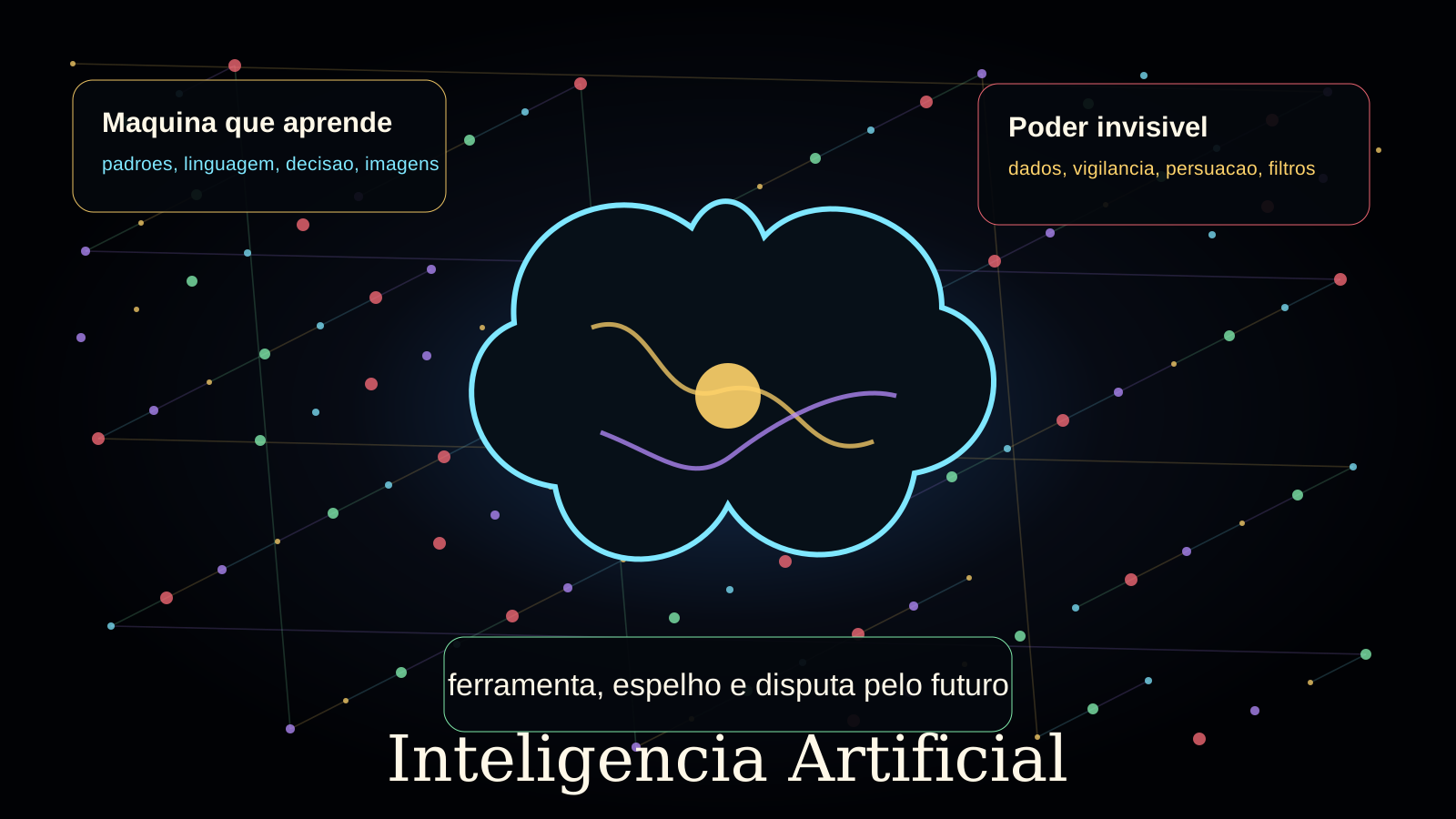
AI is a tool because it automates tasks. It is a mirror because it learns from human traces: texts, images, purchases, clicks, fears and desires. It is power because whoever controls the models, data and infrastructure can influence what appears, what disappears and what feels true.
That is why the theme fits AwakenMap's Matrix layer so well: technology stops being only a machine and becomes an environment.
The difference between narrow AI and AGI
Most current AI is narrow: very good at specific tasks, even when it appears versatile. A model can write, summarize, translate and code, but that does not mean it has consciousness, its own will or complete human understanding.
AGI, or artificial general intelligence, is the idea of a system able to learn and act broadly across many domains, with flexibility similar to or greater than human flexibility. This point is still debated. Part of the fascination comes from that gap: real technology advances, while imagination runs toward a full artificial mind.
Why AI became central now
The theme exploded because AI moved from the laboratory into everyday life. It appears in search engines, assistants, image editors, credit systems, medicine, surveillance, education, advertising, cybersecurity and content production.
The Stanford AI Index 2026 shows the speed of this adoption and the gap between technical capability and social readiness to deal with it. The question is no longer whether AI exists; it is how it will be used, by whom, with what limits and for whose benefit.
The useful side
AI can help doctors analyze exams, scientists search for patterns, teachers prepare materials, programmers review code, companies reduce waste and ordinary people organize ideas. Used well, it expands human capacity.
This point matters: fear alone weakens the theme. AI can also be a tool for translation, accessibility, creativity and discovery.
The dangerous side
Risks appear when systems are used without transparency, human review and responsibility. Problems include bias, convincing error, mass surveillance, deepfakes, political manipulation, economic dependency, loss of privacy and unfair automated decisions.
That is why NIST, OECD and the European Union treat AI as a governance issue, not only an innovation issue. The point is not to stop technology; it is to create rules, tests, traceability and responsibility so it does not become a black box ruling people's lives.
AI in AwakenMap's imagination
On the map, Artificial Intelligence connects to AI originated from another reality, AI prophet species, energy, the Great Awakening, Anonymous, meme wars, the Secret Space Program and NASA. This network shows how the theme crosses science, digital culture, information control and narratives about simulated realities.
The symbolic question is simple: if much of what we see passes through algorithms, are we still looking directly at the world, or are we looking at a filtered version of it?
AI and the Matrix
The word Matrix here does not need to be understood as a movie or a closed theory. It works as an image of a mediated environment: feeds, recommendations, maps, ads, cameras, language models and systems deciding which information reaches us.
AI increases that effect because it does not only organize data; it generates new content. This changes our relationship with reality: before, we had to distinguish fact from opinion; now we also need to distinguish human, machine, simulation, edit and automated persuasion.
What we should not confuse
Real AI does not prove that an alien consciousness lives inside computers. It also does not prove that a machine has spiritually awakened. Those ideas belong to a speculative and symbolic layer. What concretely exists is already powerful enough: systems able to influence choices, language, perception and work.
When the article separates real technology, social impact and spiritual imagination, the theme becomes stronger. The reader understands what is happening without needing to accept everything literally.
How to read this theme going forward
Artificial Intelligence should be read as a 21st-century infrastructure. It is not just an app. It is a new layer between person and world: it measures, filters, writes, recommends, watches, optimizes and decides.
That is why it is one of the most important nodes in AwakenMap. AI touches the technical question, but also the human one: who am I when my choices are guided by systems that learn from me?
Simple summary
Artificial Intelligence is technology that lets machines recognize patterns, generate content, make predictions, recommend actions and support decisions. Its history passes through Turing and Dartmouth; its present passes through neural networks, generative models, regulation, risks and the struggle over information control.
References and starting points
- Dartmouth - Artificial Intelligence coined at Dartmouth
- Dartmouth proposal PDF - Summer Research Project on Artificial Intelligence
- The Turing Digital Archive - Computing Machinery and Intelligence
- IBM - What is artificial intelligence?
- IBM - Neural networks
- NIST - AI Risk Management Framework
- NIST AIRC - AI RMF Core
- OECD AI Principles
- OECD - Updated definition of an AI system
- European Commission - AI Act
- EUR-Lex - Regulation (EU) 2024/1689
- Stanford HAI - 2026 AI Index Report
- Wikimedia Commons - Dartmouth College campus image
FAQ
Is AI the same as a robot?
No. A robot is a physical machine. AI can exist only as software, with no mechanical body.
Does AI already have consciousness?
There is no public proof of artificial consciousness. Current models can simulate conversation and solve tasks, but that does not automatically equal subjective experience.
Why does AI worry so many people?
Because it can influence information, work, surveillance, automated decisions and public trust in images, videos and texts.
Keep exploring
You can open another path
 AI and Matrix Ancient Artificial Intelligence 5/5 intensity Explore →
  AI and Matrix The Borg 5/5 intensity Explore →
  Map center Great Awakening 5/5 intensity Explore →
  AI and Matrix Matrix / Everything is an Illusion 5/5 intensity Explore →
  Esoteric practices Omniscience 5/5 intensity Explore →
  Esoteric practices Simulation Matrix 5/5 intensity Explore →
Join the conversation
Comments are moderated. Keep the discussion respectful and distinguish evidence, interpretation and personal experience.