Connection level
12 direct connectionsTao Te Ching belongs on AwakenMap through the question of when simplicity becomes lucidity and when it becomes refusal to look at the world. Traditionally attributed to Laozi, it is one of the most influential books in Chinese thought. It speaks of Tao, the way before names and forms; Te, the potency or virtue expressing that way; and a wisdom that acts without forcing. The modern conspiratorial layer appears when the book is treated as a hidden manual for exiting the Matrix, deactivating social control or accessing a primordial energy.
Tradition attributes the Tao Te Ching to Laozi, a sage said to have left the court and written the text before disappearing westward. Historically, Laozi is difficult to fix. The text likely formed in layers through schools, commentary and written transmission.
The book has about 81 short chapters of aphorism, paradox and image: water, valley, infant, uncarved wood, silence, government, war, humility, emptiness, softness and return.
The image beside this text shows a Mawangdui manuscript associated with Laozi, discovered archaeologically in China in the twentieth century. Manuscripts such as Mawangdui and Guodian show textual variants, orders and material forms earlier than common received editions.
This matters because the Tao Te Ching is not only timeless wisdom floating outside history. It is also a copied, preserved, discovered, compared and interpreted text.
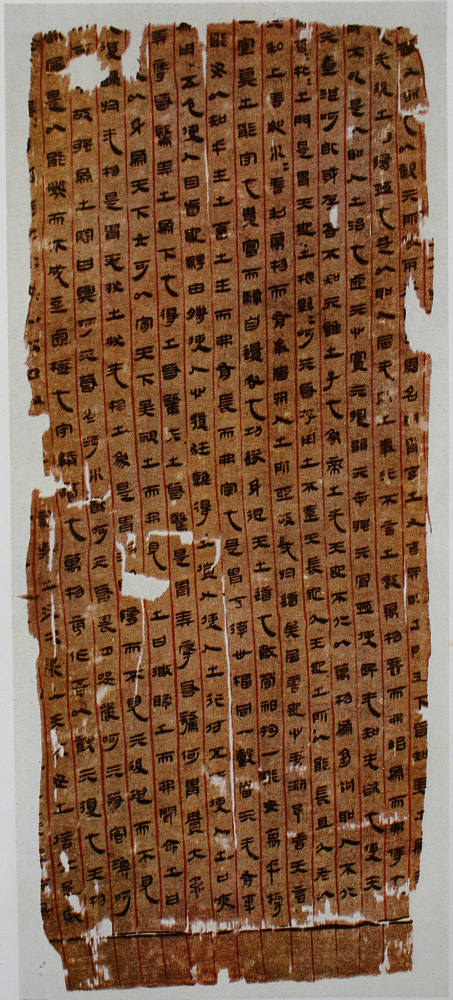
The Mawangdui manuscripts, dated to the second century BCE, and the Guodian bamboo texts, generally associated with the late Warring States period, changed the study of the book. They show ancient versions different from the received tradition.
Tao is not simply God, energy, nature or universe, though modern translations may touch those words. It is what does not fit well into concept. Naming already loses part of the movement.
The most popular principle is wu wei: non-action or action without forced effort. It does not mean laziness or abandonment. It means acting in alignment with the course of things.
The connection with Return to Source is direct. Tao Te Ching repeatedly speaks of return: to root, simplicity, emptiness and the uncarved.
Meditation enters because the text teaches attention that listens before acting. It is not a technical meditation manual, but it invites reduction of noise, desire, haste and rigidity.
empty awareness deepens this. Emptiness is not nihilism. A vessel is useful because of its inner space; a wheel turns around an empty hub.
The conspiratorial layer appears in the link with matrix illusion and Matrix. The text is read as ancient instruction for not being captured by the system: do not react to stimuli, do not obey manufactured desire, do not confuse names with reality.
global control appears because the text contains a subtle critique of excessive government, punishment, display and manipulation of desire.
collective consciousness connects because Tao is not an isolated experience. When a culture loses the way, excess, rivalry, empty language and violence appear.
The relation with Oversoul appears when Tao is treated as the common ground of life. Both point beyond individual ego, but Oversoul tends to use consciousness language; Tao uses path, source, emptiness and process.
Gnosticism enters by contrast. Gnostic readings often treat the material world as prison. Tao Te Ching does not command hatred of the world; it invites release from rigid constructions, names, desires and struggles.
unified field theory appears in modern rereadings that compare Tao to unified field, background energy or hidden order. As metaphor, this can help. As science, it requires care.
propaganda enters because the text is easy to domesticate. Short lines become motivational quote, leadership manual, political slogan or calm aesthetic for selling products.
A mature reading separates five layers: the ancient Chinese text; archaeological manuscripts and textual variants; philosophical interpretations of Tao, Te, wu wei, government and simplicity; modern spiritual uses of return and flow; and the conspiratorial reading that turns the book into a secret manual against the Matrix.
Simple summary
Tao Te Ching is a classic Chinese text attributed to Laozi, connected to Tao, Te, wu wei, simplicity, emptiness and critique of excessive control. Manuscripts such as Mawangdui and Guodian show an ancient and complex textual history. On AwakenMap, it connects Return to Source, Meditation, empty awareness, matrix illusion, global control, collective consciousness, Oversoul, Gnosticism, unified field theory and propaganda.
References and starting points
- Stanford Encyclopedia of Philosophy - Laozi
- Stanford Encyclopedia of Philosophy - Daoism
- Chinese Text Project - Daodejing in Chinese and translations
- Project Gutenberg - Tao Te Ching, James Legge translation
- Wikimedia Commons - Mawangdui Laozi manuscript
- University of Hawaii - bibliography and notes on Guodian and Mawangdui texts
Why it belongs on AwakenMap
It belongs because it shows how a radically simple text can be read as philosophy, inner practice, political critique and a modern code against systems of control. Tao Te Ching helps separate ancient wisdom, Return to Source, flow language and conspiratorial projections about exiting the Matrix.
Keep exploring
You can open another path
 Return to Source Empty Awareness 5/5 intensity Explore →
  Map center Great Awakening 5/5 intensity Explore →
  Return to Source Return to Source 5/5 intensity Explore →
  Control systems Global Control 4/5 intensity Explore →
  AI and Matrix Matrix / Everything is an Illusion 4/5 intensity Explore →
  Esoteric practices Meditation 4/5 intensity Explore →
Join the conversation
Comments are moderated. Keep the discussion respectful and distinguish evidence, interpretation and personal experience.