Connection level
12 direct connectionsMerkaba is the symbol of chariot, throne, inner ascent and light-body geometry, standing between ancient Jewish mysticism and modern spirituality.
Before the star, there was a chariot
Merkaba often appears today as a luminous tetrahedral star spinning around the body. In spiritual networks, it is treated as a vehicle of ascension, a protective field, light-body geometry or an inner technology for raising consciousness. This modern image is strong, beautiful and easy to remember. But it is only the most recent layer of a much older history.
Before Merkaba became a geometric form in contemporary meditations, there was Merkabah: a Hebrew word connected with chariot or vehicle, especially the divine throne-chariot associated with the vision of the prophet Ezekiel. The theme therefore begins not as an individual manifestation technique, but as a visionary encounter with mystery, throne, living beings, wheels, fire and divine presence.
That difference changes everything. If we look only at the star, Merkaba becomes an aesthetic tool. If we return to the chariot, we notice that the symbol speaks of movement between worlds, the danger of vision, inner preparation, religious language, the limit of mind and an encounter with what exceeds the person.
Ezekiel and the image that will not stay still
The oldest foundation of the theme is Ezekiel 1. The text describes an intense vision: wind, cloud, fire, brightness, living creatures, wings, wheels within wheels and a kind of throne above the firmament. It is not an easy scene to visualize because perhaps it was not written to become a technical drawing. It moves like dream, rite and sacred shock.
Ezekiel's power lies precisely in that instability. The wheels move without turning. The beings face several directions. Fire runs among them. Above and below seem connected through an axis of presence. Instead of explaining God, the text creates an experience of excess: the mind tries to follow and realizes that its language almost breaks.
For this reason, ancient Merkabah should not be reduced to a UFO in the Bible or to an energetic mandala. Those readings may exist in the modern imagination, but the text belongs first to prophetic and apocalyptic tradition. It speaks of exile, glory, terror, vision and spiritual authority.
Merkavah and Hekhalot: ascending the palaces
In the early centuries of the common era, a current of Jewish mysticism developed around Merkavah and Hekhalot. Hekhalot refers to palaces or heavenly precincts. Instead of merely commenting on Ezekiel's vision, these texts and practices imagined journeys of ascent through celestial layers toward the divine throne.
Sefaria summarizes this tradition as the attempt of merkavah mystics to recreate the breathtaking experience of Ezekiel's heavenly chariot, while heikhalot mystics focused on the journey through heavenly palaces. The Jewish Encyclopedia also preserves the memory that the study of the Merkabah was considered dangerous and reserved for initiates.
This matters for modern reading. In the ancient tradition, approaching the chariot was not visual play. It required preparation, ritual language, discipline, purity, awe and knowledge. The symbol was not an ornament of self-confidence; it was a boundary between the human psyche and a sacred order almost too intense to bear.
The danger of vision
Many ancient spiritual systems treat vision as dangerous. Seeing too much, too early, without structure, can disorganize. Merkabah belongs to that family of images. It is not only transportation; it is a test of maturity. Whoever ascends must know how to return. Whoever contemplates the throne must not confuse themselves with the throne.
In psychological language, this remains current. Intense experiences of meditation, breathwork, retreat, psychedelics, trauma, kundalini or altered states may open powerful symbols. The mistake is assuming every intensity is realization. A person may see lights, geometric forms, presences and synchronicities while still avoiding basic emotional work.
Read carefully, Merkaba teaches a simple rule: access is not integration. Vision may open a door, but transformation depends on how a person lives afterward.
From chariot to light body
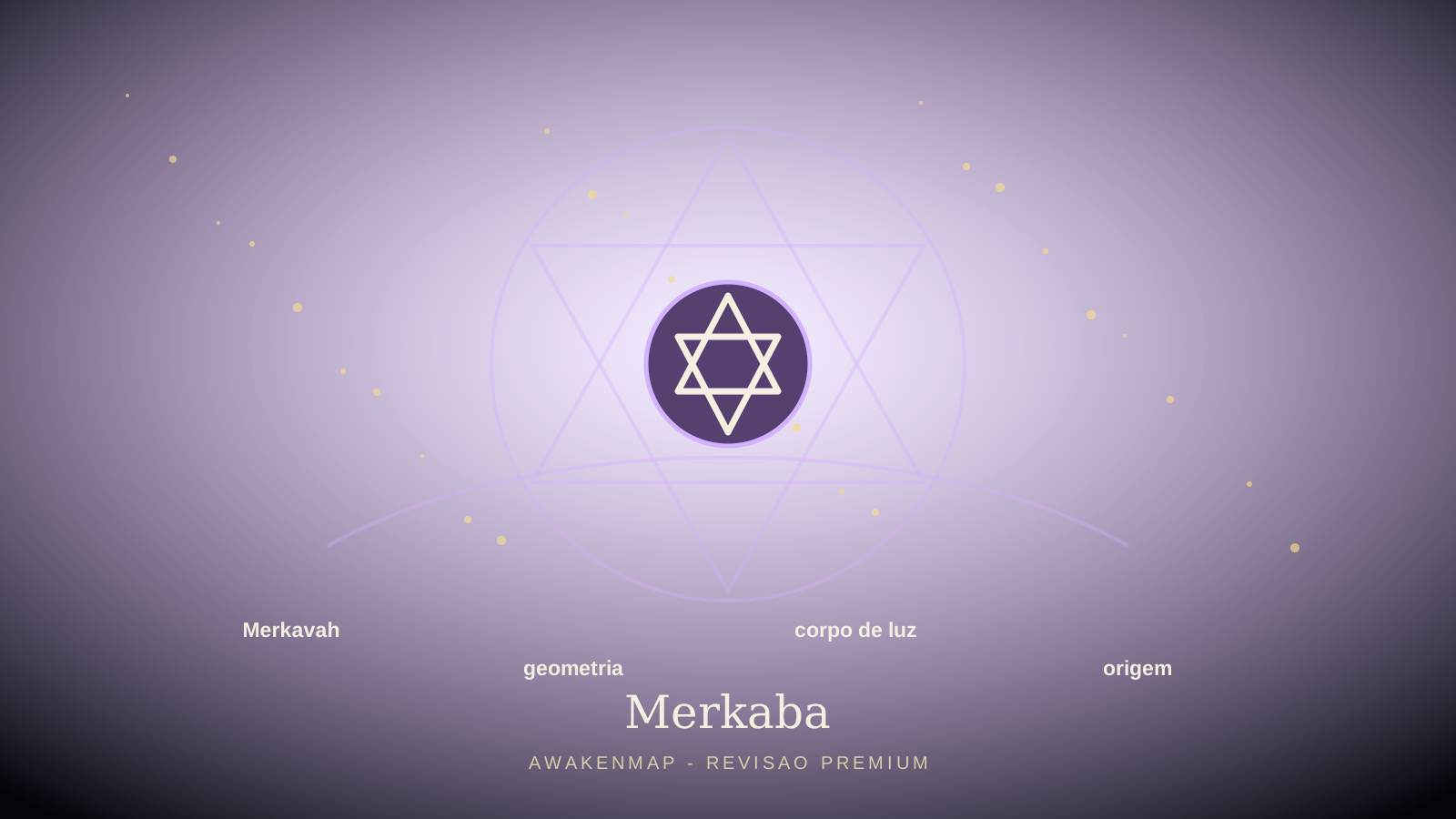
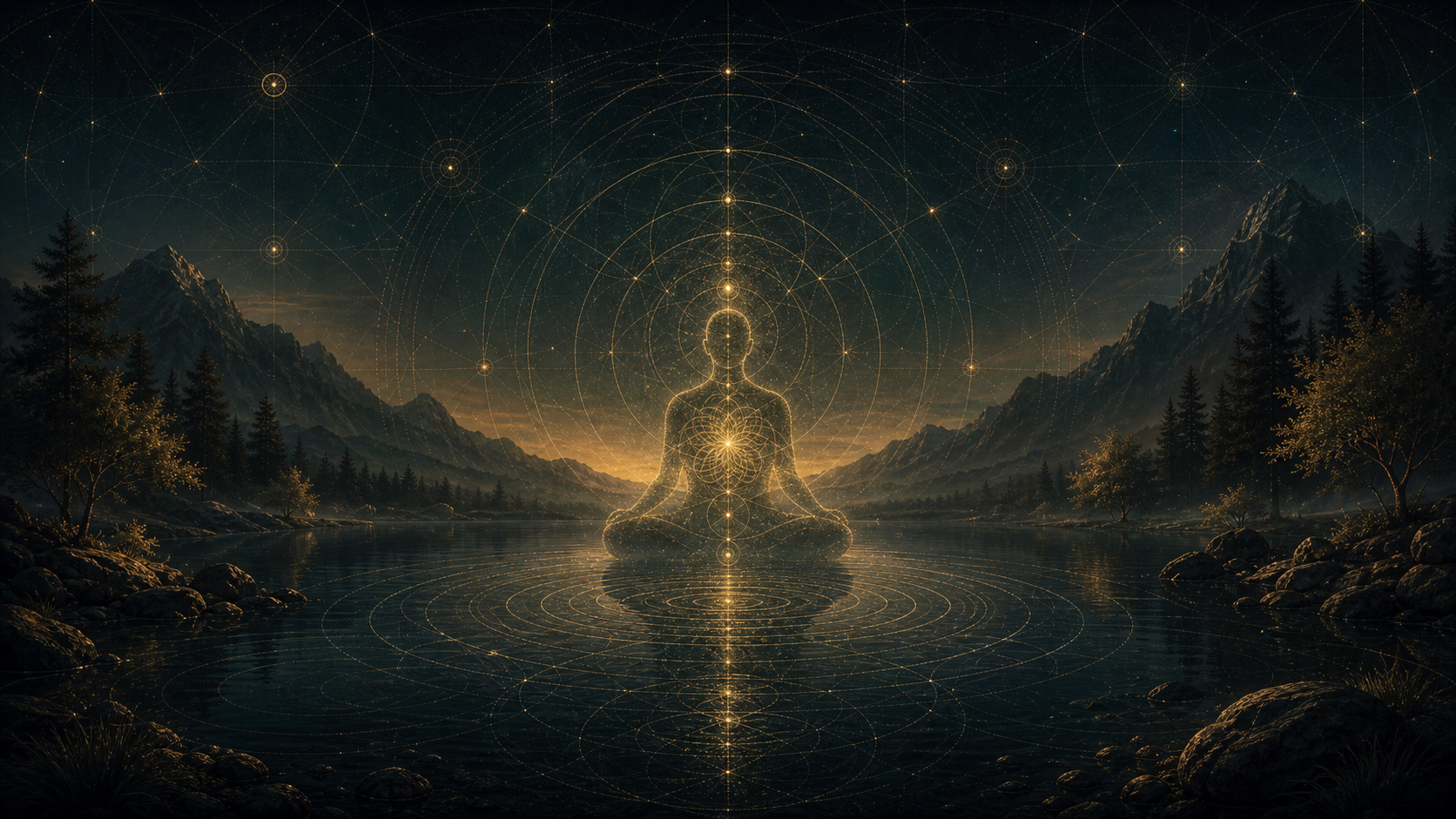
Modern spirituality moved the theme from divine chariot to human body. Merkaba came to be described as an energetic structure around the person, often formed by two interpenetrating tetrahedra: one pointing upward, one downward. This figure suggests union of heaven and earth, masculine and feminine, spirit and matter, ascent and grounding.
This version gained strength in sacred geometry, New Age spirituality, meditation, channeling and ascension teachings. Modern authors popularized the idea of activating the Merkaba through breathing, visualization, spinning fields and heart alignment. For many practitioners, it works as an imaginative map of the subtle body.
Even when ancient history does not support every modern detail, the image can be psychologically effective. Visualizing a geometric field around the body may organize attention, posture, breathing and a sense of axis. The problem begins when symbolic practice is sold as proven literal technology, with exaggerated promises of teleportation, invulnerability or automatic ascension.
Sacred geometry and disciplined imagination
The tetrahedral star associated with Merkaba has visual kinship with sacred geometry: triangles, symmetry, center, proportion, rotation and balance between opposites. Sacred art history shows that geometric patterns have always served more than decoration. In many cultures, geometry organizes attention and suggests an invisible order behind the sensible world.
The Metropolitan Museum of Art, when discussing geometric patterns in Islamic art, shows how repetition, symmetry and mathematical structures can express infinity, order and contemplation. This example is not an origin of modern Merkaba, but it helps explain why geometric forms work so well spiritually: they give shape to the unsayable without turning it into a portrait.
Modern Merkaba can be read as disciplined imagination. It is not merely loose fantasy; it is a way of training the mind to feel axis, center, boundary, expansion and relation between above and below. Like all powerful imagination, it needs discernment so it does not become grandiose delusion.
Gershom Scholem and the seriousness of Jewish mysticism
To avoid flattening the theme, it is worth remembering Gershom Scholem, one of the great scholars of Jewish mysticism. Scholem helped show that Kabbalah and earlier forms of Jewish mysticism were not marginal curiosities without importance, but complex traditions with language, history, internal tensions and deep religious impact.
The Stanford Encyclopedia of Philosophy presents Scholem as a central figure in the modern study of Kabbalah and Jewish mysticism. For AwakenMap, the point is not to turn a spiritual page into a heavy academic lecture. It is to recognize that the word Merkabah belongs to a real history, with texts, debates, practices and dangers. It was not born as an energy meme.
When the site respects that depth, it gains authority. The reader may remain interested in modern Merkaba, but begins to understand that they are touching an old root and not merely a beautiful internet image.
What can be practiced safely
A healthy reading of modern Merkaba may include visual meditation, slow breathing, attention to the center of the chest, awareness of the body's vertical axis and contemplation of the relation between earth and sky. This may help some people feel more present, protected and aligned. There is no problem in using symbols as supports for practice, as long as symbols are not confused with cosmic guarantees.
The care lies in absolute promises. No visualization replaces medical treatment, therapy, spiritual discernment, emotional responsibility or concrete life. If someone uses Merkaba to avoid the body, deny conflict, inflate spiritual identity or feel superior to others, the symbol reverses: what should integrate begins to separate.
The most useful question is not is my Merkaba activated? The better question is: does this practice make me more whole, more humble, more lucid and more able to love without escaping reality?
Merkaba, Star Merkaba and ascension
In AwakenMap, Merkaba naturally connects with Star Merkaba, Sacred Geometry, Kundalini, Light Body, Meditation, Return to Source, Love and Light and Mental and Spiritual States. Basic Merkaba is the symbol of the inner vehicle. Star Merkaba can be read as its cosmic expansion: the same structure applied to ideas of star origin, planetary ascension or multidimensional identity.
That connection must be handled carefully. When everything becomes ascension, nothing matures. The better reading is to see Merkaba as a language of integration: the human being as meeting point between matter and spirit, history and myth, body and symbol, limit and infinity.
It does not need to prove itself as a physical object to have value. It needs to function as an honest inner map. A good symbol does not hijack the person; it returns the person to themselves with more presence.
The technological temptation
A modern risk is turning Merkaba into a spiritual machine. The language of activating, switching on, spinning fields, raising frequency and unlocking codes can be inspiring, but it can also reduce a visionary tradition to a control panel. That matches contemporary culture: we want a button, a quick method, measurable result and intense experience.
Ezekiel's chariot, however, does not function like an app. It does not appear to satisfy spiritual performance desire. It interrupts. It frightens. It displaces the prophet. It demands response. Perhaps modern Merkaba becomes deeper when it stops being an ascension technology and becomes a question again: what kind of human being could sustain a larger vision without getting lost in it?
How to read without appropriating or ridiculing
Merkaba crosses a delicate line. On one side, there is the Jewish tradition of Merkabah, with its own religious context. On the other, there are modern spiritual uses that often mix Kabbalah, geometry, channeling, New Age language and therapeutic vocabulary. The reader needs to recognize the difference without automatically despising either side.
Respect means naming the origin, not erasing the Jewish layer of the word, not pretending modern practices are identical to ancient texts and not using sacred symbols as empty decoration. Criticism also means not accepting every modern promise just because it uses an old word.
The mature path is double: honor the root and examine the fruit. Where did this image come from? What does it produce in practice? Does it increase lucidity, responsibility and reverence? Or does it only feed fantasy of power?
The best way to read this theme
Merkaba is one of the most beautiful themes in AwakenMap when read in layers. In the first layer, it is a prophetic vision of chariot and throne. In the second, it is a mystical tradition of ascent through heavenly palaces. In the third, it is a modern geometry of the light body. In the fourth, it is a living metaphor for consciousness trying to become a vehicle for something greater without losing the ground.
The poor reading asks only whether Merkaba is real. The better reading asks: real at what level? As sacred text? As symbol? As meditative practice? As subjective experience? As energetic claim? Each level requires different evidence and criteria.
When these layers remain distinct, Merkaba stops being shallow fantasy and becomes a map: not a map for fleeing the world, but for crossing spiritual intensity without abandoning body, history, community and discernment.
Critical reading
Merkaba should be read in layers: prophetic text, mystical tradition, modern geometric symbol and subjective practice. Mixing everything as if it were the same thing flattens the theme; separating the layers allows respect, beauty and discernment.
References and starting points
- Sefaria - Ezekiel 1, the chariot vision
- Sefaria - Introduction to Merkavah
- Jewish Encyclopedia - Merkabah
- Encyclopedia.com - Merkabah Mysticism
- Stanford Encyclopedia of Philosophy - Gershom Scholem
- Stanford Encyclopedia of Philosophy - Mysticism
- Metropolitan Museum of Art - Geometric patterns in Islamic art
FAQ
Does Merkaba come from Kabbalah?
The ancient root is Jewish Merkabah, connected to Ezekiel's chariot vision and to currents of Jewish mysticism earlier than or parallel to later Kabbalistic developments. The modern geometric Merkaba is a contemporary spiritual reinterpretation.
Is Merkaba literally an energetic vehicle?
That is a spiritual claim, not a consensually demonstrated fact. As symbol and meditative practice, it may have subjective value. As literal technology, it requires much more care and evidence.
Keep exploring
You can open another path
 Consciousness and symbols Flower of Life 4/5 intensity Explore →
  Esoteric practices Kabbalah 4/5 intensity Explore →
  Consciousness and symbols Sacred Geometry 4/5 intensity Explore →
  Esoteric practices Star Merkaba 4/5 intensity Explore →
  Esoteric practices Meditation 4/5 intensity Explore → Consciousness and symbols Sacred Geometry 4/5 intensity Explore →
Join the conversation
Comments are moderated. Keep the discussion respectful and distinguish evidence, interpretation and personal experience.