Connection level
17 direct connectionsVector equilibrium belongs on AwakenMap through the question of when a mathematical form becomes a promise of total revelation. The idea begins as geometry: a form in which center, vertices and edges seem to express perfect balance of distances and directions. But in contemporary esoteric culture, it becomes something larger: the matrix of space, the zero point of creation, the hidden design behind energy, consciousness and the structure of the cosmos itself.
The name became associated mainly with Richard Buckminster Fuller, the American architect, inventor, writer and systems thinker born in 1895 and deceased in 1983. Fuller became famous for popularizing geodesic domes, but his ambition was broader: to create a geometric language for thinking about whole systems. In Synergetics, he treated tetrahedra, octahedra, vector networks and triangulated structures as keys for understanding efficiency, stability and nature's organization.
The image beside this text shows a cuboctahedron, the geometric form Fuller called vector equilibrium. It has 8 triangular faces, 6 square faces, 24 edges and 12 vertices. The detail that fascinated Fuller is that, in this configuration, the distance from the center to each vertex can equal the length of the edges.
That mathematical fact is real. The dispute begins when it is turned into proof of infinite energy, instant healing or the secret architecture of the universe.
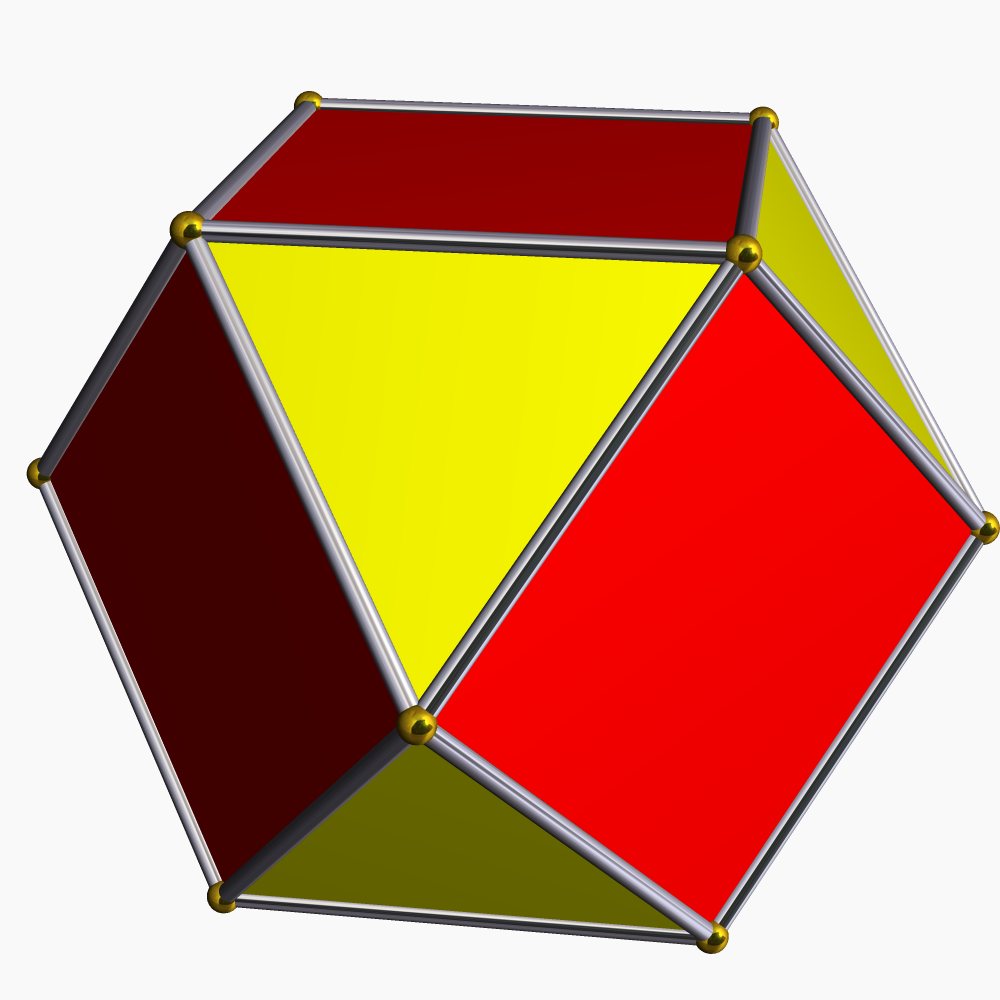
In simple terms, vector equilibrium is a way of looking at the cuboctahedron as a network of balanced vectors. Imagine a central point connected to twelve surrounding points, all in an organized distance relationship. The form seems suspended between expansion and contraction, stability and movement. This is why it became attractive to architecture, spatial modeling, geometric art and visual spirituality.
The connection with sacred geometry appears because balanced forms often feel like more than drawing. They produce a sense of order, harmony and inevitability. The problem is not feeling that beauty; the problem is jumping from beauty to an absolute conclusion. A form can be elegant, recurring and useful without automatically being the final code of reality.
Fuller was not merely a mystic drawing polygons. He thought about structures, materials, energy, housing, ecology and planetary survival. His principle of doing more with less runs through geodesic domes and design science. Vector equilibrium appears in that environment as part of a spatial grammar: an attempt to replace fragmented thinking with relation, system and interdependence.
The concrete case is the reception of Synergetics itself. Originally published in the 1970s, the book mixed geometry, philosophy, Fuller's own technical language and speculation about how nature organizes systems. For admirers, Fuller opened an integrative vision. For critics, his language could be difficult, idiosyncratic and not always absorbed by traditional academic mathematics. That ambiguity is exactly what makes the theme fertile on AwakenMap.
The conspiratorial layer appears when vector equilibrium stops being a geometric model and becomes suppressed secret. In strong versions, universities, governments, energy corporations or initiatory societies hid this geometry because it would reveal free energy, antigravity, vibrational healing, zero-point technology or forbidden unified physics. The form moves from cuboctahedron to master key.
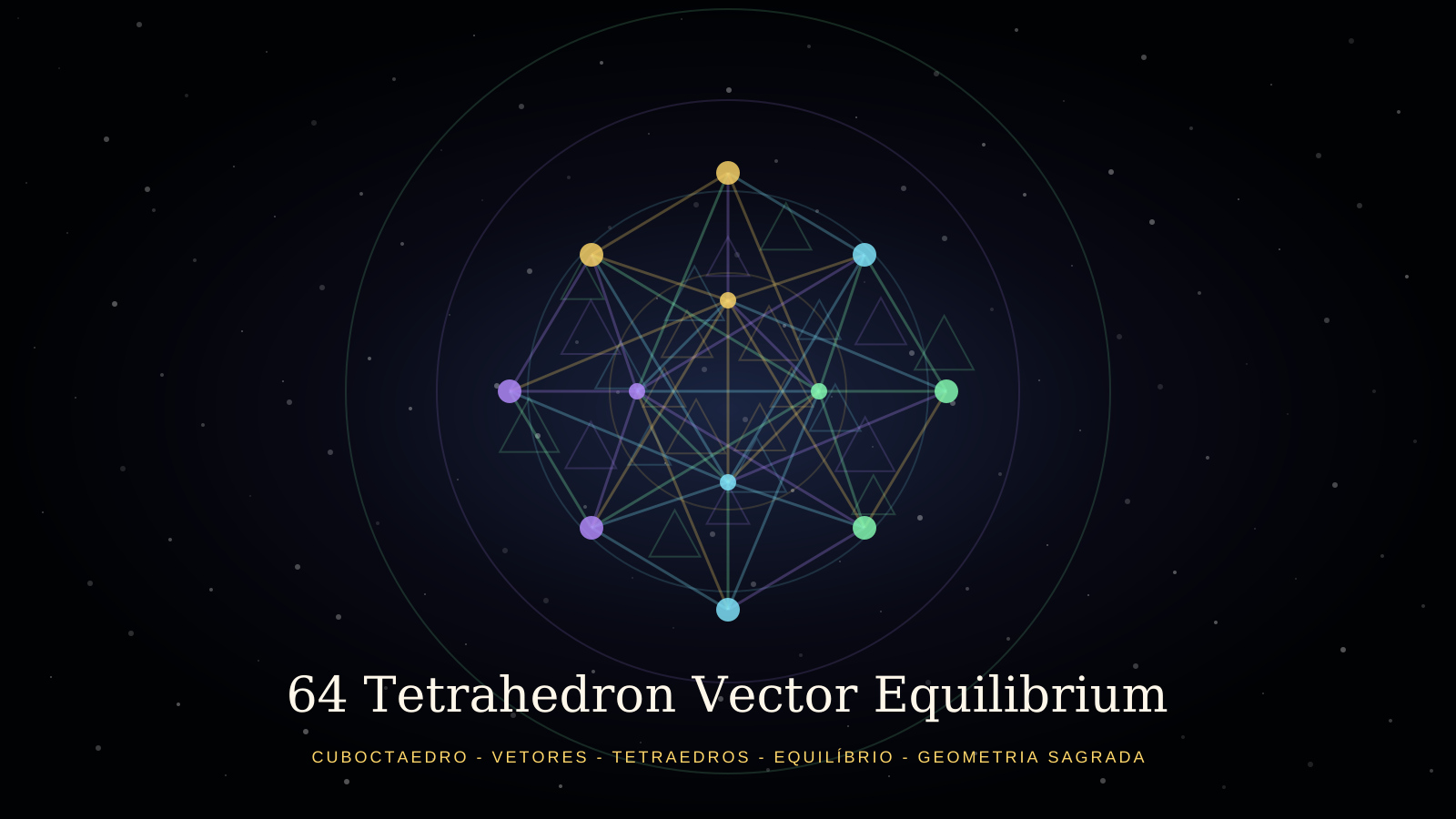
This is where the theme connects to the 64-tetrahedron vector equilibrium. The 64-tetrahedron grid is popular in sacred geometry because it seems to expand the cuboctahedron into a more complex network of tetrahedra and octahedra. For some, it represents a fundamental structure of the void, a seed of the quantum field or a primordial pattern of creation. The fascination is understandable: the form is visually powerful. The caution is necessary: geometric beauty is not enough as physical proof.
The Flower of Life enters because many esoteric systems try to derive solids, stars and spatial networks from overlapping circles. The Flower of Life functions as a two-dimensional matrix from which cubes, tetrahedra, hexagonal patterns and figures such as Metatron's cube are extracted. Vector equilibrium appears in this environment as a three-dimensional version of an order supposedly already drawn in ancient geometry.
The relationship with Merkaba and the star Merkaba comes from the idea of a geometric vehicle of transformation. While the Merkaba is often represented by interpenetrating tetrahedra, vector equilibrium offers another image of center and expansion. In spiritual communities, these forms can be used in meditation, visualization and light-body language. The subjective experience can be intense, but this does not turn the form into a proven physical engine.
The torus completes the narrative because many diagrams combine cuboctahedron, torus, vortex and energetic breathing. The torus suggests flow leaving the center and returning to the center. Vector equilibrium suggests a state of balance before expansion. Together, they become a visual cosmology: everything pulses, everything breathes, everything emerges from a geometric center. As metaphor, it is strong. As scientific claim, it requires much more.
The connection with frequency, energy and cymatics appears when form and vibration are placed in the same sentence. Cymatics shows patterns formed by vibration in sand, liquid or plates. That is real and beautiful. The conspiratorial leap is saying that any beautiful geometry reveals secret frequencies capable of healing everything, moving matter or opening portals. Form, sound and vibration relate in many systems; this does not mean every spiritual interpretation is operational technology.
zero-point energy is perhaps the most seductive association. The phrase zero point suggests vacuum energy, potential before manifestation and absolute balance before motion. Vector equilibrium fits that imaginary perfectly: a still form that seems to contain all directions. This is why it became a symbol of primordial field. The care is to distinguish zero-point energy as a specific physical concept from “zero point” as spiritual metaphor.
The link with free energy and unified field theory follows the same trail. When someone believes there is a hidden fundamental geometry, it is tempting to imagine that it could produce a technology able to unify gravity, electromagnetism, energy, consciousness and matter. The search for a unified theory is legitimate in physics; it is another thing to claim that one figure solves the problem without mathematics, testing, prediction and peer review.
Nassim Haramein appears because he popularized, in alternative environments, geometric readings of vacuum, proton, gravity and the structure of space. For his audience, he offers a bridge between Fuller, sacred geometry and frontier physics. For scientific critics, many of these proposals lack academic acceptance. The article needs to keep that tension: there is real cultural influence, but cultural influence does not equal scientific validation.
quantum physics is also frequently invoked. Words such as field, vacuum, matrix, vibration and energy give spiritual interpretations a scientific appearance. Sometimes they help create useful metaphors; sometimes they act as varnish. The test is simple: does the claim make a verifiable prediction? Can it be measured? Can it fail? Or does it merely use scientific vocabulary to protect a belief?
The link with the simulation matrix is direct. If reality has a base geometry, then the world can be imagined as a coded construction. Vector equilibrium becomes a sacred pixel, a module of simulation, a cell of space. This image is fascinating because it makes something invisible visible. The risk is confusing map with territory: a visualization tool starts being treated as reality itself.
The relationship with collective consciousness appears when entire communities meditate on the same form, build mandalas, print 3D models, run workshops and share the feeling that a common key is present there. This shows how geometry can organize collective imagination. It also shows how a figure can become identity: those who “understand the geometry” feel part of an awakened minority.
On AwakenMap, the mature reading separates three planes. First, the mathematical plane: the cuboctahedron as an Archimedean solid with defined geometric properties. Second, the Fullerian plane: vector equilibrium as part of a systemic language about structure and design. Third, the conspiratorial-esoteric plane: the idea that this form is the suppressed key to energy, healing, consciousness and the architecture of the universe.
Vector equilibrium matters because it is a perfect example of how something true can be amplified until it becomes unrecognizable. The form exists. Its properties are interesting. Fuller really did treat it as an important piece of his geometry of thinking. But the leap to “proof of infinite energy” or “secret hidden by science” needs evidence, not only enchantment. The good question is not whether the form is special. It is. The question is what exactly that specialness authorizes us to conclude.
Simple summary
Vector equilibrium is the name associated by Buckminster Fuller with the cuboctahedron, a form with 8 triangular faces, 6 square faces, 24 edges and 12 vertices. On AwakenMap, the theme connects sacred geometry, 64 tetrahedra, Flower of Life, Merkaba, torus, frequency, cymatics, zero-point energy, free energy, unified field theory, Nassim Haramein and simulation matrix. The conspiratorial layer appears when a mathematical form becomes a supposedly hidden key to energy, healing and control of reality.
References and starting points
- Buckminster Fuller Institute - synergetics and design science
- R. Buckminster Fuller - Synergetics, online edition
- Wikimedia - cuboctahedron, mathematical form associated with vector equilibrium
- Internet Archive - Synergetics: Explorations in the Geometry of Thinking
- Buckminster Fuller Institute - geodesic domes and structural thinking
- Wikimedia Commons - cuboctahedron image
Why it belongs on AwakenMap
It belongs because it shows how real geometry can become a bridge between science, symbol and myth. Vector equilibrium helps think about order and relation; the challenge is not to turn visual fascination into automatic proof of secret physics.
Keep exploring
You can open another path
 Consciousness and symbols Torus 5/5 intensity Explore →
  Consciousness and symbols 64-Tetrahedron Vector Equilibrium 5/5 intensity Explore →
  Map center Great Awakening 5/5 intensity Explore →
  Consciousness and symbols Sacred Geometry 5/5 intensity Explore →
  Healing and energy Cymatics 4/5 intensity Explore →
  Consciousness and symbols Flower of Life 4/5 intensity Explore →
Join the conversation
Comments are moderated. Keep the discussion respectful and distinguish evidence, interpretation and personal experience.