Connection level
6 direct connections64 Tetrahedron Vector Equilibrium joins Buckminster Fuller's vector equilibrium, the 64 tetrahedron structure, sacred geometry, energy matrix and the idea of field structure. The power of the theme lies in the passage between visual mathematics and spiritual interpretation: when does a balanced form become metaphor, energy map or supposed architecture of the universe?
What the name means
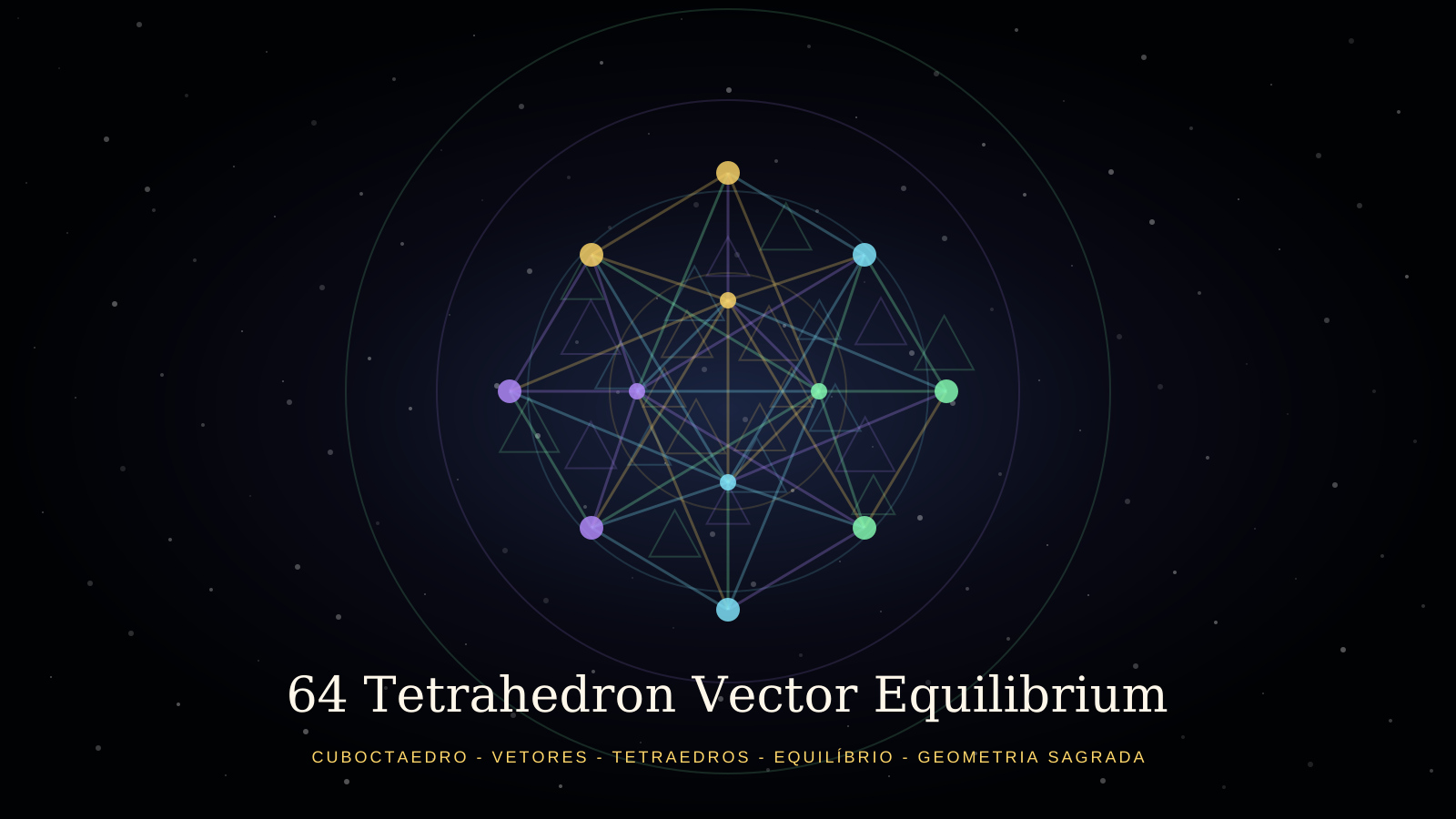
A tetrahedron is a four-faced triangular pyramid. “Vector equilibrium” can be understood as vector balance: a form in which the vectors from the center to the vertices and the outer edges have the same measure. The associated form is the cuboctahedron, a solid with square and triangular faces.
On AwakenMap, this theme connects to Sacred Geometry, zero-point energy, energy, meditation, crystals, the Earth Grid and the Law of One. It sits where visual mathematics, spiritual symbol and cosmic imagination meet.
The real base: Fuller's cuboctahedron
R. Buckminster Fuller used the term “vector equilibrium” within his language of Synergetics. Fuller saw the tetrahedron as a fundamental piece for thinking about structure, tension, compression, systems and nature. The cuboctahedron drew his attention because it seemed to represent a state of equilibrium: forces extending from the center and distributing symmetrically.
This part of the theme is geometric. The cuboctahedron exists as a known solid, studied in geometry, with its own properties. Fuller gave it a more philosophical vocabulary, connecting form, system, energy and thought.
The image that needs context
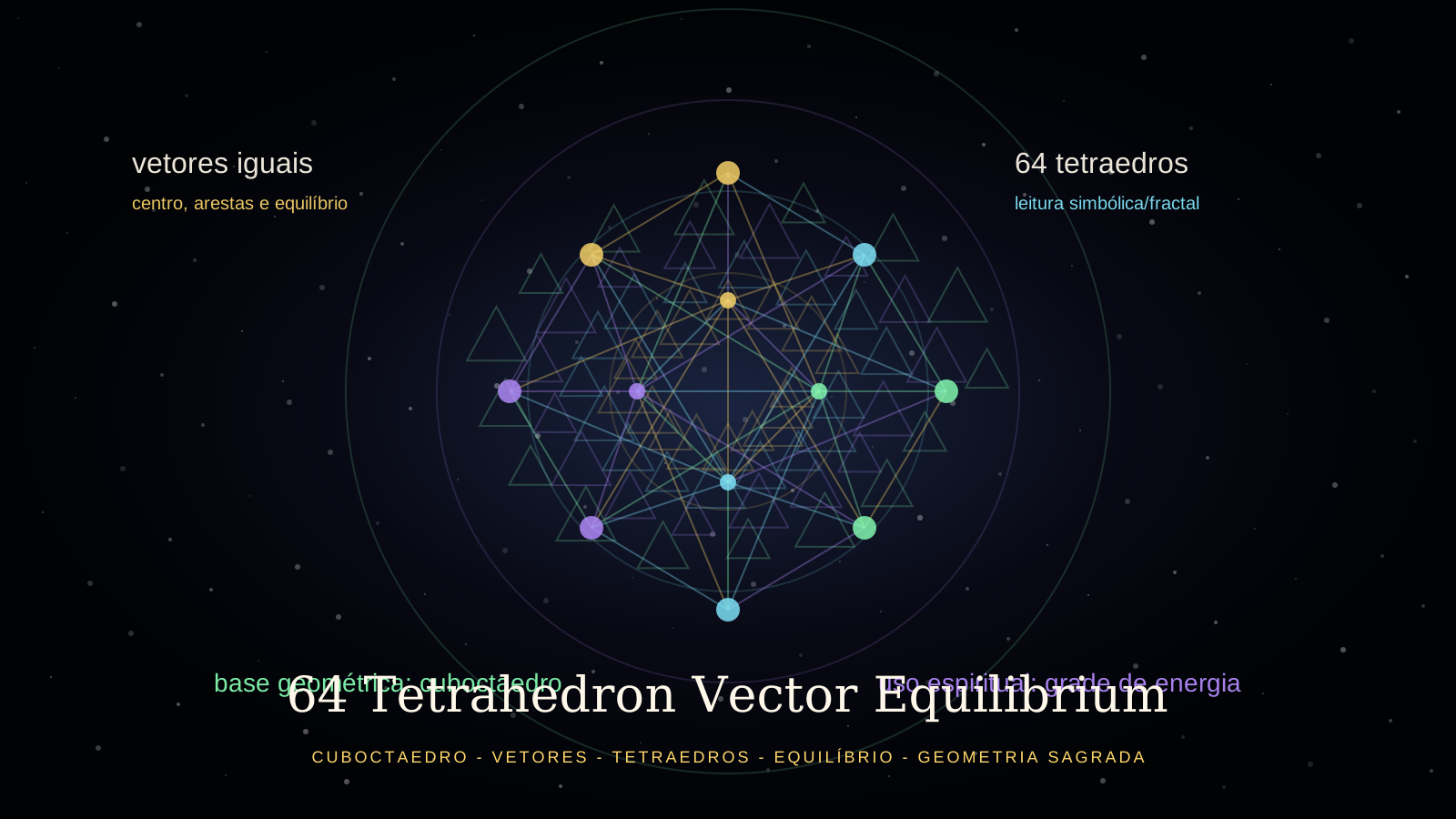
The figure beside this text is not a photograph of an object found in nature. It is an editorial visualization of the idea: a center, equal vectors, layers of tetrahedra and a structure suggesting balance.
This care matters. Geometry can be real, beautiful and mathematically interesting without every spiritual interpretation becoming scientific proof.
Where the 64 tetrahedra enter
The 64 tetrahedron grid appears in sacred geometry circles as an expansion of the cuboctahedron and tetrahedral structures. It is often presented as a matrix of balance, a seed geometry, or even an image of the fabric of space.
The number 64 also carries symbolic force in several readings: 64 I Ching hexagrams, 64 codons in the genetic code, 8 times 8, two octaves of growth. These associations make the grid attractive, but they do not all belong to the same field of knowledge. Some are mathematical, some symbolic, some speculative.
Nassim Haramein and the “fabric of space” reading
One of the names that most popularized the 64 tetrahedron grid is Nassim Haramein. In his talks and videos, he presents the structure as a possible seed geometry of spacetime, relating tetrahedra, fractals, vacuum, energy and unity.
This is the most speculative layer of the theme. It matters culturally because it explains why so many people connect the figure with zero-point energy, holographic universe language and vacuum geometry. But it should be read as an alternative and spiritualized proposal, not as a consensus view in physics.
Why the form feels powerful
The tetrahedron is a minimal and strong form. Four points already create volume. Unlike a square, which can deform if its joints are flexible, the triangle holds rigidity. That is why triangulated structures appear in engineering, architecture, geodesic domes and trusses.
When many tetrahedra are organized together, the mind sees order: center, repetition, symmetry, expansion and pattern. It is natural for sacred geometry to turn that visual feeling into spiritual language.
The spiritual meaning
In spiritual reading, the 64 tetrahedron grid represents balance between opposing forces: expansion and contraction, spirit and matter, center and perimeter, void and form. The cuboctahedron becomes a symbol of perfect pause before movement, as if all creation were born from a point of balance.
This interpretation speaks to meditation, zero-point energy and the Law of One: silence at the center, potential energy and unity behind forms. The reader does not have to accept it as physics to use it as a symbol for contemplation.
How to use the theme without exaggeration
A good reading separates three layers. The first is geometry: cuboctahedron, tetrahedron, symmetry and vectors. The second is Fuller: a systems philosophy based on forms and relationships. The third is spiritual: the grid as an image of balance, field and consciousness.
When these layers mix without explanation, the text becomes confusing. When they are separated, the theme becomes stronger: the reader understands what is mathematical form, what is Fuller's vision and what is modern mystical interpretation.
Connections to continue
After this theme, open Sacred Geometry, zero-point energy, energy, the Earth Grid, crystals, meditation, the Law of One and the Great Awakening. This path shows how a geometric figure can become a bridge between visual science, architecture, subtle energy and spirituality.
Simple summary
64 Tetrahedron Vector Equilibrium is a sacred geometry reading based on the cuboctahedron, vector balance and the 64 tetrahedron grid. The geometric base comes from the cuboctahedron and Buckminster Fuller's language. The spiritual layer interprets the form as a symbol of balance, energy and unity.
References and starting points
- Buckminster Fuller Institute - Everything I Know, Section 7
- R. Buckminster Fuller - Synergetics, online edition by R. W. Gray
- R. W. Gray - Synergetics PDF, section 200
- Wolfram MathWorld - Cuboctahedron
- Buckminster Fuller Institute - Geodesic Domes
- Geometry of Thinking - Vector Equilibrium and the VE
- Nassim Haramein - The 64 Tetrahedron Grid, Black Whole excerpt
- Cosmos and History - Fundamental Pattern and Consciousness
FAQ
Is vector equilibrium the same as the cuboctahedron?
In practice, Fuller's term points to the cuboctahedron understood as a structure of vectors in equilibrium.
Is the 64 tetrahedron grid proven science?
As visual geometry, it can be built and drawn. As the “structure of spacetime”, it is a speculative interpretation, not scientific consensus.
Why does this theme appear in sacred geometry?
Because it brings together symmetry, center, repetition, tetrahedra and a feeling of balance. These elements are easily used as symbols of order, energy and unity.
Keep exploring
You can open another path
 Consciousness and symbols Vector Equilibrium 5/5 intensity Explore →
  Consciousness and symbols Flower of Life 4/5 intensity Explore →
  Consciousness and symbols Sacred Geometry 4/5 intensity Explore → Consciousness and symbols Sacred Geometry 4/5 intensity Explore →
  Consciousness and symbols Torus 4/5 intensity Explore → Consciousness and symbols Flower of Life 3/5 intensity Explore →
Join the conversation
Comments are moderated. Keep the discussion respectful and distinguish evidence, interpretation and personal experience.