Connection level
9 direct connectionsAtlantis, Lemuria and Mu form the great triad of lost civilizations: Plato, Theosophy, James Churchward, sunken continents, ancestral memory and critical reading of myth.
The triad of lost lands
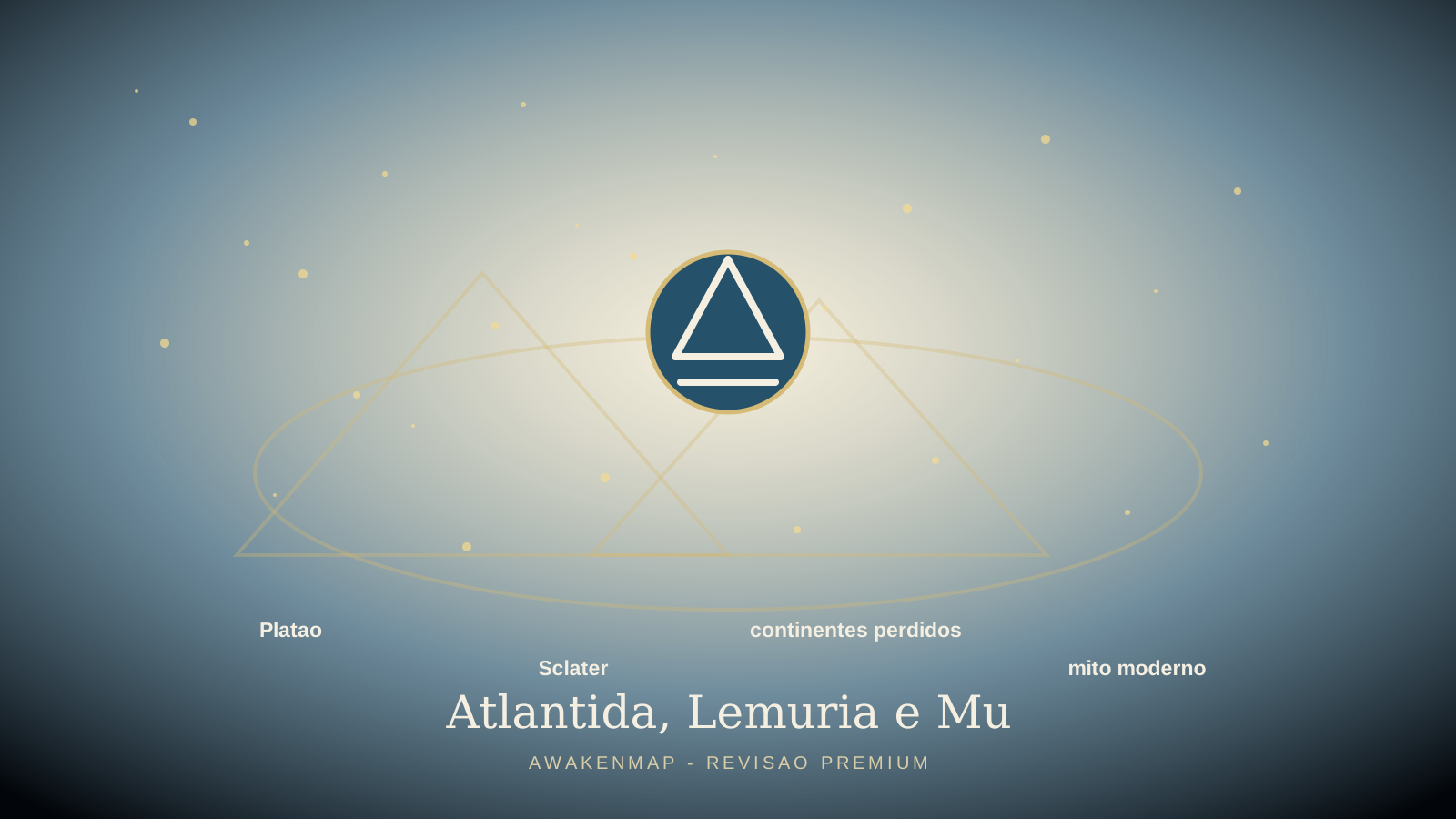
Atlantis, Lemuria and Mu are not the same story. They belong to different moments, different authors and different imagined geographies. But in alternative culture they became a powerful triad: Atlantis in the Atlantic, Lemuria linked to the Indian Ocean and later the Pacific in esoteric readings, Mu as a lost Pacific continent and supposed matrix of ancient civilizations.
The fascination comes from a deep human question: what if known history is only the surface? What if before official records there were cultures capable of science, spirituality, architecture and collapse? That question has moved books, films, channelings, alternative archaeology and spiritual maps for more than a century.
In AwakenMap, this theme needs to be strong because it is a root. It connects to pyramids, Egypt, Antarctica, Lemuria, ley lines, ancient civilizations, Akashic records, the Great Awakening and cataclysm narratives. But it also needs honesty: each layer must be separated into ancient text, historical hypothesis, modern occultism and unsupported speculation.
Atlantis in Plato: myth, politics and memory
Atlantis enters Western history through Plato, especially the dialogues Timaeus and Critias, written in the fourth century BCE. In the narrative, Egyptian priests tell Solon about a powerful island beyond the Pillars of Hercules that tried to conquer Mediterranean peoples and was defeated by an idealized ancient Athens. Then, through disaster, the island disappears into the sea.
Plato's version is not only adventure. It functions as a philosophical and political instrument. Atlantis is the rich, expansive, proud and corrupted city; Athens is presented as a model of virtue and order. For this reason many scholars read Atlantis as an allegory about hubris, decay and imperial danger.
That does not prevent the story from having been inspired by memories of real disasters such as eruptions, tsunamis, coastal collapses or echoes of Minoan civilization. But inspiration is not identity. Saying an event helped shape the myth is different from claiming we have found Plato's Atlantis.
The island that became a mirror
Atlantis became a mirror because every age projected its desires onto it. Renaissance thinkers imagined ancient wisdom; occultists saw a spiritual civilization; nationalists tried to appropriate the myth; ufologists spoke of advanced technology; New Age authors turned Atlantis into soul memory, crystals and vibrational fall.
The interesting part is that the island changes as the question changes. For some, it is moral warning. For others, lost archive. For others, collective trauma. For others, memory of an earlier human cycle. This plasticity explains the survival of the myth.
On the map, Atlantis should be read as one of the great narratives of fall. It asks what happens when technique grows without wisdom, when naval power becomes domination, when a civilization loses balance between knowledge and ethics.
Lemuria: from nineteenth-century science to occultism
Lemuria began as a scientific hypothesis now superseded. In the nineteenth century, before plate tectonics became established, naturalists tried to explain the distribution of lemurs and fossils between Madagascar, India and other regions. Philip Sclater proposed a lost landmass in the Indian Ocean as a biogeographic bridge. The name came from lemurs.
With advances in geology, especially continental drift and plate tectonics, that explanation became unnecessary. But Lemuria did not disappear. It was absorbed by occult currents, especially Helena Blavatsky's Theosophy, which transformed the geographic hypothesis into a spiritual narrative about root races, ancient ages and human evolution.
This shows an important transition: an idea can die as science and remain alive as myth. Lemuria is a perfect example of a concept that changed category. It should not be presented as a proven continent, but as a modern myth built over an old scientific question.
Spiritual Lemuria and Pacific memory
In contemporary spirituality, Lemuria gained another life. It came to represent a softer, intuitive civilization linked to the feminine, nature, crystals, oceans, love and telepathy. In many New Age circles, Lemuria appears as a counterpart to Atlantis: less technology of control, more energetic communion.
This reading is not conventional archaeology. It belongs to a field of spiritual experience, channeling, symbolic memory and mythic imagination. It may have value for people working with inner language, healing, belonging and spiritual ancestry, but it should not be sold as historical fact without material evidence.
The mature question is: why do so many people need Lemuria? Perhaps because the myth offers a nonviolent origin, a lost civilization where sensitivity and nature were not defeated by the machine. Even without literal proof, that cultural desire says a great deal about the modern crisis.
Mu and James Churchward
Mu was popularized mainly by James Churchward, author of The Lost Continent of Mu, published in 1926. He claimed Mu had been a great continent in the Pacific, cradle of humanity and origin of civilizations such as Egypt, India, the Maya and others. His ideas involved supposed ancient tablets, sacred symbols and an alternative global history.
Churchward's work is influential in esoteric imagination, but it lacks robust archaeological or geological support. Mu, as a recently sunken Pacific continent and matrix of all civilizations, belongs to pseudohistory. Still, its cultural impact is large: it organized a language of symbols, loss, cataclysm and primordial wisdom.
In AwakenMap, Mu should be treated through two lenses: as weak historical claim and strong cultural myth. The first requires critique. The second deserves study, because it shaped books, alternative maps, spiritual communities and readings of human origins.
Sunken continents and real geology
The existence of submerged lands is not fantasy in itself. Geology recognizes continental shelves, microcontinents, sunken islands, Zealandia, Mauritia and changes in sea level. The problem is jumping from this to recent, populated and technologically advanced continents disappearing exactly as esoteric narratives describe.
Sea level rose greatly after the last glaciation, covering coastal areas where humans lived. This means underwater archaeology can reveal important settlements. But flooded coastal cities do not automatically equal Atlantis, Lemuria or Mu.
This distinction is essential. The real world already has enough mystery: lost shorelines, ancient routes, flood memory, deluge myths, volcanic islands that appear and disappear. Good reading does not need to turn every submarine discovery into confirmation of a total myth.
Cataclysm, trauma and collective memory
The force of these myths may come from disaster memory. Peoples in many places preserve stories of floods, swallowed lands, punished cities, previous worlds and destroyed ages. Some may preserve echoes of real events; others function as moral teachings about excess, pride and imbalance.
Atlantis, Lemuria and Mu speak less of a single place and more of a pattern: a civilization rises, accumulates knowledge, crosses limits, collapses and leaves fragments for future seekers. This pattern appears because humanity knows ruin. We have seen cities burn, empires fall, rivers change and seas take land.
Symbolically, these myths ask whether a civilization can be wise enough to survive its own power. That question remains current in an age of artificial intelligence, nuclear energy, climate crisis and technological surveillance.
The dispute between search and fantasy
Searching for lost civilizations can be a serious impulse. Archaeology continually finds sites, trade networks, forgotten cultures and complexities older models underestimated. Gobekli Tepe, for example, showed that Neolithic societies were more capable than many assumed.
But fantasy enters when every gap becomes proof of the desired narrative. A large stone becomes antigravity; a symbolic similarity becomes global contact; a submerged ruin becomes a lost continent; an absence of record becomes cover-up. This method looks investigative, but it already knows the answer before looking.
AwakenMap's balance is to allow enchantment without losing discernment. The reader can feel the call of Atlantis, Lemuria and Mu, but should also learn to ask: where did this idea come from, who wrote it, in what context, with what evidence and with what interests?
A comparison that avoids the great amalgam
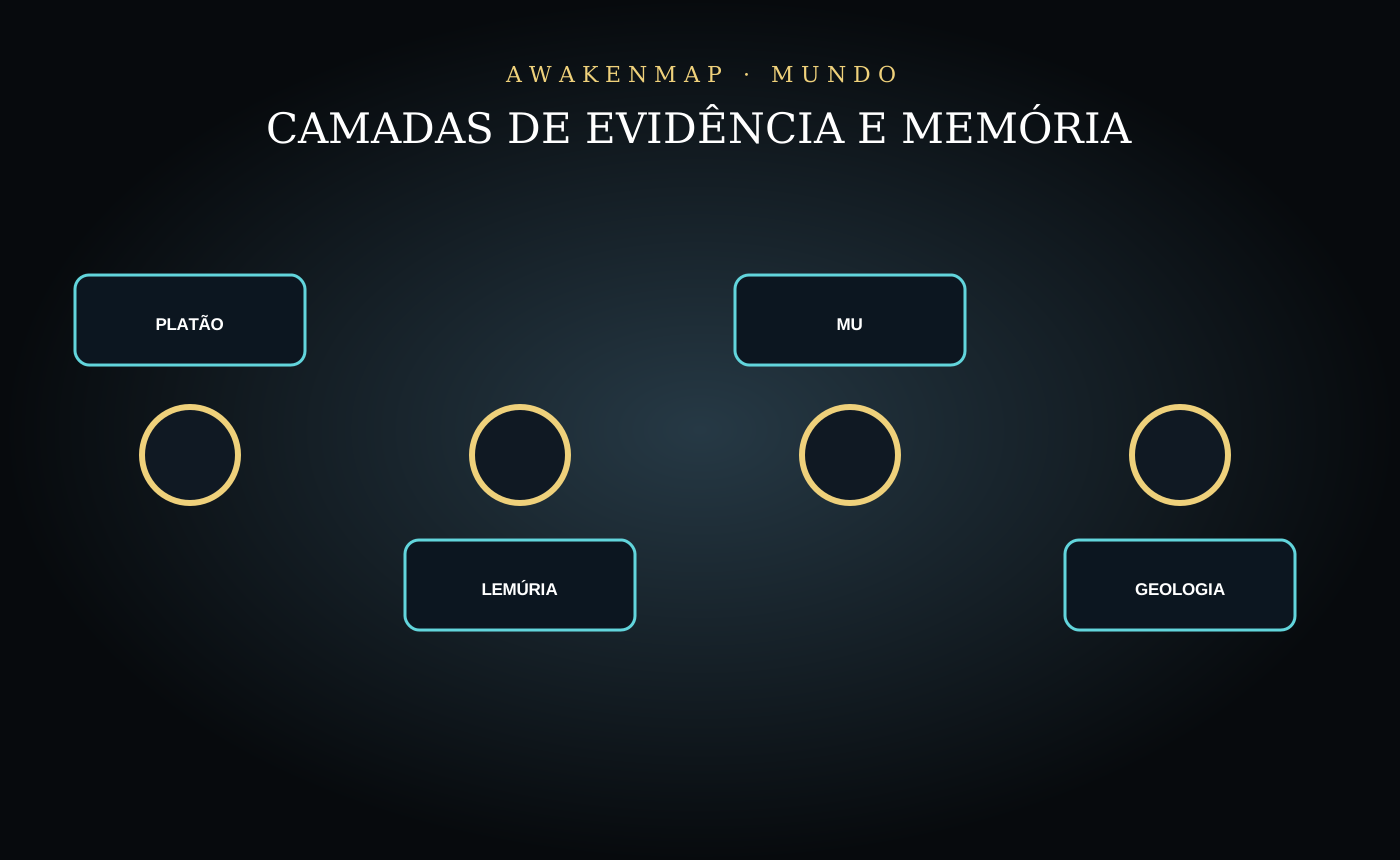
Atlantis arrives through dialogues attributed to Plato; Lemuria began as a biogeographic hypothesis explaining lemur distribution; Mu was popularized by Augustus Le Plongeon and especially James Churchward. Placing them within one ancient chronology is a later construction.
This distinction does not destroy the imagination. It reveals how different periods created lost continents to answer their own problems: political morality, scientific gaps, spiritual searching, cultural diffusion and desire for a common origin.
Theosophy and the fusion of lost lands
Theosophical authors transformed Lemuria into a stage of humanity's spiritual evolution and connected continents, root races, catastrophes and cosmic cycles. Names drawn from science and philosophy acquired one esoteric architecture.
The result influenced New Age movements, channeling and contemporary narratives about crystals, cellular memory and advanced civilizations. This tradition deserves study as modern religious history without being presented as archaeological or geological consensus.
What plate tectonics permits—and does not
Oceanic crust is created and recycled, continents move, and sections of continental margins can subside. Real microcontinents and submerged masses such as Zealandia exist. This makes geology dynamic, but it does not confirm every lost-continent map.
A recent continental civilization would leave signatures in bathymetry, rock ages, sediments, fossils and archaeology. Analogies with real discoveries must respect scale and chronology. “Land can sink” does not mean every tradition describes the same event.
Cultural memory and respect for the Pacific
Modern Lemuria and Mu narratives often use Pacific islands, monuments and traditions as fragments of an external continent. This gesture can erase the seafaring ability, history and knowledge of Oceanic peoples themselves.
Responsible reading compares myths without appropriating living cultures as decorative evidence. Polynesian peoples need not be survivors of Mu to have achieved extraordinary navigation, settlement and oral transmission.
Atlantis, Lemuria and Mu in AwakenMap
In AwakenMap, this theme connects to Antarctica, Ancient Egypt, Giza Complex, Sphinx, Pyramids, Ley Lines, Megalithic Sites, Ancient Civilizations, Great Awakening, Akashic Records, Lemuria, Mu, Atlantis and cataclysm narratives. It is a backbone of alternative imagination.
As World, it speaks of oceans, continents, islands, underwater archaeology, geology and ruins. As Knowledge, it speaks of Plato, Theosophy, Churchward, comparative mythology and history of ideas. As Cosmic, it speaks of cycles, fall, soul memory, frequency, lineages and return to lost wisdom.
A premium page must do something rare: neither ridicule the myth nor sell fantasy as certainty. The reader should leave with more curiosity and more discernment.
How to read this theme
Start by separating the origins: Atlantis comes from Plato; Lemuria begins as a nineteenth-century biogeographic hypothesis and later becomes occult myth; Mu is popularized by James Churchward in the twentieth century. Mixing everything as if it were a single ancient tradition weakens the subject.
Then separate the levels: philosophical text, superseded scientific hypothesis, occultism, pseudohistory, contemporary spirituality, real geology and underwater archaeology. Each level has different rules of evidence.
Atlantis, Lemuria and Mu remain important not because they are already proven, but because they reveal a wound and a hope: the suspicion that we lost something essential and the desire to rediscover a civilization where knowledge, power and soul were aligned again.
Critical reading
Atlantis, Lemuria and Mu should be read as history of ideas, spiritual myth and alternative hypothesis, not as a single package of proven facts. The theme grows when Plato, Theosophy, Churchward, geology and underwater archaeology remain in separate layers.
References and starting points
- Britannica - Timaeus and Plato's Atlantis
- Naval History and Heritage Command - Atlantis: The Legendary Island
- National Geographic - Real-life events and the myth of Atlantis
- Britannica - Lemuria
- History - Atlantis
- Sacred Texts - The Sacred Symbols of Mu
FAQ
Has Atlantis been proven?
No. The central source is Plato, and interpretations vary between allegory, disaster memory and historical speculation. No site has been confirmed as Plato's Atlantis.
Were Lemuria and Mu real continents?
Lemuria began as a superseded scientific hypothesis and became occult myth. Mu was popularized by Churchward and has no robust scientific support as a recent lost continent.
Keep exploring
You can open another path
 Ancient civilizations Lemuria 5/5 intensity Explore →
  Ancient civilizations Ancient Civilizations, Mysteries and Forbidden Archaeology 5/5 intensity Explore →
  Ancient civilizations Ancient Builder Race 4/5 intensity Explore →
  Earth and Antarctica Antarctica 4/5 intensity Explore →
  Ancient civilizations Atlantis 4/5 intensity Explore → Ancient civilizations Lemuria 4/5 intensity Explore →
Join the conversation
Comments are moderated. Keep the discussion respectful and distinguish evidence, interpretation and personal experience.