
Connection level
18 direct connectionsWilliam Tompkins belongs on AwakenMap through the question of when technical testimony begins to function as revelation. He matters because he occupies a delicate place: not merely “another storyteller” in UFO culture, but also not a source that can be accepted without verification. His force comes from the mixture of a real technical biography, proximity to military and aerospace environments, documented skill as a model maker and very large claims about extraterrestrials, naval intelligence, defense companies and a space program kept outside public knowledge.
William Mills Tompkins lived from 1923 to 2017. Before becoming known in ufology circles, he was already remembered for something concrete: scale naval models. The Miniature Engineering Craftsmanship Museum records that, as a teenager, Tompkins built a 1/600-scale fleet of ships with details precise enough to attract the attention of the United States Navy before America's full entry into World War II. This beginning is essential for understanding why his story later gained weight. The Tompkins myth begins with a verifiable technical ability: to observe, memorize, draw and reconstruct complex machines.
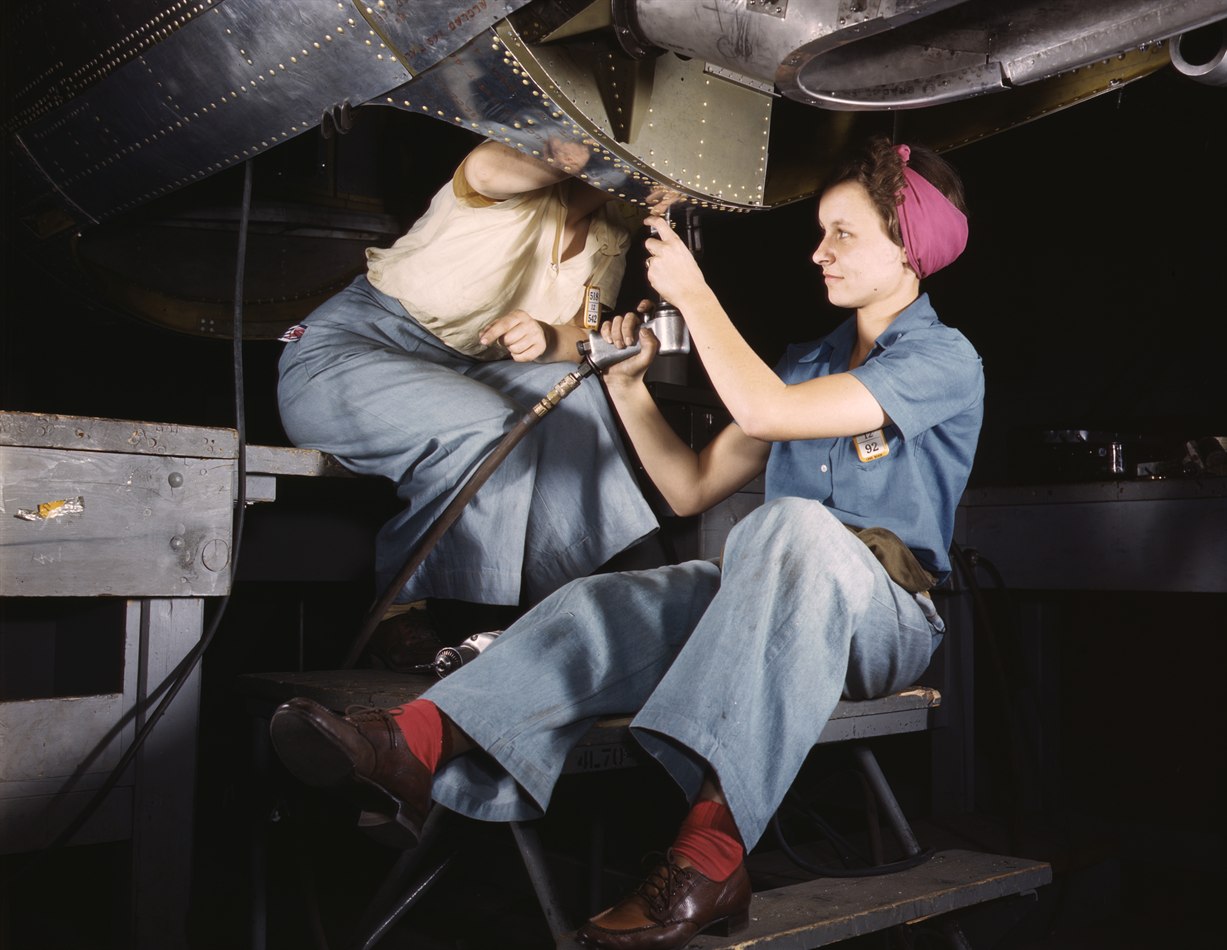
The image beside this text shows workers at Douglas Aircraft Company in Long Beach, California, in October 1942. It does not show Tompkins, but it shows the industrial world that makes his narrative plausible as an environment: factories, aircraft, wartime secrecy, accelerated production and technical workers handling strategic machines.
That is the difference between context and proof. The photo helps visualize the real aerospace setting; it does not prove Tompkins' extraordinary claims.
According to the museum, the Navy's attention began when Tompkins' models were displayed in a store window. Officers reportedly noticed the precision of details considered sensitive, such as antennas, armament and ship forms. The explanation attributed to Tompkins himself was less cinematic: he visited ships in Long Beach, observed without a camera, measured mentally, drew from memory and turned that into miniatures. Even so, the episode creates the narrative pattern of his later public life: a young person capable of seeing details others missed being pulled into intelligence circles.
In 1942, Tompkins was reportedly brought into the Navy and connected to intelligence and technical research functions. After the war, his path moved through engineering firms and environments such as Northrop, Douglas Aircraft, TRW and General Dynamics, with different levels of work on advanced projects. Even when these passages are told by sources sympathetic to him, the safest point is this: Tompkins built a public identity as someone who moved between model making, technical drawing, the aerospace industry and military culture.
The conspiratorial layer appears when Tompkins turns that resume into testimony about the Secret Space Program. In his books and interviews, he claimed that the United States Navy received information from spies embedded in German programs during World War II, that those reports involved non-human technology, and that part of American industry used that knowledge to develop craft, space structures and concepts far beyond what appears in official history.
The most cited book is Selected by Extraterrestrials. In it, Tompkins narrates his life as if it crossed a hidden war among human groups, extraterrestrial factions and secret technological programs. The work should not be read as a proven historical document. It should be read as a central piece in a tradition: the technical insider who says he saw fragments of a larger truth while working near the military-industrial apparatus.
The link with aerospace corporations is direct. Douglas, Northrop, TRW and other companies appear in the postwar imagination as bridges among military contracts, rockets, satellites, defense and space exploration. This is not fantasy: the American aerospace industry really did grow around secrecy, public contracts, military research and the space race. Tompkins' claim goes further: for him, certain design groups worked with knowledge of extraterrestrial origin or with assistance from non-human beings.
This is where Project Paperclip and Project Paperclip and NASA in 1958 enter. The historical fact is that German scientists and engineers were brought to the United States after the war and played roles in military and space programs. The conspiratorial reading adds a layer: if there was real transfer of German knowledge, perhaps there was also transfer of antigravity technology, disc projects, exotic energy or engineering derived from non-human contact. Tompkins fits that leap because he presents the postwar period as a moment when official history hid the origin of certain aerospace ideas.
The Nazi Bell and Nazi breakaway groups appear as echoes of that same imaginary. In stronger versions, breakaway German groups survived, migrated, protected advanced technologies and competed with American programs. Tompkins reinforces this universe by speaking of disputes among factions and technical knowledge circulating through secret military channels. The problem is that the historical existence of advanced German projects does not automatically authorize the conclusion that operational interstellar craft existed.
The Nordics occupy a particular role in Tompkins' narratives. He spoke of female figures with a Nordic appearance, sometimes described as secretaries or assistants, who allegedly guided projects inside aerospace environments. This is one of the strangest and most symbolic parts of the account: extraordinary knowledge does not appear as a technical manual, but as a discreet presence inside the office. For skeptical readers, it sounds like sexualized myth and backstage fantasy. For sympathizers, it is a sign of subtle intervention by non-human allies.
The relationship with Solar Warden, TR3B and other hidden-technology themes comes from the same mechanism. Tompkins is not the only source for these ideas, but he helps give them a sense of historical continuity: from World War II to the postwar period, from naval drawing to rockets, from factories to space, from public engineering to a secret program. He functions as a narrative bridge between the industrial past and modern claims of hidden space fleets.
The link with UFO / UAP is unavoidable. Tompkins claimed that unidentified aerial phenomena, non-human civilizations and secret technology should be read together. Today, after public hearings, official reports and institutional discussion of UAP, part of the public has asked whether older testimonies should be reexamined. But reexamining does not mean accepting everything. It means separating claim, context, document, memory and physical evidence.
Area 51 helps explain why stories like Tompkins' survive. Even when a facility or program has no proven connection with extraterrestrials, the simple fact that secret bases, classified aircraft and defense projects exist creates cultural space for imagining larger things. Real secrecy becomes fuel for hypothetical secrecy.
The most interesting point is not proving or mocking Tompkins as a whole. The point is asking why his story convinces so many people. It has the elements awakening audiences tend to recognize: early talent, interested military officers, missing documents, giant companies, hidden war, allied beings, hidden enemies, suppressed technologies and an ordinary life crossed by a cosmic mission. It is autobiography converted into a conspiracy map.
The concrete case that anchors the article is his model collection. Seventy-six pieces were placed on permanent display at the museum in 2014, and the museum page documents their precision and craft value. This does not confirm extraterrestrial contact, but it confirms the human base of the character: Tompkins was obsessed with technical detail, scale, visual memory and machines. That base is exactly what makes his claims more seductive than those of someone with no technical connection.
A mature reading separates three layers. First, William Tompkins as a model maker and technical worker connected to the American aerospace environment. Second, Tompkins as an author and witness inside UFO culture. Third, Tompkins as a symbolic piece of disclosure and full disclosure, where personal testimonies are treated as fragments of a truth still hidden.
The risk is turning resume into proof. Working near advanced projects does not prove every memory, interpretation or claim. At the same time, automatically dismissing every technical testimony also impoverishes cultural investigation. Tompkins matters because he shows how technical authority can become myth: not by magic, but because it is born where society already knows real secrecy exists.
The bridge with remote viewing and time travel and temporal defense appears in the same frontier territory: programs that mix intelligence, perception, technology and the struggle over the future. In all these cases, AwakenMap faces the same challenge: recognize the narrative power of testimony without abandoning the basic question of evidence.
Simple summary
William Tompkins was a naval model maker and UFO-culture figure associated with the Secret Space Program. His story begins with highly detailed ship models, attention from the United States Navy and work in military and aerospace engineering environments. The conspiratorial layer appears when he claims that secret American programs received information about non-human technology, German breakaway groups, Nordic beings and hidden craft. The theme matters because it shows how a real technical resume can become testimony of revelation.
References and starting points
- Miniature Engineering Craftsmanship Museum - William Tompkins biography and naval models
- Clairemont Mortuary - William M. Tompkins obituary
- Google Books - Selected by Extraterrestrials, Volume 2
- Los Angeles Space Force Base - history of the Douglas El Segundo plant
- Wikimedia Commons - women working at Douglas Aircraft, 1942
- AARO - historical report on secret program allegations
Why it belongs on AwakenMap
It belongs because Tompkins represents a central question of the map: when someone with a technical background makes extraordinary claims, does that increase the obligation to investigate or merely make the myth more convincing? The node helps separate historical context, personal memory, UFO culture and the collective desire for someone inside the system to finally tell the truth.
Keep exploring
You can open another path
 Secret Space Program Aerospace Corporations 5/5 intensity Explore →
  Map center Great Awakening 5/5 intensity Explore →
  Secret Space Program Secret Space Program 5/5 intensity Explore →
  Esoteric practices Breakaway Group 4/5 intensity Explore →
  Map center Disclosure 4/5 intensity Explore →
  Map center Full Disclosure 4/5 intensity Explore →
Join the conversation
Comments are moderated. Keep the discussion respectful and distinguish evidence, interpretation and personal experience.