Connection level
14 direct connectionsPizzagate belongs on AwakenMap through the question of when moral suspicion becomes political identity. The case is central because it shows a conspiracy theory being born in real time: leaked emails, obsessive readings of ordinary words, online forums, accusations without proof, demonized political figures, a restaurant turned into the scene of an imaginary crime and, finally, physical violence. Here, the question is not whether there was a hidden network at the site. Public investigations did not support that accusation. The question is how so many people came to feel the accusation was true without verifiable evidence.
The immediate origin lies in the 2016 American presidential election. Emails from John Podesta, then chair of Hillary Clinton's campaign, were obtained through a digital intrusion and published by WikiLeaks. The material contained ordinary campaign messages, schedules, donations, dinners and political conversations. On forums and social networks, users began interpreting words such as pizza, pasta, sauce and references to social meetings as secret codes for crimes against children. This reading did not arise from direct proof; it arose from accumulated suspicion, an inflamed electoral context and a desire to find an absolute moral plot.
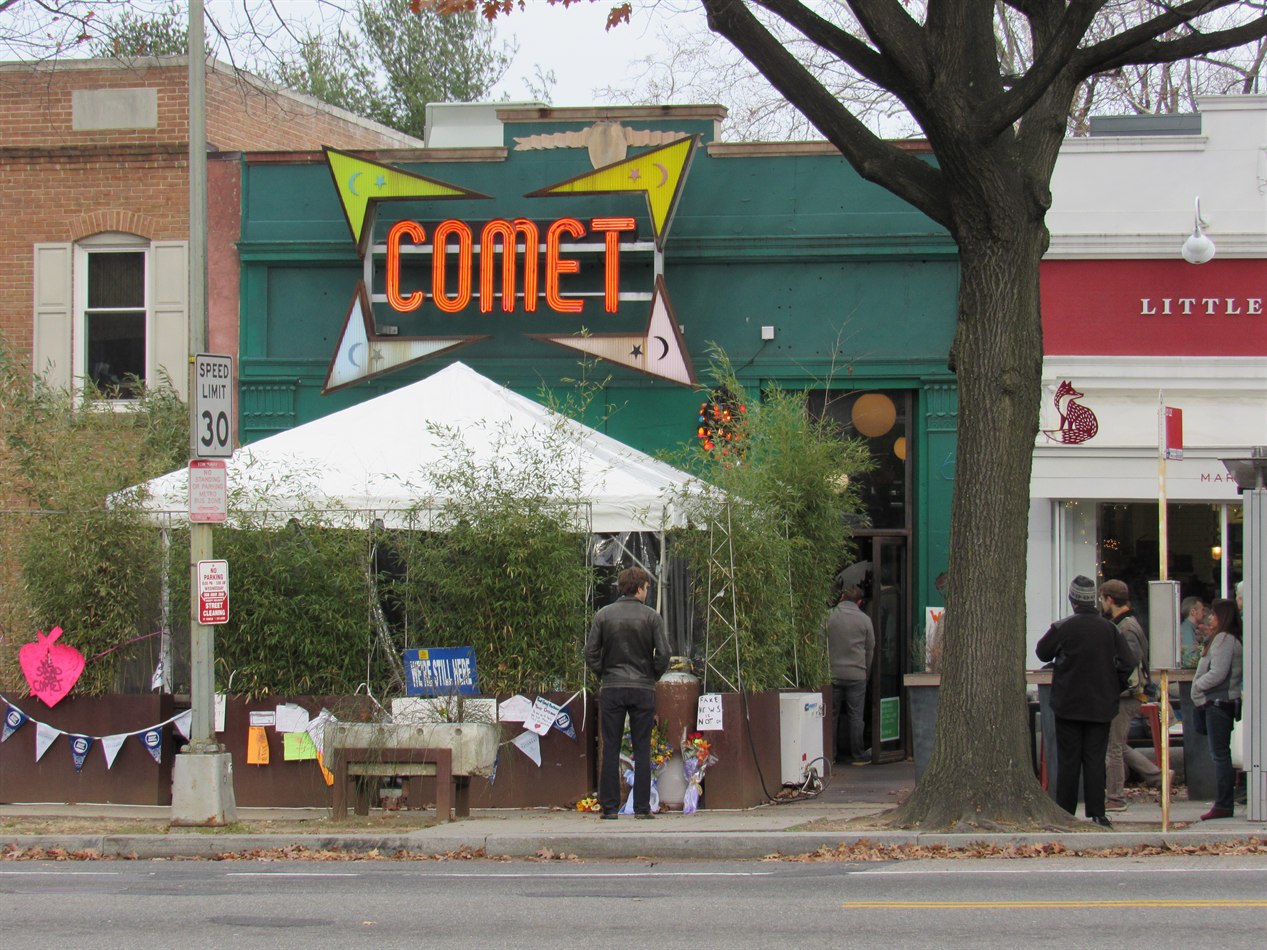
The image beside this text shows Comet Ping Pong, a Washington, D.C. restaurant, photographed in December 2016. It became Pizzagate's symbolic center because conspiracy theorists claimed, without evidence, that the site was linked to a criminal network. That accusation affected real employees, owners, customers and families.
Using the image here does not reinforce the accusation. It reminds us that online theories can choose a physical target and place concrete people at risk.
The mechanism was simple and dangerous. First, an ordinary word was removed from context. Then someone claimed it meant something else. Next, another image, comment or social-media profile was fitted in as confirmation. The absence of proof became part of the narrative itself: if no evidence could be found, the system must be hiding it well. Thus Pizzagate protected itself from refutation. Everything could become a clue; nothing had to be proof.
The concrete case that made Pizzagate unavoidable happened on December 4, 2016. Edgar Maddison Welch left North Carolina and went armed to Comet Ping Pong to “investigate” the theory himself. According to the United States Department of Justice, he entered the restaurant with a rifle and revolver, customers and employees fled, and he fired inside the site. No one was injured. In 2017, Welch was sentenced to four years in prison. This episode shows the critical point: a digital belief can cross the screen and reorganize a person's behavior in the physical world.
Later, Welch's own fate added a tragic layer. In January 2025, North Carolina authorities reported that he was killed during a police encounter after a traffic stop. That outcome proves nothing about the original theory. It only reinforces how disinformation stories can leave long traces in the lives of involved people, even years after the first event.
The link with Q / QAnon is direct. Pizzagate worked as an emotional predecessor to QAnon: the idea that a political, media and cultural elite was involved in monstrous crimes against children, and that a secret war was underway to expose that network. QAnon expanded the plot, adding cryptic messages, a messianic figure, a battle between patriots and hidden enemies, and the promise of future revelation.
The Storm is born in the same climate. The promise that “truth will fall” gives meaning to any waiting period. If nothing happens, the plan remains secret. If something happens, it is interpreted as confirmation. Pizzagate taught a grammar that later returned in many narratives: looking for codes, interpreting images, distrusting the press, expecting mass arrests and treating silence as evidence of cover-up.
The connection with Trump appears because part of the public came to see Trump not only as a politician, but as a figure of moral restoration. In that reading, he was the person able to confront the hidden network. This does not mean every Trump voter believed in Pizzagate, nor that real politics reduces to the theory. It means the case helped create an emotional field where politics, salvation, revenge and moral purity mixed.
Deep State and Cabal, Deep State and Illuminati enter as framing. Pizzagate offered a concrete image for a larger suspicion: that institutions, media, celebrities, parties and billionaires formed a secret structure above the law. The restaurant became a local theater for an imagined cosmic war. The specific accusation did not need to hold, because many believed it merely pointed to something larger.
This is where the Illuminati reappears. The theory mixed electoral politics, occult symbolism, satanic panic, celebrity culture and fear of child abuse. Ordinary images were read as initiatory signs. Logos became codes. Party photos became rituals. This pattern is old: when a society enters moral panic, common symbols start to look like encrypted confessions.
mainstream media plays an ambiguous role in the plot. For believers, the press was complicit for denying the story. For journalists and fact-checkers, coverage was necessary to prevent real damage. This tension fed the cycle. Every report dismantling the theory could be reinterpreted as “narrative control.” Distrust of media became fuel for the belief itself.
propaganda is a better key than “collective madness.” Pizzagate did not spread only because people were naive. It spread because it used effective narrative techniques: protection of children, an absolute enemy, hidden symbols, urgency, invitation to personal investigation and a feeling of belonging to a community that “sees what others do not.” This structure rewards participation. The user does not only believe; the user hunts clues.
Researchers of conspiracy narratives have shown that Pizzagate connected domains that normally would not need to be linked: politics, food, art, family, religion, sexuality, celebrities, emails and crime. This is an important feature. A theory of this kind grows because it allows anything to be linked to anything. The map seems more complete, but the method becomes weaker.
The relationship with the White Hats and patriots comes from the need for heroes. If there is a demonic network, someone must fight it. Pizzagate and QAnon provide that narrative role: good agents, secret military figures, insiders, citizen investigators. The danger is that ordinary people can feel authorized to act against real targets in the name of imagined victims.
spiritual superiority appears when belief becomes moral identity. Believers can feel more awake, braver, more protective of children and less deceived than the general population. That makes leaving difficult. Abandoning the theory is no longer just changing an opinion; it feels like betraying a mission. Spiritual and political ego attach to the narrative.
The connection with mental and spiritual states helps explain why the theme is so emotionally powerful. Pizzagate touches disgust, protection, fear, anger and helplessness. Crimes against children are one of the most extreme images of evil. When a theory captures that theme, it begins to operate below rational debate. The person feels that doubting the theory would mean abandoning victims. That emotional blackmail is part of the plot's power.
Kabbalah and other esoteric systems sometimes appear in versions that try to turn Jewish, occult or religious symbols into proof of a ritual elite. This is dangerous terrain. Investigating moral panic is not repeating accusations against entire peoples, religions or traditions. AwakenMap needs to map the theory without recycling its poison.
A mature reading separates three levels. First, the historical fact: leaked emails, online interpretation, harassment, threat and armed attack with no injuries. Second, the narrative mechanism: imaginary codes, moral panic, collective clue hunting and total distrust. Third, the mythic layer: satanic elite, secret war, hidden saviors and future revelation. Confusing these levels makes the theory look stronger than it is.
Pizzagate matters because it teaches that not all “independent research” is investigation. Sometimes it is only a confirmation machine. The difference is method: evidence must be able to fail, accusation requires responsibility, and real people cannot be turned into characters in a collective script without cost. The case remains on AwakenMap because it shows, with rare clarity, how the search for awakening can become persecutory delusion when it loses contact with proof, proportion and human care.
Simple summary
Pizzagate was a conspiracy theory that emerged in 2016 from false interpretations of John Podesta's emails published by WikiLeaks. The theory accused political figures and the Comet Ping Pong restaurant, without evidence, of involvement in crimes against children. The case generated harassment, threats and an armed attack in December 2016. On AwakenMap, Pizzagate connects QAnon, The Storm, Deep State, Cabal, Illuminati, propaganda, mainstream media, Trump, White Hats and moral panic.
References and starting points
- U.S. Department of Justice - Edgar Maddison Welch sentencing
- WikiLeaks - John Podesta email archive
- PLOS ONE - narrative structure of conspiracy theories, including Pizzagate
- AP - Edgar Maddison Welch killed in 2025 after police traffic stop
- Time - overview of the case and its consequences
- Wikimedia Commons - Comet Ping Pong image in 2016
Why it belongs on AwakenMap
It belongs because Pizzagate is a case study in how desire for truth can become total accusation. It shows the border between investigating real power and projecting absolute evil onto fragile targets, without sufficient evidence, until an online narrative produces damage in the physical world.
Keep exploring
You can open another path
 Control systems Cabal / Deep State / Illuminati 5/5 intensity Explore →
  Map center Great Awakening 5/5 intensity Explore →
  Control systems Q / QAnon 5/5 intensity Explore →
  Esoteric practices QAnon 5/5 intensity Explore →
  Control systems Deep State 4/5 intensity Explore →
  Control systems Illuminati 4/5 intensity Explore →
Join the conversation
Comments are moderated. Keep the discussion respectful and distinguish evidence, interpretation and personal experience.