Connection level
2 direct connectionsThe Sun seems lonely when we look at the daytime sky. But on a galactic scale, it travels inside a neighborhood: nearby stars, gas clouds, bubbles opened by ancient supernovae and regions where new systems continue to form. Local Star Cluster is the name AwakenMap uses for this “cosmic neighborhood” around the Sun.
What Local Star Cluster is
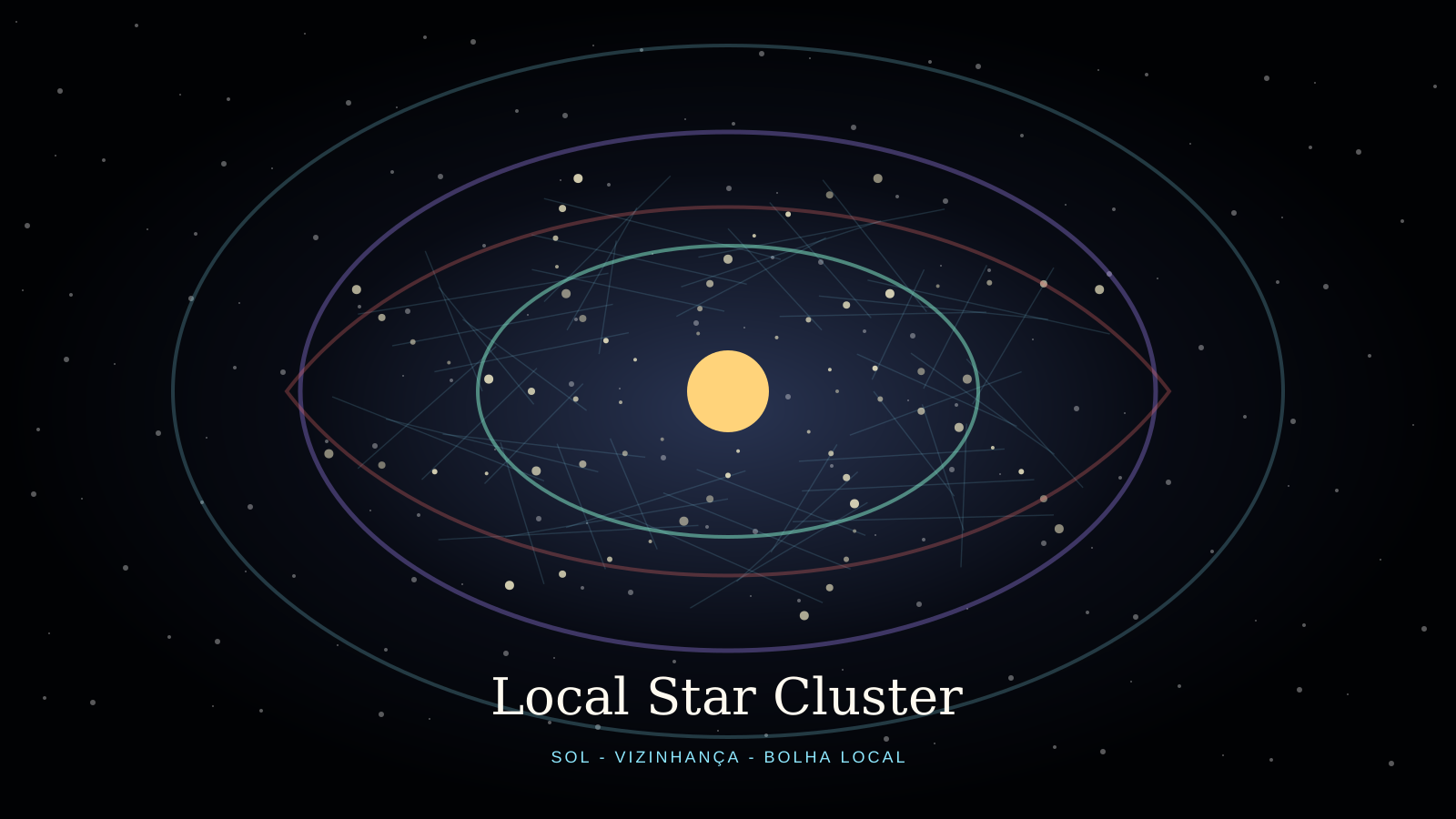
Local Star Cluster is the idea of a region of stars near our system. In astronomy, the more technical term changes with context: solar neighborhood, Local Bubble, Orion Arm, nearby stellar associations or local interstellar medium. On the map, the name works as an entry point for seeing the Sun as part of a network.
It connects to the 52 Local Star Cluster Protective Barrier Grid, The Outer Energetic Barrier, Oumuamua, the Secret Space Program and the portal system. These links show two layers: the real science of our galactic region and modern accounts about routes, barriers and groups moving between nearby systems.
The real fact: there is a Local Bubble around the Sun
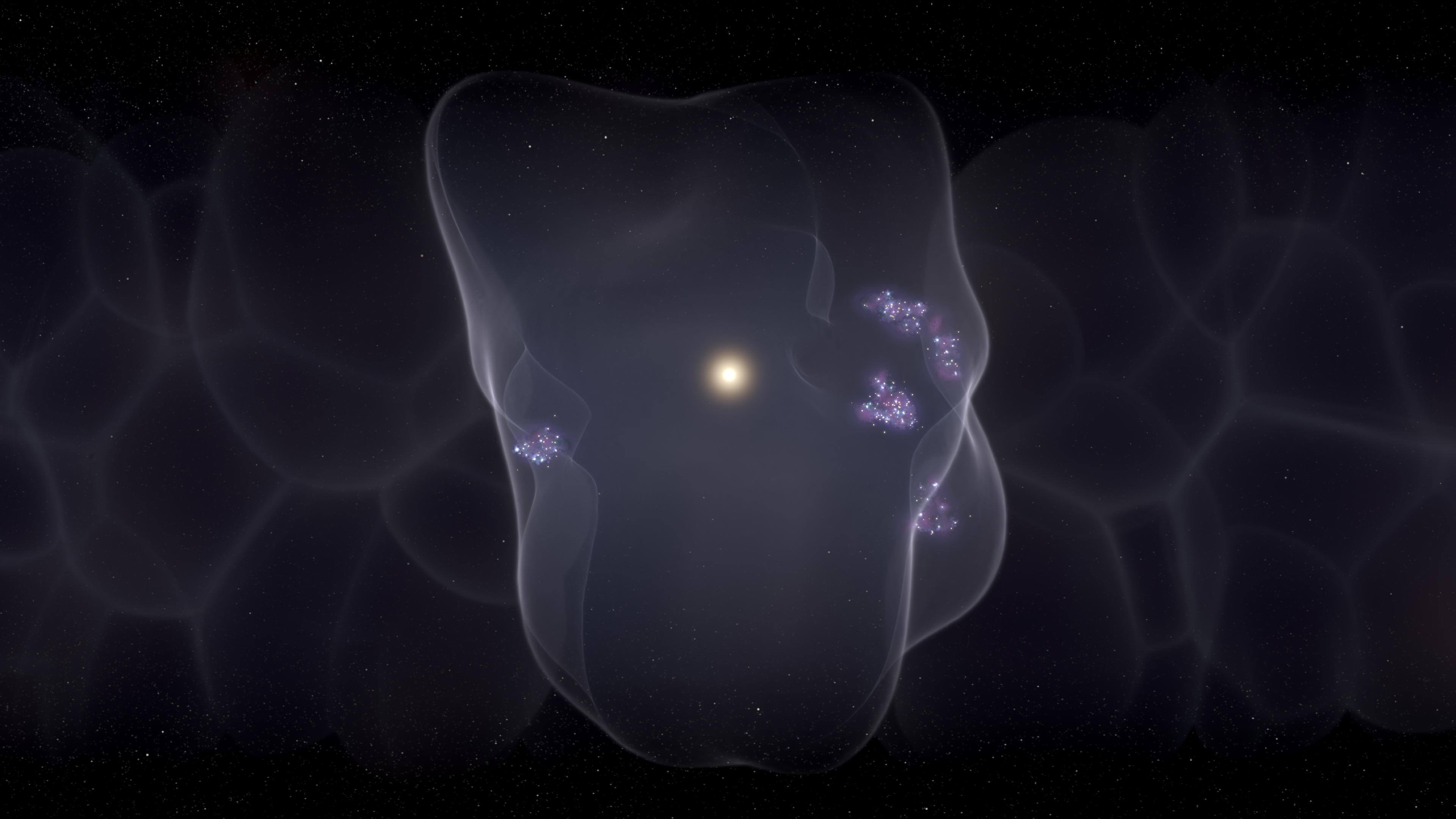
ESA describes the Local Bubble as a relatively empty region, with less dust and gas than surrounding areas, moving with the Sun as it orbits the center of the Milky Way. Data from the Gaia mission helped scientists map this structure and connect it to supernova explosions that occurred around 14 million years ago.
The Center for Astrophysics | Harvard & Smithsonian also notes that the bubble is about a thousand light-years wide and that many nearby young stars formed on its surface. This gives the theme a strong real context: our neighborhood is not random emptiness; it has shape, history and boundaries.
The real image that locates the reader
This official ESA illustration shows the Local Bubble surrounding the Sun. It is not a direct photograph, but a scientific representation based on Gaia mission data. The image helps show that the Sun sits inside a larger structure, as if our region of the galaxy had its own “cavity.”
This is the visual base that makes the theme interesting: before speaking of route and barrier accounts, there is already a real cosmic neighborhood to observe.
Why the word “cluster” feels powerful
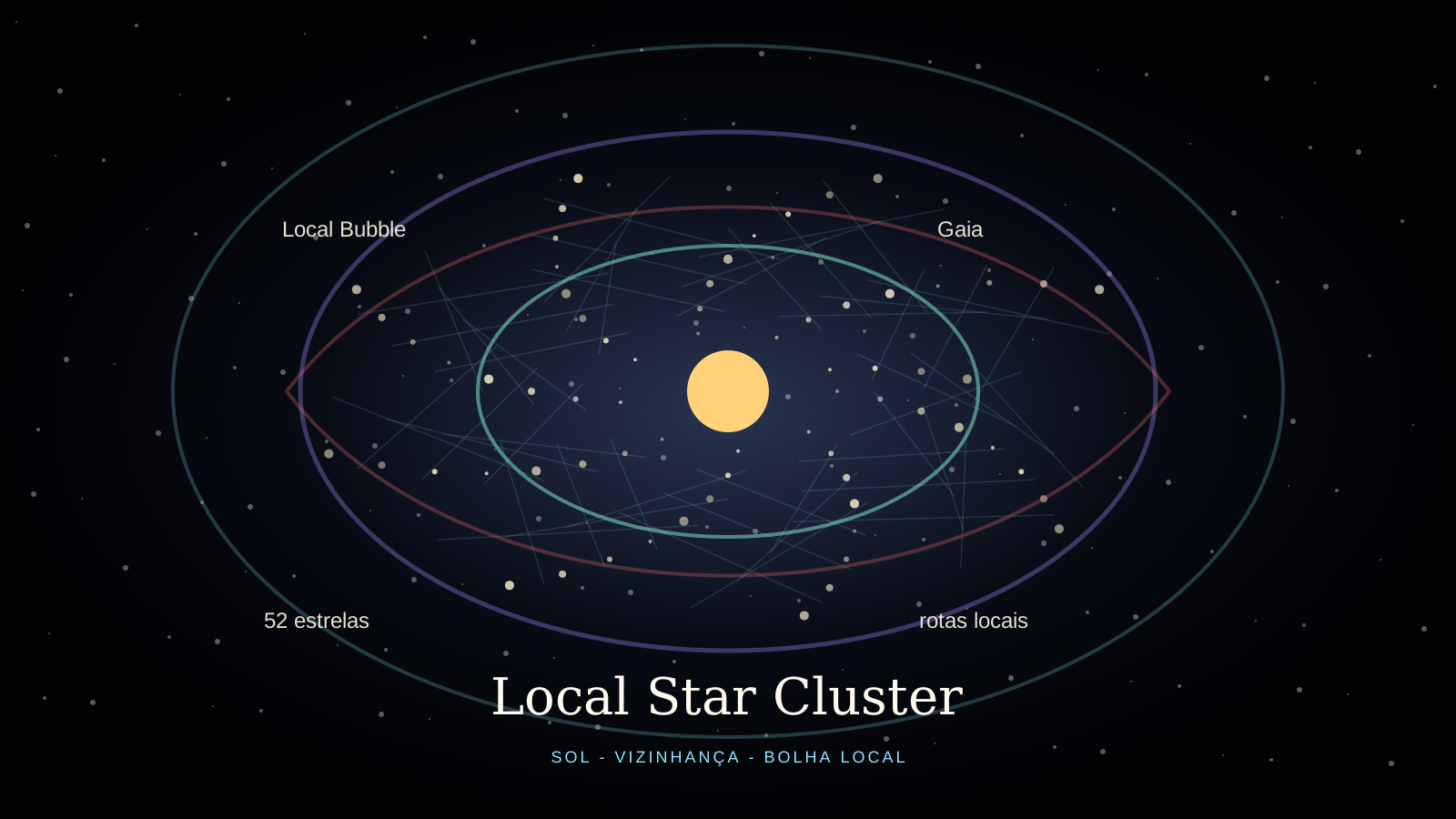
In astronomy, a cluster can mean a formal grouping of stars, such as the Pleiades. Here the use is more narrative: it speaks of neighborhood, not a strict official star cluster. The important part is proximity: the Sun is not lost in darkness; it is inside a stellar neighborhood.
That image changes everything. If there is a neighborhood, there can be paths. If there are paths, there can be frontiers. If there are frontiers, themes such as the 52 Local Star Cluster Protective Barrier Grid and The Outer Energetic Barrier appear.
Corey Goode and the 52 or 53 star count
In a Mt Shasta presentation transcript, Corey Goode speaks of a local region of “52 or 53 stars, depending on who you ask.” The phrase appears within accounts about operations of groups tied to the Secret Space Program and the Dark Fleet. This detail helped feed the idea that the local neighborhood had routes, jurisdiction and boundaries.
This is where Local Star Cluster stops being only popular astronomy and enters AwakenMap's imagination. The term becomes a setting: a set of systems where alliances, fleets, portals and barriers could operate.
Oumuamua as a visitor on this map
Oumuamua became famous for coming from outside the solar system and passing quickly through our region. It does not prove artificial routes, but it works as a perfect example of real interstellar transit: objects can indeed cross the space between stars.
That is why Oumuamua fits here. It reminds us that the solar system is not an absolute island. Material comes from outside, movement exists between systems, and there is a frontier between what we call “ours” and what comes from interstellar space.
The account layer: local routes and barriers
In accounts tied to David Wilcock, the Sphere Being Alliance and the Secret Space Program, the local region appears as a field of circulation. It is not only a starry background. It is an environment with possible routes, meeting zones, energy locks, portals and ancient technology tied to the Ancient Builder Race and Ancient Builder Race Technology.
This reading approaches the Cosmic Web: the idea that the cosmos can be understood as a network of paths and nodes. In the scientific layer, we speak of stars, gas and dust. In the narrative layer, we speak of passage, surveillance and movement.
What exists publicly
There is public data on Gaia, the Local Bubble, the heliosphere, the local interstellar medium, nearby stars and interstellar objects. There are also modern accounts using this neighborhood as a setting for stories of barriers, races, routes and secret programs.
AwakenMap keeps the layers separate: real astronomy, symbolic interpretation and speculative narrative. The interest lies in seeing how a scientific structure — our local region of the galaxy — becomes the stage for a much larger story.
Simple summary
Local Star Cluster is how AwakenMap organizes the idea of a stellar neighborhood around the Sun. The real base includes the Local Bubble, the heliosphere and Gaia mission studies.
In the accounts, this neighborhood becomes territory: a set of nearby stars where routes, barriers, portals and groups tied to the Secret Space Program could exist.
References and starting points
- ESA - The Local Bubble around the Sun
- ESA Gaia - The Local Bubble
- CfA / Harvard & Smithsonian - Local Bubble around Earth
- Nature - Star formation near the Sun is driven by expansion of the Local Bubble
- NASA Science - The Bubble of Our Solar System
- Ascension Works TV - Mt Shasta presentation transcript
- Divine Cosmos - Corey Goode Mega-Update: Ancient Builder Race, Part II
- Great Awakening Map PDF - Local Star Cluster references
FAQ
Is Local Star Cluster an official astronomy term?
Not exactly. Here it works as an editorial name for the local stellar neighborhood. Science uses more specific terms, such as Local Bubble, solar neighborhood and local interstellar medium.
Is the Local Bubble real?
Yes. It is a structure studied by astronomers, with less gas and dust than nearby regions, tied to ancient supernovae and the formation of young stars.
Where do the 52 stars come in?
That count appears in accounts linked to Corey Goode and in the theme of the 52 or 53 star protective grid. It belongs to the narrative layer, not formal astronomical classification.
Keep exploring

Join the conversation
Comments are moderated. Keep the discussion respectful and distinguish evidence, interpretation and personal experience.