Connection level
9 direct connectionsBeyond the Solar System belongs on AwakenMap through the question of when leaving our cosmic backyard becomes a promise of revelation. The theme is compelling because it blends two very different layers: science already touches the interstellar boundary with real instruments; conspiratorial imagination turns that boundary into a secret route, forbidden frontier, hidden colony or proof that humanity belongs to a larger galactic politics.

In astronomy, going beyond the Solar System does not simply mean passing Neptune. The strongest marker is crossing the heliopause, where the influence of the solar wind gives way to the interstellar medium. Voyager 1 crossed that boundary in August 2012; Voyager 2 did the same in November 2018. They have not reached another star, but they carry data from a region that, for most of human history, existed only as calculation and imagination.
This is the verifiable ground of the theme. We have probes in interstellar space, exoplanet catalogs, telescopes searching for atmospheres and conceptual projects such as Starshot, which proposes light-driven nanocraft to reach Alpha Centauri on a decades-long scale. We also have Proxima Centauri b, discovered in 2016, orbiting the closest star to the Sun. None of this proves secret human travel, but it shows that the “outside” is no longer abstraction.

The conspiratorial layer begins when this real expansion is read as evidence of something already accomplished in secret. Instead of “one day we will get there,” the narrative says: we already went, and bases, fleets, portals and agreements already exist. The Secret Space Program appears as the technological version of that leap; the Secret Space Program Alliance and the Galactic Federation appear as its political version; stargates appear as the mystical and operational shortcut. The Solar System stops being a limit and becomes only the visible neighborhood of a much larger civilization.
The theory does not feed on nothing. It feeds on real facts that are emotionally enormous: the extreme distance of the Voyagers, the Golden Record sent as a message to unknown intelligences, the discovery of planets around other stars, the first passage of an interstellar object such as ʻOumuamua. Each fact opens a legitimate question. Conspiracy enters when the question arrives with a total answer: there is organized presence out there, and governments or elites know more than they admit.

The Voyager Golden Record is the strongest symbolic case. Launched in 1977 aboard Voyagers 1 and 2, it carried sounds, images, music and greetings from Earth. Carl Sagan and his team were not proving that someone would find the record; they were creating a civilizational gesture. Still, for conspiratorial imagination, the record can look like an admission: if we sent a message, perhaps we expected a reply; if we drew our location, perhaps we already knew there was a recipient.
ʻOumuamua added another layer. Discovered on Oct. 19, 2017 by Pan-STARRS1, it was the first known interstellar object observed passing through the Solar System. Its unusual shape, trajectory and non-gravitational acceleration generated scientific debate and public speculation. For NASA, it is a natural visitor whose behavior is still studied. For part of the public, it became the possibility of a probe, sail, artifact or clue of alien technology.

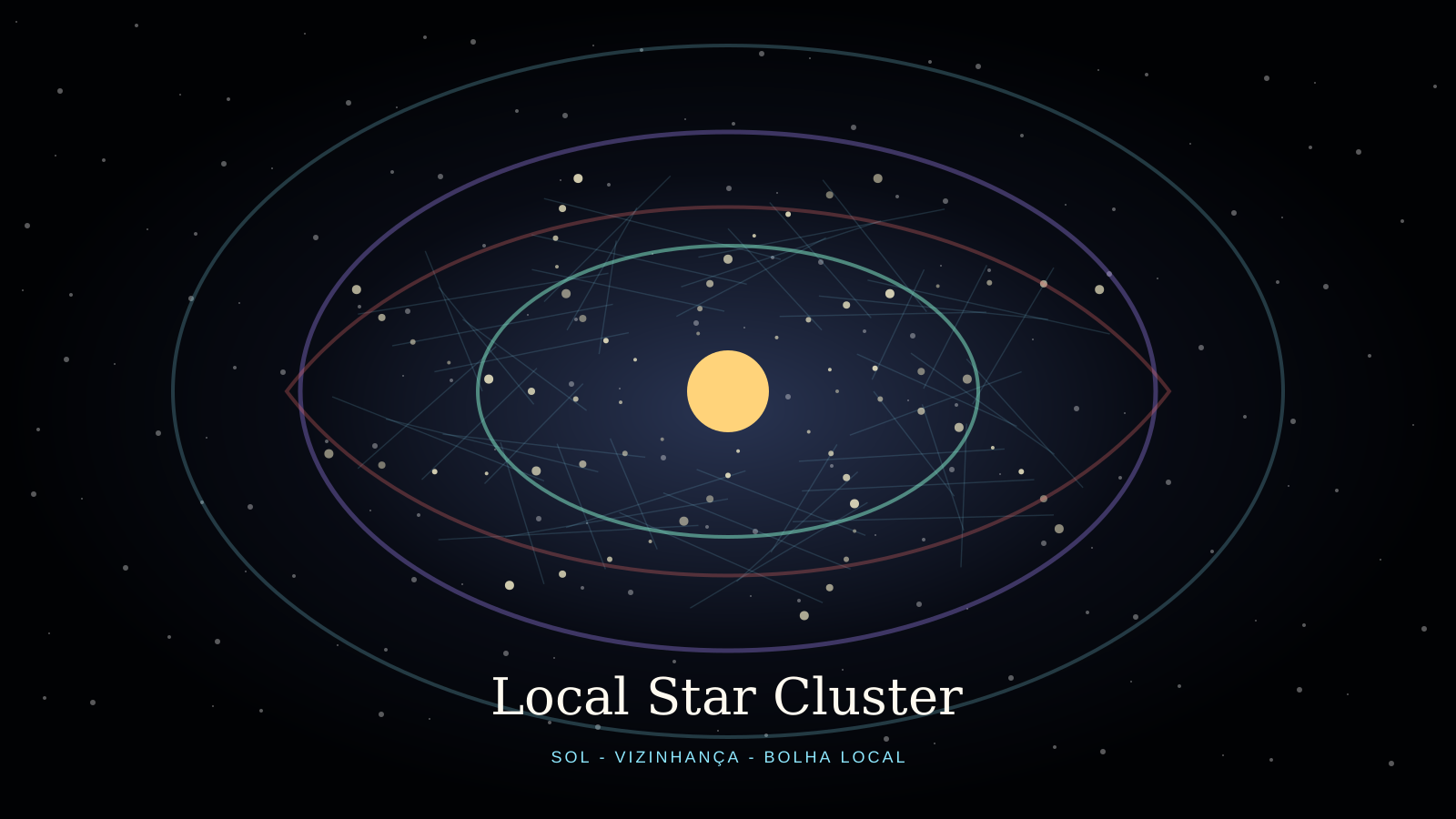
This is where the theme speaks with the outer energetic barrier, the local star cluster and the 52 local star cluster protective barrier grid. If there is a boundary of the Solar System, imagination asks whether there is a larger boundary. If there is a physical heliosphere, perhaps there is an energetic grid. If there are nearby stars, perhaps there is an administered neighborhood. The language moves from astronomy to cosmic geopolitics: who enters, who leaves, who watches, who authorizes, who blocks.
The Global Galactic League of Nations takes this reading into the field of secret human organization: in the narrative, governments or military groups participate in agreements beyond Earth. full disclosure would then reveal not merely extraterrestrial life, but infrastructure: routes, craft, bases, treaties and hidden history. “Beyond” stops being distance and becomes a suppressed archive.
A mature reading must hold both sides. Humanity has begun, in a very limited way, an interstellar presence through probes and signals. Exoplanets, interstellar objects and laser-sail concepts have changed our sense of the future. But turning that opening into certainty about secret human colonies beyond the Solar System requires a kind of evidence that has not been publicly presented.
Even so, the theme matters because it reveals a spiritual and political hunger. Many people look at the sky and feel that human history is too small to explain consciousness itself. Beyond the Solar System becomes a screen for a deep question: are we an isolated species learning to leave home, or an amnesiac species trying to remember a network it has always belonged to?
That question also touches the cosmic web and starseeds. In spiritual versions, leaving the Solar System is not only travel; it is recovering origin, mission or belonging. In technological versions, it is overcoming distance. In conspiratorial versions, it is breaking secrecy. The point of discernment is not to confuse the longing for belonging with proof of hidden infrastructure.
Simple summary
Beyond the Solar System combines real interstellar exploration with myths of secret presence outside Earth. The verifiable layer includes Voyagers 1 and 2 in interstellar space, exoplanets such as Proxima Centauri b, conceptual projects such as Starshot and objects such as ʻOumuamua. The conspiratorial layer turns these signals into suspicion of bases, portals, fleets, treaties and human or non-human civilizations operating beyond the Solar System.
References and starting points
- NASA - Voyager 1, the most distant human-made object
- NASA - Voyager interstellar mission
- NASA - Proxima Centauri b in the exoplanet catalog
- Breakthrough Initiatives - Starshot and the Alpha Centauri nanocraft concept
- NASA - ʻOumuamua, first known interstellar object observed in the Solar System
- Smithsonian - Voyager Golden Record cover
- Wikimedia Commons - Voyager and heliosphere illustration
Why it belongs on AwakenMap
The theme belongs on AwakenMap because it places humanity at the boundary between exploration, myth and cosmic belonging.
Awakening here means accepting the grandeur of the universe without turning every unknown horizon into automatic proof of secrecy.
Keep exploring
You can open another path
 Secret Space Program Galactic Federation 5/5 intensity Explore →
  Map center Great Awakening 5/5 intensity Explore →
  Great Solar Flash Outer Energetic Barrier 5/5 intensity Explore →
  Secret Space Program Secret Space Program 5/5 intensity Explore →
  Secret Space Program Global Galactic League of Nations 4/5 intensity Explore →
  Esoteric practices Local Star Cluster 4/5 intensity Explore →
Join the conversation
Comments are moderated. Keep the discussion respectful and distinguish evidence, interpretation and personal experience.