Connection level
2 direct connectionsJapanese Underwater Pyramids, linked to the Yonaguni Monument, explore the frontier between geology, ruins, diving, Mu/Lemuria, Masaaki Kimura, Robert Schoch and submerged archaeology.
A stone staircase under the sea
The so-called Japanese Underwater Pyramids refer mainly to the Yonaguni Monument, a submerged formation near Yonaguni Island, at the southern end of Japan's Ryukyu archipelago, close to Taiwan. The site became famous for steps, platforms, apparent right angles, terraces and surfaces that resemble a monumental construction covered by the sea.
Britannica describes Yonaguni as an underwater rock structure discovered in the mid-1980s near Yonaguni Island, with interpretations divided between natural origin and a possible ancient city. That division is the heart of the theme: the place looks architectural, but appearance alone does not decide origin.
In AwakenMap, Yonaguni is a perfect World node because it is physical, diveable, touristic and geological. But it is also Knowledge and Cosmic because it awakens questions about sea-level rise, lost civilizations, Mu, Lemuria, coastal memory, geology and the desire to find cities before official history.
Discovery and visual impact
The site was reportedly noticed in 1986 by Kihachiro Aratake, a diving operator linked to local tourism, while exploring waters also known for hammerhead sharks. What drew attention was the visual regularity: flat surfaces, marked edges, corridors and steps that, photographed underwater, look like ruins of a pyramid or ziggurat.
This visual impact explains how quickly Yonaguni entered alternative culture. Unlike an ambiguous pottery fragment or a subtle sensor anomaly, Yonaguni is photogenic. The person looks and immediately feels that something there seems built. The problem is that geology can also produce straight forms, fractures, planes and steps.
The first question, therefore, should not be 'does it look artificial?'. It should be: what kind of natural or human process could produce this set, and what evidence allows us to distinguish one from the other?
Masaaki Kimura and the artificial hypothesis
Marine geologist Masaaki Kimura of the University of the Ryukyus became the main defender of artificial origin. He argued that the complex shows signs of human intervention: terraces, stairways, possible paths, walls, monumental forms and interpretations linked to a culture submerged by sea-level changes or tectonic activity.
In popular versions, Yonaguni appears as the remains of an ancient city, a lost Pacific civilization or even Mu/Lemuria. The fascination is understandable: if the formation were artificial and ancient, it could push the conversation about coastal civilizations much farther back than the public imagines.
Kimura's hypothesis matters for AwakenMap because it represents the impulse to look at the seafloor as an archive of lost worlds. But it is not consensus. It must be presented as controversial proposal, not established conclusion.
Robert Schoch and the geological reading
Robert Schoch, a geologist known for alternative readings of the Sphinx, dived at Yonaguni and defended a mostly natural interpretation. According to him, sandstones and sedimentary rocks can fracture along regular planes, creating steps, edges and surfaces that look carved, especially in tectonically active areas swept by strong currents.
This position matters because Schoch is not a skeptic who rejects every ancient mystery by principle. He has defended heterodox hypotheses in other themes. When someone with that profile considers Yonaguni geologically explainable, critical reading needs to take it seriously.
The great lesson is that 'it looks built' is not enough. Nature produces basalt columns, sandstone stairways, straight cliffs, joints, fractures and platforms. The challenge is finding specifically human signs: tools, displaced blocks, artifacts, inscriptions, cultural layers, occupation remains or unequivocal archaeological context.
The geology of straight forms
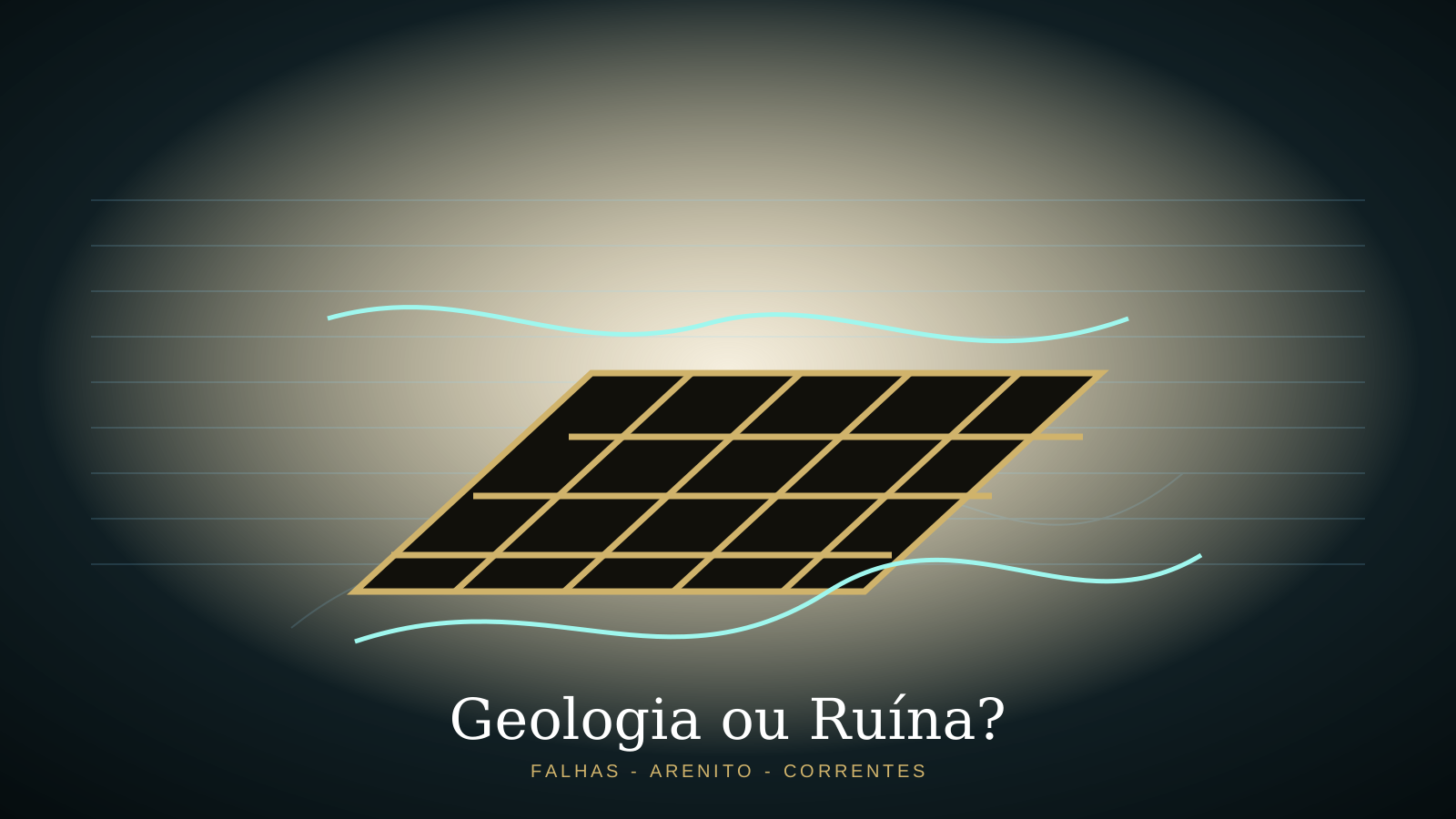
Yonaguni is often described as composed of sandstones and sedimentary rocks that can break along natural planes. In certain environments, stratification, faults, marine erosion and tectonism create surprisingly geometric forms. The ocean also works as sculptor: currents remove weaker parts and leave steps, ledges and clean surfaces.
This does not mean everything is solved. It means the natural hypothesis is strong enough not to be dismissed. When a formation is connected to the rock mass and not made of transported and fitted blocks, the artificial reading becomes harder.
The second image in this article shows that tension: the same step a diver perceives as staircase can be read by a geologist as fracture plane. Yonaguni lives on that edge between human perception and Earth process.
Sea level and lost coastal cities
Even if Yonaguni is natural, the question of submerged sites remains legitimate. After the last glaciation, sea level rose greatly, covering ancient coastlines, plains, caves, routes and possible settlements. Underwater archaeology is a real and important field.
This point is crucial for avoiding a false dilemma. Saying Yonaguni may be natural does not mean there are no ancient submerged ruins. There are drowned coastal landscapes across the world, and future discoveries may greatly change our understanding of coastal peoples.
The mistake is turning every geometric submerged formation into a lost city. The correct path is investigation with method: bathymetry, geology, dating, sediments, artifacts, archaeological diving, regional comparison and reviewed publication.
Mu, Lemuria and Pacific memory
Yonaguni was quickly connected to Mu and Lemuria, lost continents of esoteric imagination. The association is almost inevitable: a submerged structure in the Pacific, with monumental appearance and possible antiquity, seems to fit perfectly into the map of lost civilizations.
But the connection with Mu/Lemuria belongs more to the history of ideas than to established archaeology. Mu was popularized by James Churchward in the twentieth century; Lemuria began as a nineteenth-century biogeographic hypothesis and was later absorbed by occultism. Neither provides proof of Yonaguni's origin by itself.
In AwakenMap, this layer should be treated as interpretive myth. It helps explain why Yonaguni fascinates so much, but it does not replace material evidence.
Diving, tourism and direct experience
Japan Travel presents Yonaguni as a diving attraction, but warns that the waters can have strong currents and require experience. This matters: the site is not only a desk debate. It is a bodily experience. The diver sees walls, platforms, filtered light, depth and moving sea.
That experience changes perception. Underwater, scale and orientation become strange. Silence, pressure, limited visibility and marine life make the formation more dramatic. It is easy to feel that one is facing a drowned city.
The experience is real, but it does not decide origin. Feeling mystery is different from proving architecture. AwakenMap can respect the diver's experience and still require archaeological method.
What would be needed to prove construction
For Yonaguni to be recognized as human construction, more than straight forms would be needed. We would expect artifacts in context, convincing tool marks, displaced and organized blocks, occupation areas, datable materials, repeated construction patterns, relationship with land sites and independent evidence reviewed by specialists.
It would also be necessary to explain when the formation was accessible. If it was built on dry land, what was sea level? What population would have lived there? What technologies did it possess? Where are the other traces? How does the structure relate to the material culture of the Ryukyu archipelago or nearby regions?
These questions do not kill the hypothesis. They make it serious. A large theory needs to withstand large questions.
Why Yonaguni holds attention
Yonaguni holds attention because it condenses three forces: a form that appears artificial, the ocean that hides, and the possibility of a much older coastal human history. It seems to offer a concrete image for a common intuition: perhaps the sea swallowed whole chapters of humanity.
That intuition is not absurd. The sea really did swallow ancient coasts. But imagination needs to learn to walk with evidence. The desire to find a lost city cannot choose the conclusion before the dive is over.
Yonaguni's true value may be this: it trains the gaze to live in the interval between wonder and caution.
Underwater archaeology and loss of context
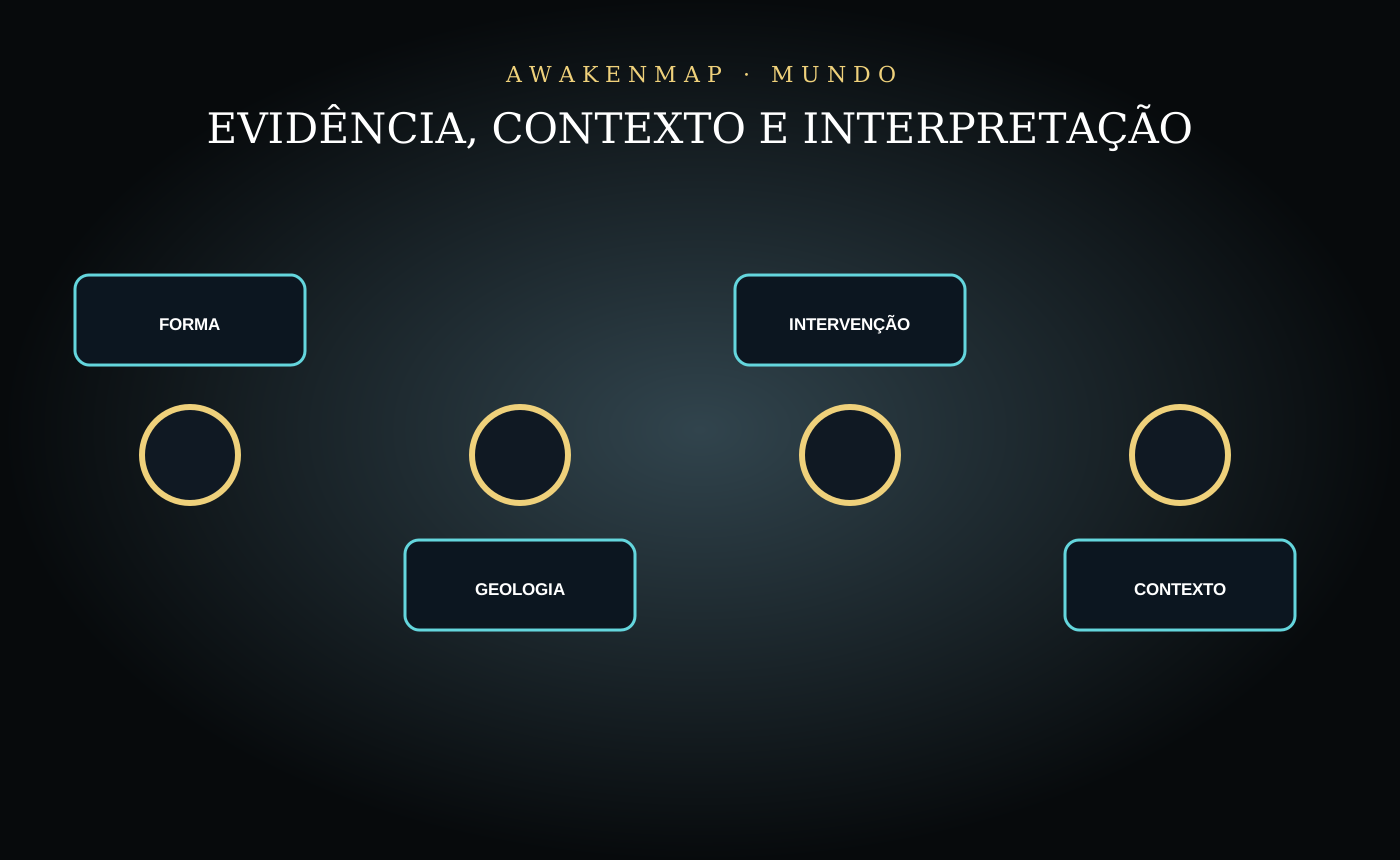
Underwater, currents, organisms, sedimentation and erosion alter surfaces and remove light materials. Objects that might indicate human occupation can move, while natural fractures become more dramatic under diving lights.
Impressive photographs therefore require plans, scales, geological sampling and three-dimensional recording. Marine archaeology depends as much on relationships among finds as on the appearance of an isolated formation.
Human modification does not mean a lost city
A third possibility lies between an entirely natural monument and a constructed pyramid: people may have used, cut or adapted a pre-existing geological formation. Rocky coasts often become platforms, quarries, shrines or fishing places.
Even if some human marks were demonstrated, their period, function and extent would remain to be established. A modified stair does not automatically confirm an urban complex, unknown civilization or the continent of Mu.
Sea level as an incomplete clock
During the last glacial period, global sea level stood much lower, exposing coastal zones now submerged. This makes ancient human sites on continental shelves plausible and strengthens the importance of coastal archaeology.
Yet the present depth of a rock does not by itself date an alleged structure. Local tectonic movement, erosion and sea-level history must be modelled together.
Yonaguni in AwakenMap
In AwakenMap, Japanese Underwater Pyramids connect to Atlantis/Lemuria/Mu, Pyramids, Ancient Ruins, Ancient Civilizations, Earth, Ley Lines, Ancient Builder Race, Sacred Geometry and submerged memory. It is a node where stone, ocean and imagination meet.
As World, it speaks of island, sea, diving, currents, rock and submerged landscape. As Knowledge, it speaks of geology, underwater archaeology, sea level, scientific debate and history of hypotheses. As Cosmic, it speaks of lost continents, planetary memory, earlier civilizations and the return of what was drowned.
The premium page needs to hold both images at once: the mythical vision of a pyramid under the sea and the critical vision of rock fractured by Earth. The theme lives exactly between those two lenses.
How to read this theme
Start with the place: Yonaguni, Ryukyu, Japan, proximity to Taiwan, discovery in the 1980s, diving and strong currents. Then separate the interpretations: Masaaki Kimura and the artificial hypothesis; Robert Schoch and the geological explanation; popular culture and the connection to Mu/Lemuria.
When you see impressive images, ask: are there artifacts? Are there tool marks? Is there cultural context? Is there dating? Is the structure connected to natural rock? Does the natural explanation answer the main patterns?
Yonaguni teaches that the seafloor is a real archive, but not every page in that archive was written by human hands.
Critical reading
Yonaguni should be read as real place, diving experience, geological debate and submerged myth. Artificial origin is controversial; the natural hypothesis is strong; the symbolic value remains enormous.
References and starting points
- Britannica - Yonaguni Monument
- National Geographic - Japan's Ancient Underwater Pyramid Mystifies Scholars
- Japan Travel - Yonaguni Underwater Ruins
- Robert M. Schoch - Yonaguni, Japan
- Atlas Obscura - Yonaguni Monument
- Masaaki Kimura - Ancient Megalithic Construction Beneath the Sea off Ryukyu Islands
FAQ
Is Yonaguni a human-built pyramid?
There is no consensus. Masaaki Kimura argues for human intervention, while geologists such as Robert Schoch consider the formation mostly natural. Conclusive artifacts and archaeological context are lacking.
Does Yonaguni prove Mu or Lemuria?
No. The connection with Mu/Lemuria is an esoteric and cultural reading, not an established archaeological conclusion.
Keep exploring

Join the conversation
Comments are moderated. Keep the discussion respectful and distinguish evidence, interpretation and personal experience.