Connection level
3 direct connectionsGobekli Tepe is one of the most important Neolithic sites on Earth: T-shaped pillars, animal reliefs, hunter-gatherer ritual and a profound revision of how human complexity began.
The hill that changed the question
Gobekli Tepe, in southeastern Anatolia near Sanliurfa in present-day Turkey, is not merely an ancient ruin. It is a change of question. For a long time the schoolbook sequence seemed simple: first agriculture, then settled villages, then surplus, then organized religion, then monuments. Gobekli Tepe scrambled that order.
UNESCO places its monumental enclosures between roughly 9600 and 8200 BCE, in the Pre-Pottery Neolithic. This means that hunter-gatherer groups, or communities moving toward more settled lifeways, were able to plan, carve, transport and raise large stone pillars long before the pyramids, Stonehenge and classical cities.
In AwakenMap, Gobekli Tepe is a fundamental node because it stands between three worlds: it is a physical place, with stone, relief, excavation and stratigraphy; it is knowledge, because it forces a revision of social complexity; and it is also symbol, because its animal figures seem to speak of death, territory, memory and cosmos before writing.
Where it is and why it matters
The site lies in the Germus mountains, in a region belonging to Upper Mesopotamia, near zones important for the domestication of plants and animals. This matters: Gobekli Tepe does not appear in a vacuum. It emerges in a landscape where humans were changing lifeways, moving among hunting, gathering, experiments with cereals, settlements and new forms of cooperation.
Its importance is not only age. There are many old sites. The shock of Gobekli Tepe is the combination of monumental scale, complex iconography and the lack of an easy initial explanation. The circular and oval structures, with T-shaped pillars, suggest collective planning and a shared ritual language.
UNESCO recognized the site's outstanding universal value because it represents one of the earliest known manifestations of human-made monumental architecture. That sentence needs care: it does not mean all religion or all civilization began there, but that there we see an ancient and sophisticated way of building meaning in community.
Klaus Schmidt and the modern rediscovery
The hill was known through archaeological surveys since the 1960s, but its significance was decisively recognized by Klaus Schmidt, a German archaeologist associated with the German Archaeological Institute. From the 1990s onward, Schmidt understood that the stones were not ordinary medieval remains or simple rural landscape features.
Schmidt led excavations at Gobekli Tepe from 1996 until his death in 2014. His interpretation popularized the idea of a very ancient sanctuary, perhaps linked to rituals of hunter-gatherer groups. That reading had enormous impact because it seemed to invert the traditional formula: perhaps ritual and symbolic impulse helped gather people before agricultural life was fully consolidated.
Today research is more cautious and richer. Gobekli Tepe does not need to be reduced to a single phrase like 'the world's first temple'. That expression attracts attention, but it oversimplifies. The site may involve ritual, social memory, seasonal gatherings, collective labor, food, death, group identity and relationships with other sites in the region.
The T-shaped pillars
The T-shaped pillars are Gobekli Tepe's visual signature. Some are monumental, arranged in circular or oval enclosures, with two larger central pillars surrounded by others. The T form may represent stylized human figures: in some cases, arms, hands, belts and bodily elements are carved on the stone.
That possibility changes everything. If the pillars are bodies, the enclosures are not merely architecture; they are assemblies of presences. The visitor would not be facing walls, but standing inside a composition inhabited by stone figures, animals, signs and perhaps ancestors. The construction begins to look ritual before it looks utilitarian.
Still, quick certainty should be avoided. Archaeology works through patterns, comparison, excavation, dating, context and revision. Saying the pillars may be anthropomorphic is different from claiming we know exactly whom they represented. The power of Gobekli Tepe lies precisely in this limit: meaning is clear, but translation is incomplete.
Animals, danger and symbolic language
Animal images are among the most fascinating elements of the site. Snakes, foxes, boars, birds, scorpions and other creatures appear in relief. Many are not domesticated or gentle; they are wild, fast, venomous, nocturnal or dangerous. This suggests an imagination deeply tied to environment and risk.
One possible reading is that these animals participated in a cosmology of potency: beings that inhabit borders, carry force, threaten bodies and mark invisible territories. Another reading is that animals served as group emblems, hunting memories, mythic narratives or signs linked to death and transformation.
The important point is not to turn each animal into a fixed translation. Snake does not automatically mean DNA; scorpion does not mean a modern astrological sign; fox does not mean a known deity. A more honest reading starts with the question: what kind of world does a community create when it chooses to carve these animals into monumental stone?
Ritual before the city?
One of the most provocative ideas associated with Gobekli Tepe is the possibility that ritual gathering preceded, or at least accompanied, the development of more complex settled lifeways. Instead of imagining monuments as late products of already established farming societies, the site suggests that belief, feast, memory and collective labor may have been engines of organization.
This does not mean 'religion invented agriculture' in a simple way. Human life rarely fits a single cause. What Gobekli Tepe shows is that symbol and survival are not separate. People may gather to eat, remember the dead, negotiate alliances, exchange knowledge, mark territory and build a ritual enclosure at the same time.
This is the part that holds attention: before written temples, kings, taxes and armies, communities were already capable of moving stone and creating images for something beyond immediate necessity. Gobekli Tepe forces us to take the inner life of prehistoric peoples seriously.
The burial of the enclosures
One of the most intriguing aspects is that structures at Gobekli Tepe were deliberately filled over time. Monumental enclosures were not merely abandoned as ordinary ruins; they appear to have been covered, closed, replaced or transformed. This creates a powerful image: a place built to appear and then buried in order to remain.
The filling may have many explanations: ritual change, renewal of spaces, closing of cycles, protection, disposal, social reorganization or practices we still do not understand. Covering does not need to be accidental; it may be part of the monument's biography.
For AwakenMap, this detail is central. Gobekli Tepe is not only 'ancient'. It is an archive buried by human choice. It shows that memory can also be guarded through concealment. Some cultures preserve by displaying; others preserve by covering.
What Gobekli Tepe does not prove
Because it is extraordinary, Gobekli Tepe attracts exaggerations. It has been used as proof of lost super-advanced civilizations, external visitors, Anatolian Atlantis, impossible technology or total astronomical knowledge. The problem is not imagination; the problem is declaring as proof what the evidence does not support.
The site does not need impossible technology to be impressive. The fact that Neolithic groups organized labor, carved pillars and created a rich symbolic language is already enormous. When we place a ready-made lost civilization over the site, we may end up diminishing the real intelligence of the people who built it.
Critical reading separates three layers: what was excavated and dated; what is plausible archaeological hypothesis; and what is modern symbolic speculation. All three can have value in AwakenMap, as long as they are not mixed as if they were the same thing.
Connections with other sites
Gobekli Tepe belongs to a larger regional horizon. In recent years, other sites around Sanliurfa and the Tas Tepeler area, such as Karahan Tepe, have expanded the conversation. This shifts Gobekli Tepe from an isolated miracle to a broader cultural landscape, where different communities experimented with monumental forms, images and gatherings.
This matters because the internet loves the single object: 'the first', 'the oldest', 'the one nobody can explain'. Archaeology, however, usually reveals networks. Gobekli Tepe becomes more interesting when connected to other mounds, routes, settlements, stone technologies, food, water and shared memory.
On the map, this connects Gobekli Tepe to Megalithic Sites, Ancient Ruins, Pyramids, Ancient Civilizations, Ley Lines, Sacred Geometry and Atlantis/Lemuria/Mu. The connection does not mean everything has the same origin. It means these themes all ask how humans organize stone, landscape and transcendence.
Hunter-gatherers were not simple societies
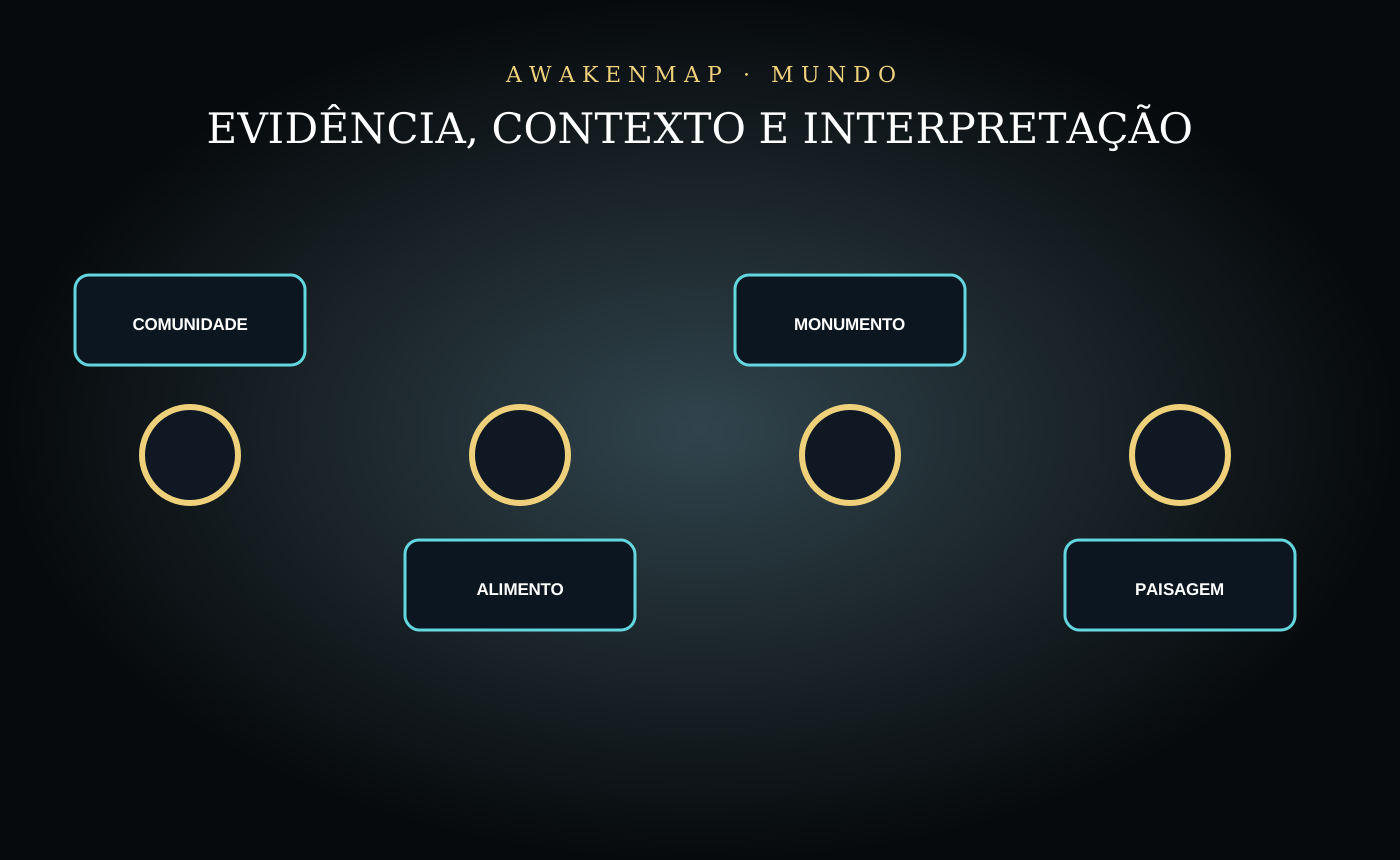
The old opposition between simple nomads and complex farmers has weakened. Hunter-gatherer groups could maintain specialized knowledge, exchange networks, seasonal calendars and enough labour for monumental works.
Göbekli Tepe does not require a vanished civilization between evolutionary stages. It shows that ritual and social organization could flourish before fully established farming and perhaps participate in its transformation.
Food, feasting and collective labour
Concentrations of animal bones, vessels and cereal processing support hypotheses about feasting. Periodic gatherings may have mobilized people to carve, transport and raise pillars while reinforcing alliances and identities.
This reading joins economy and symbol. Monuments do not arise outside material life: they require food, tools, time and negotiation. Feasts may have been a social technology as important as stone.
Taş Tepeler and a larger landscape
Göbekli Tepe is now compared with Karahan Tepe and other sites in the Taş Tepeler project. This network shows that T-shaped pillars and monumental enclosures belonged not to one inexplicable place but to varied regional traditions.
Regional context reduces mysterious isolation while increasing historical importance. Instead of an impossible anomaly, a landscape appears in which communities experimented with architecture, imagery and new forms of aggregation.
Deliberate burial or gradual transformation?
The idea that enclosures were carefully buried remains influential, but dumping, collapse, remodelling and filling processes may have varied. New research makes the picture less simple than one closing ceremony.
Prudence helps: fill preserved the structures, but its formation must be studied enclosure by enclosure. “Deliberately buried” should not become an automatic explanation for every layer.
Gobekli Tepe in AwakenMap
In AwakenMap, Gobekli Tepe should work as an antidote to two weak readings. The first is the cold reading, which sees only stone, date and catalog. The second is the fantasy reading, which uses the site as a screen for any ready-made theory. The best path sits between them: enough rigor to respect the find and enough imagination to feel its magnitude.
As a World theme, it is hill, limestone, relief, excavation, conservation and territory. As Knowledge, it is debate about the Neolithic, sedentarization, ritual, cooperation and symbolism. As Cosmic, it is a question about how ancient communities linked animals, death, sky, body and memory.
The page needs to invite the reader to stay. Gobekli Tepe is not a slogan about 'history rewritten'. It is a place where history becomes more human, stranger and deeper. The great revelation may not be that there was an impossible civilization, but that ancient humans were far more complex than modern narratives wanted to admit.
How to read this theme
Start with what is strong: location, approximate dating, monumental architecture, T-shaped pillars, animal reliefs, archaeological research and UNESCO recognition. Then move to what remains debated: the function of the enclosures, degree of sedentism, role of ritual, relationship with domestication and meaning of the images.
When you encounter an extraordinary theory, ask: does it cite excavations, dates and publications? Does it distinguish evidence from interpretation? Does it recognize other sites in the region? Or does it simply use Gobekli Tepe as a shortcut into a ready-made narrative?
Gobekli Tepe teaches that mystery is not lack of knowledge. Here, mystery is an excess of ancient humanity appearing where we once expected simplicity.
Critical reading
Gobekli Tepe should be read as a real archaeological site, a Neolithic ritual landscape and a meeting point between evidence and imagination. The mystery grows when we respect the data, not when we replace it with ready-made certainty.
References and starting points
- UNESCO World Heritage Centre - Gobekli Tepe
- Britannica - Gobekli Tepe
- German Archaeological Institute / Tepe Telegrams - Commemorating Klaus Schmidt
- UNESCO Decision 42 COM 8B.34 - Gobekli Tepe
- Smithsonian Magazine - Gobekli Tepe: The World's First Temple?
- DAI Tepe Telegrams - Gobekli Tepe Research Project
FAQ
Is Gobekli Tepe the oldest temple in the world?
The phrase is popular, but simplified. The site has strong evidence of very ancient ritual use and monumental architecture, but its exact function remains debated.
Does Gobekli Tepe prove a lost advanced civilization?
No. It shows that Neolithic communities were capable of organization, symbolism and monumental construction much earlier than older models assumed.
Keep exploring
Join the conversation
Comments are moderated. Keep the discussion respectful and distinguish evidence, interpretation and personal experience.