Connection level
41 direct connectionsFree Will is not the fantasy of choosing outside every cause; it is the question of who is really choosing inside a reality full of conditioning.

What free will means
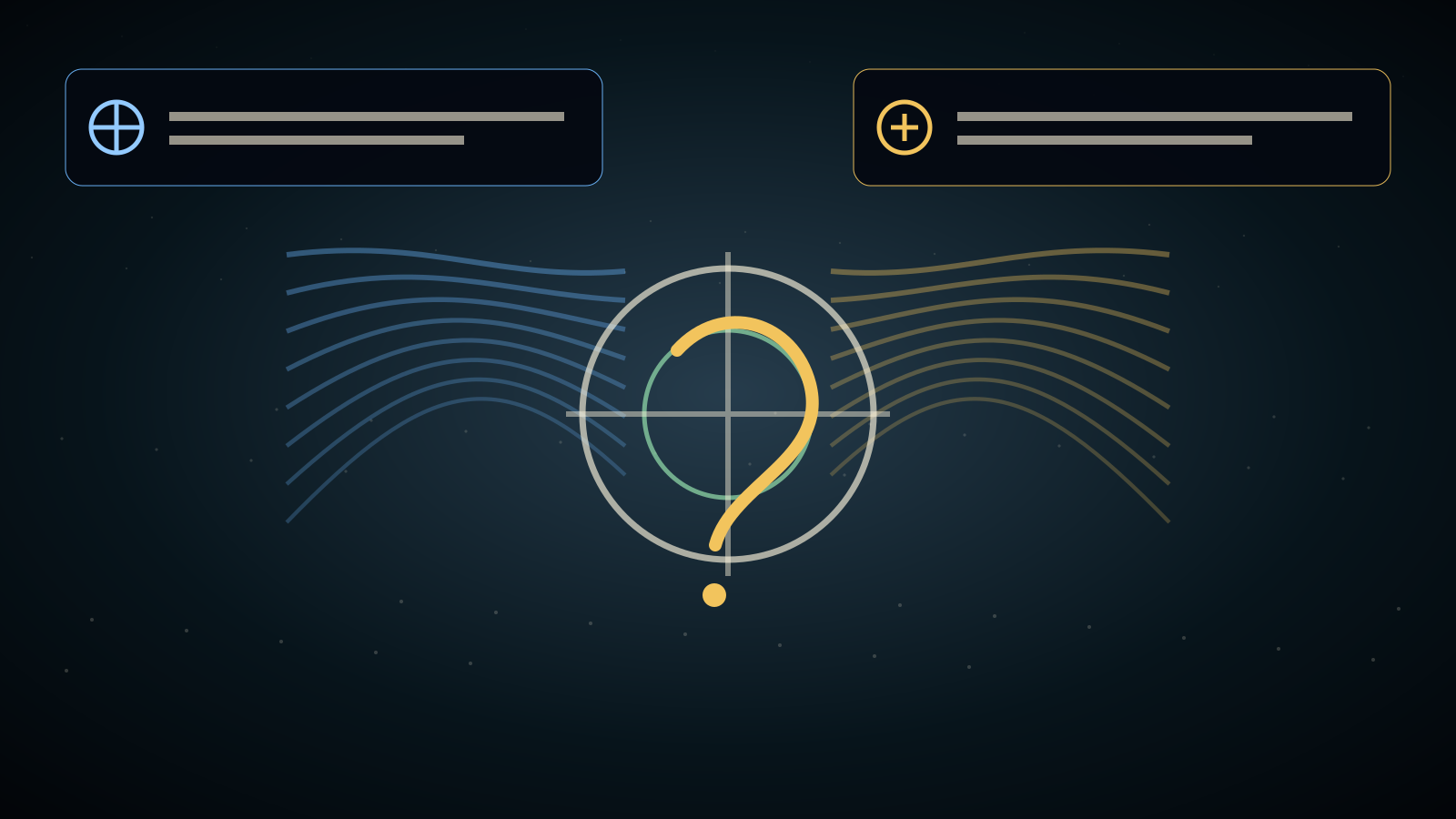
Free will is the idea that a person, in some relevant sense, can choose, respond, deliberate and author their actions. The difficulty begins when we ask what kind of authorship this is. Does choosing mean having a soul outside the chain of causes? Does it mean acting without external coercion? Does it mean being able to reflect on impulses before obeying them?
The theme is old because it touches metaphysics, religion, law, ethics, psychology and neuroscience. If nobody truly chooses anything, blame, merit, regret, promise and personal transformation change their meaning. If everyone chooses absolutely, we ignore trauma, habit, biology, culture, propaganda and inequality.
Where the problem came from
The question appears in different forms in Greek philosophy, Christianity, Islam, Judaism, Buddhism, Hinduism and modern philosophy. In ancient Greece, Aristotle already discussed voluntary action, involuntary action, ignorance, character and moral responsibility. The point was not only “am I free?” but “when can an action be attributed to me?”.
In religious traditions, the problem gains another layer: if God knows the future, if there is providence, karma, destiny or divine plan, what room remains for human choice? In modern science, the question changes clothes: if the body and brain obey physical causes, how could a conscious decision initiate something new?
Three classic answers
The first answer is hard determinism: everything we do is the consequence of prior causes, and strong free will is an illusion. In this frame, a choice feels free from the inside, but from the outside it would be the result of genetics, environment, personal history, brain state and circumstances.
The second answer is metaphysical libertarianism, a philosophical expression that should not be confused with a political position. Here, real freedom requires that not everything is determined before the choice. The person, soul, mind or agent has some originating role.
The third answer is compatibilism: even if our choices have causes, an action can still be called free when it comes from our motives, values and deliberation, without direct coercion. This matters because it shifts the question: freedom may not be total absence of cause, but the capacity to respond to reasons.
Libet's experiment
In the twentieth century, Benjamin Libet made the debate more concrete. In studies of voluntary action, participants were asked to move a finger whenever they wished, while researchers measured brain activity and the moment when participants reported feeling the intention to act.
The famous result was the readiness potential: preparatory brain activity seemed to begin before the reported conscious decision. Many people read this as a blow against free will: the brain decides first, and consciousness merely signs afterward.
The Libet clock
The clock used in this kind of experiment tried to mark the subjective instant when a person felt the intention to act. The power of the study is that it brings philosophy and laboratory together; its limit is turning simple finger movements into proof about complex moral choices.
Libet did not simply conclude that freedom was dead. He discussed the possibility of conscious veto: perhaps consciousness does not initiate every impulse, but can stop some of them.

What neuroscience shows and does not show
Later studies, such as the 2008 work by Soon, Brass, Heinze and Haynes, suggested that brain patterns could predict simple choices seconds before they entered awareness. This deepened the suspicion: perhaps decisions are prepared by unconscious processes before becoming conscious narrative.
But there is an important limit. These experiments use narrow choices, such as pressing a button with one hand or the other. That is not the same as deciding to forgive someone, leave an addiction, change professions, resist manipulation or take responsibility for an entire life. Neuroscience weakens the idea of a sovereign and transparent “I”, but it does not solve the philosophical problem by itself.
Free will and awakening
In spiritual vocabulary, free will often appears as cosmic law: beings, guides, civilizations or higher intelligences should not violate the choice of an evolving consciousness. This is why the theme connects with the law of non-interference and with narratives about the Galactic Federation.
In the Law of One, the language of free will appears as part of consciousness learning: choosing between control and compassion, separation and unity, service to self and service to others. In this context, freedom is not doing anything whatsoever. It is revealing, through repeated choice, the deep orientation of being.
Conditioning is not absolute prison
A common mistake is treating conditioning as a sentence. Yes, a person carries body, trauma, culture, addictions, fears, desires, algorithm, propaganda, family, social class and history. But conditioning does not mean the complete absence of inner space.
Practices such as meditation exist precisely to widen the interval between impulse and action. When someone observes anger before discharging it, notices desire before obeying it or recognizes a narrative before repeating it, something changes. Maybe freedom begins small: not as absolute power, but as a margin of response.
Matrix, illusion and choice
The theme also speaks to the Matrix. If reality can be manipulated by beliefs, media, fear, desire, social engineering or simulation, the question of freedom becomes sharper: what are we choosing if the field of options has already been shaped?
This is one reason free will matters on AwakenMap. It is not enough to denounce control systems. We also have to ask how a person recovers attention, discernment and responsibility inside them. Without that, “awakening” becomes merely trading one program for another.
The delicate spiritual point
In many traditions, freedom and destiny are not simple enemies. Buddhism speaks of causes and conditions, but also practice, attention and liberation from suffering. Hinduism discusses action, duty, karma and detachment. Christian mysticism can speak of grace and will. These languages do not fit into a quick yes or no.
That is why the escape from samsara is a useful comparison: if we are trapped in repeated patterns, freedom is not choosing capriciously inside the prison. It is seeing the pattern, weakening identification and opening another relationship with causality.
Why it belongs on AwakenMap
The main fracture here is between conditioning and responsibility. Free will shows that a person is not an isolated god choosing from nothing, but also need not be reduced to a machine without interiority.
The philosophical connection on AwakenMap lives in this question: if invisible forces shape perception, desire and behavior, is there still a point where consciousness can recognize the pattern and respond differently? The answer does not need to be naive. It needs to be honest enough to take causes seriously without erasing the possibility of transformation.
How to continue on the map
After this theme, explore law of non-interference, Law of One, service to others, meditation, Matrix, collective consciousness, quantum physics, escape from samsara, One Infinite Creator and Galactic Federation.
Simple summary
Free will is the question of how choices can be ours if we are shaped by causes, body, brain, culture and history. Philosophy organizes the debate through hard determinism, metaphysical libertarianism and compatibilism. Neuroscience, with Libet and later studies, shows that unconscious processes participate in decision-making, but it does not close the debate about complex moral choices. On AwakenMap, the theme matters because awakening requires discerning conditioning without abandoning responsibility.
References and starting points
- Stanford Encyclopedia of Philosophy - Free Will
- Stanford Encyclopedia of Philosophy - Compatibilism
- Internet Encyclopedia of Philosophy - Free Will
- Benjamin Libet - Do We Have Free Will?
- PMC - Revisiting Libet's classic experimental study
- PubMed - Unconscious determinants of free decisions in the human brain
- Wikimedia Commons - The School of Athens
- Wikimedia Commons - LibetClock.jpg
FAQ
Did Libet prove that free will does not exist?
No. He showed that unconscious brain processes precede certain simple movements. That challenges a naive view of will, but it does not settle responsibility, deliberation and moral transformation.
Can free will exist if everything has a cause?
That is the central compatibilist question. For many philosophers, responsibility does not require total absence of cause; it requires acting from reasons, values and responsiveness, without direct coercion.
Why does this matter spiritually?
Because many spiritual systems treat choice as the place where consciousness reveals its orientation. Freedom is not only power; it is discernment, responsibility and direction.
Keep exploring
You can open another path
 Esoteric practices Law of Non-Interference 5/5 intensity Explore →
  Secret Space Program Law of One / RA 5/5 intensity Explore →
  Consciousness and symbols Service to Others 5/5 intensity Explore →
  Ancient civilizations The Grand Experiment 5/5 intensity Explore →
  Return to Source In Service to Others 5/5 intensity Explore →
  Esoteric practices Indigos 5/5 intensity Explore →
Join the conversation
Comments are moderated. Keep the discussion respectful and distinguish evidence, interpretation and personal experience.